Complete understanding of Electrical bus bar welding process and core knowledge
Mar 11, 2026
Core definition and functional positioning
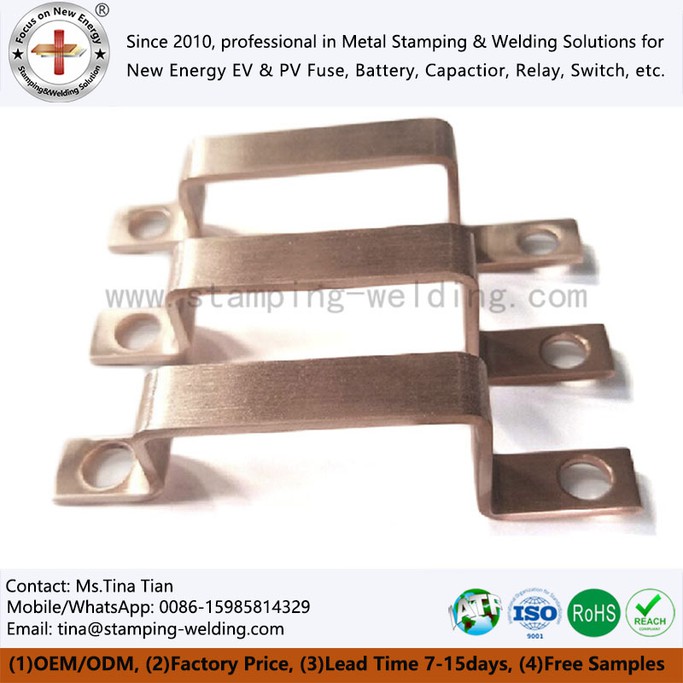
Electrical bus bar is a specialized conductive metal component in electrical and electronic systems, typically in the form of a flat strip. It is mainly made of metal materials with excellent conductivity such as copper and aluminum, and some products are treated with insulation protection on the surface.
The core function of Ground bus bar is to achieve efficient transmission and distribution of power and signals. It is the core connecting component of the main switch and various branch switches in the distribution cabinet, internal circuits of electrical equipment, new energy battery packs, and high-voltage substation equipment. It plays a key role in current collection, conduction, and distribution. It is also an indispensable core component in the current electrical architecture of new energy vehicles and wind and photovoltaic distribution systems. It is mainly suitable for high current local distribution scenarios, ensuring stable and efficient power transmission.
Common classification methods
Electrical bus bars can be divided into multiple categories based on different application scenarios, materials, structures, protection, and installation methods to meet different working conditions.
Divided by purpose, it is mainly divided into Busbar electrical, signal busbar, and power signal hybrid busbar; Divided by conductive substrate, it includes three categories: copper busbar, aluminum busbar, and silver busbar, among which copper busbar and aluminum busbar are the mainstream industrial choices; Divided by structural form, there are conventional styles such as flat busbars, cylindrical busbars, blade busbars, and bridging busbars; According to the insulation protection level, it can be divided into uninsulated bare busbar and fully wrapped insulated busbar; According to the installation mode, busbar can be divided into surface mounted and plug-in busbars. The diverse classification allows busbar to adapt to the assembly and usage needs of various electrical equipment.

The core advantage of replacing traditional wiring harnesses
Compared to traditional circular cable harnesses, Electrical copper busbars have multiple irreplaceable advantages in terms of performance, space, cost, and practicality.
Firstly, the space utilization rate is extremely high. Compared with traditional wiring harnesses, flat structures can reduce installation height by 70%, greatly saving internal space of equipment, reducing supporting facility costs, and accelerating on-site installation efficiency;
Secondly, the current carrying capacity is stronger. Under the same cross-sectional area, the Copper solid bus bar can carry 15% more power load than traditional cables, and its heat dissipation efficiency is much better than that of twisted wire structures, effectively reducing operating temperature rise;
In addition, the Power busbar is convenient for system expansion and reconstruction, allowing for quick addition, removal, or repositioning of lines without the need for downtime operations. It has lower maintenance costs in the later stages and requires fewer installation consumables, making it more environmentally friendly; At the same time, the lightweight advantage is prominent, and the flexible busbar is a high-quality alternative to traditional circular cables. It can also adapt to automated assembly processes, improving equipment assembly quality and safety.
Core welding process and characteristics
The welding quality of High voltage busbars directly determines the conductivity and mechanical strength of the connecting parts. The mainstream welding processes in the industry are resistance welding and polymer diffusion welding, with polymer diffusion welding being the preferred solution. Resistance welding is a conventional welding method that applies current at the joint of the busbar, uses instantaneous high temperature to melt the joint, and forms a welding connection with pressure. It has the characteristics of fast welding speed, high efficiency, and low energy consumption, and is suitable for busbar welding under conventional working conditions.
Polymer diffusion welding belongs to metallurgical connection technology. Under specific temperature and pressure, the welding surface of Busbar connector is tightly adhered through micro plastic deformation. After heating and insulation, atoms diffuse and penetrate each other to form a firm joint. This technology has high welding quality, excellent conductivity and stability of the joint. The operation is controlled by a digital touch screen, which does not require complex welding techniques and greatly reduces the difficulty of operation. At the same time, it significantly improves the overall welding efficiency, meeting the requirements of large-scale and high standard Busbar welding.
contact us
Reasonably selecting Electrical bus bars and matching them with standardized welding processes is the key to ensuring stable operation of the power system and extending the service life of equipment. Various new energy and industrial scenarios can be matched with corresponding specifications of products as needed. If you have any inquiries regarding Industrial busbar connection procurement, customized processing, or welding processes, please feel free to contact us at any time for professional technical answers and precise cooperation solutions.