

EV Charging Cabinet Manufacturer for Custom DC Fast Charger Enclosures
Xiamen Apollo Stamping Welding Technology manufactures custom EV charging cabinet enclosures and sheet metal housings for electric vehicle charging equipment. Production covers steel and stainless steel sheet processing, CNC laser cutting, precision bending, welding, and powder coating. Cabinet structures are designed around equipment dimensions, installation conditions, ventilation requirements, and outdoor protection specifications.
Apollo supports OEM enclosure projects from 2D drawing review and 3D structural assessment to tooling, fabrication, and batch production. Engineering evaluation covers sheet thickness, bend geometry, weld distortion, door alignment, cable openings, and mounting interfaces. Dimensional inspection and project-specific quality documentation can be arranged according to customer drawings and acceptance requirements.
Request a Factory Direct Quote
Explore Our EV Charging Cabinet Product Catalog
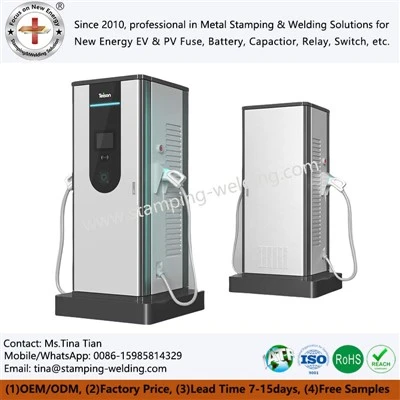
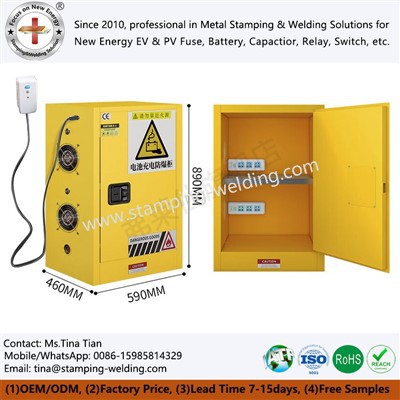
Review our EV charger housings, DC fast charging enclosures, and custom sheet metal cabinet structures for commercial and outdoor charging installations.
-
![Battery Charging Cabinet For Electric Vehicles]()
Battery Charging Cabinet For Electric Vehicles
Add to Inquiry -
![Lithium-Ion Battery Charging Cabinet]()
Lithium-Ion Battery Charging Cabinet
Add to Inquiry -
![DC Fast Charging]() Add to Inquiry
-
![High-power DC Charging]() Add to Inquiry
-
![EV Fast Charger]() Add to Inquiry
-
![Electric Vehicle Charging Cabinet]()
Electric Vehicle Charging Cabinet
Add to Inquiry -
![Lithium Battery Charging Cabinet]()
Lithium Battery Charging Cabinet
Add to Inquiry -
![Charger Enclosure]() Add to Inquiry
-
![Battery Charging Rack]() Add to Inquiry
-
![Battery Charging Cabinet]() Add to Inquiry




Material Standards, Tooling & Forming Processes
EV charging cabinet fabrication starts with the mechanical layout, operating environment, and installation requirements. Material selection affects enclosure stiffness, corrosion resistance, forming behavior, welding distortion, and finished weight. Depending on the project, the enclosure may use cold-rolled steel, galvanized steel, stainless steel, or aluminum sheet. The final grade and thickness should be specified according to the structural load, corrosion exposure, grounding design, and surface treatment.
Sheet Metal Selection for EV Charging Cabinets
Cold-rolled steel is commonly used for indoor or protected enclosures where stiffness, forming accuracy, and coating compatibility are important. Galvanized steel can be considered where additional corrosion protection is required. Stainless steel may be specified for demanding corrosive environments, while aluminum can reduce enclosure mass when the structural and thermal design permits its use.
Material selection should account for the full finishing process. Galvanized material, for example, requires suitable welding and edge-protection procedures. Aluminum requires process parameters that address its thermal conductivity, oxide layer, and distortion behavior.
Dissimilar materials require an appropriate joining method and a defined approach to galvanic corrosion.
CNC Laser Cutting and Precision Bending
CNC laser cutting is suitable for panel outlines, ventilation openings, mounting slots, and cable entry cutouts. Hole locations and edge distances should be coordinated with the internal mounting structure and the clearances needed for electrical installation.
CNC press-brake bending forms doors, side panels, reinforcement sections, and mounting brackets. Bend allowance, inside radius, material thickness, and springback affect the final dimensions. For parts with multiple bends, the manufacturing drawing should identify critical dimensions and functional datums rather than applying unnecessarily tight tolerances to every feature.
For welded enclosures, fixture design and welding sequence are important to control panel distortion. Door openings, sealing flanges, and mounting interfaces should be checked after forming and joining, because a dimensionally acceptable flat panel may shift during assembly.
EV Charging Cabinet Manufacturing Specifications
| Parameter | Specification approach | Inspection or validation |
| Enclosure material | Cold-rolled steel, galvanized steel, stainless steel, or aluminum as specified | Material certificate and grade verification |
| Sheet thickness | Defined by structural design and approved drawings | Calibrated thickness gauge |
| Panel dimensions | Drawing-defined tolerances based on assembly function | Calipers, gauges, or optical measurement |
| Mounting holes | Position and diameter defined by interface drawing | Hole gauges or coordinate measurement |
| Door and panel fit | Defined gaps, alignment, and closure requirements | Assembly inspection |
| Welded structure | Weld type, location, and acceptance criteria per drawing | Visual inspection and specified weld tests |
| Surface treatment | Powder coating, paint, or other specified protective finish | Coating inspection and adhesion testing where required |
| Outdoor protection | Target IP rating defined for the complete enclosure assembly | Applicable ingress protection testing |
The final tolerance should reflect the component's function, fabrication method, and measurement capability. A blanket ±0.01 mm tolerance is generally inappropriate for every feature of a large sheet metal cabinet. Critical mounting interfaces and precision components should have specific tolerances supported by process capability and inspection data.
Tooling and Assembly Considerations
Bend compensation: Account for material thickness, bend radius, and springback when defining flat patterns.
Weld distortion control: Use suitable fixtures, weld sequencing, and post-weld inspection to maintain panel geometry.
Door alignment: Check hinges, latches, sealing flanges, and mating surfaces after the enclosure is assembled.
Cable entry planning: Coordinate glands, conduits and cable bend radius with the internal electrical layout.
Service access: Reserve space for installation, maintenance, and replacement of charging modules.
Design for assembly: Review fastener access, panel removal and internal mounting points before releasing tooling.
For projects requiring multiple enclosure sizes or configurations, standardizing common panels, brackets, and fastening interfaces can reduce tooling changes and simplify spare-part management.
Advanced Joining, Insulation & Surface Treatments
EV charging cabinets must combine structural rigidity, environmental protection, and electrical installation requirements. Joining and surface treatment should be selected according to enclosure material, expected mechanical loading, outdoor exposure and the required protection rating.
Welding and Mechanical Joining
Resistance welding, MIG welding, TIG welding and other suitable joining methods may be used depending on the material thickness, joint configuration and production volume. The welding procedure should define the joint location, weld length, sequence and acceptance criteria.
Continuous welds may be required in specified areas where the joint forms part of a sealing boundary. Other areas may use intermittent welds or mechanical fasteners when permitted by the design. The joining method should not be selected on appearance alone; weld distortion, corrosion protection, serviceability and structural loading must also be considered.
Threaded inserts, captive nuts and mounting brackets can simplify the installation of charging modules and internal electrical equipment. Their locations should be coordinated with the panel layout and checked for tool access during assembly.
Outdoor Coating and Corrosion Protection
Outdoor EV charging cabinets may be exposed to rain, airborne salts, humidity, UV radiation, and temperature cycling. The protective coating system should match the site environment and the substrate preparation method.
Powder coating or a specified paint system can provide surface protection and a consistent finish. Edge coverage, weld areas, cutouts, and fastener interfaces need particular attention because coating damage or inadequate pretreatment can create local corrosion sites.
Where the customer requires a defined corrosion qualification, the specification should identify the test method, duration, sample preparation, and acceptance criteria. A salt spray test duration by itself does not establish the service life of the complete enclosure.
IP65 and IP66 Enclosure Design
IP65 and IP66 are ingress protection classifications for the complete tested enclosure configuration. The required rating should be confirmed against the applicable IEC 60529 test conditions and the product's intended installation environment.
The design review should include:
Door gasket material, compression, and joint continuity.
Cable glands, conduit entries and connector openings.
Ventilation openings and any associated protective assemblies.
Fastener holes, service panels and removable covers.
Drainage requirements and water accumulation risks.
Grounding continuity across painted or coated interfaces.
A cabinet should not be advertised as IP65 or IP66 solely because its panels or gaskets are individually rated. The complete assembly must meet the relevant test requirements in its specified configuration.
Surface Treatment and Electrical Integration
Paint and powder coating are normally nonconductive at the coated interface. Grounding points therefore require a defined conductive connection, such as an approved bare-metal interface, grounding stud or other specified bonding arrangement. The finished assembly should be inspected to confirm the required protective bonding continuity.
Internal busbars, cable supports and module mounting brackets should be positioned to preserve electrical clearances, cable routing space and access for maintenance. If a project integrates copper busbars, see the Busbar Product Range for related conductive components.
Request Custom Technical Evaluation
Quality Control & Certifications at Apollo
Quality control for EV charging cabinet enclosures should cover incoming material, cut-panel dimensions, formed geometry, welded joints, surface treatment, and final assembly fit. The inspection plan should be established from the approved drawing and the customer's functional requirements.
Dimensional and Structural Inspection
Incoming material checks verify the specified grade and thickness. During fabrication, laser-cut profiles, hole positions, and bend dimensions can be checked using calibrated gauges, measuring instruments, and optical inspection equipment where appropriate.
After welding, inspection should focus on panel distortion, joint condition, mounting interface positions, and door alignment. If the design uses load-bearing brackets or equipment mounting rails, their positions and attachment integrity should be included in the inspection plan.
For repeat production, first-article inspection can establish the baseline for critical dimensions. In-process checks then monitor features that may drift due to tooling wear, forming variation, or welding distortion.
Environmental and Electrical Verification
The applicable validation plan depends on whether Apollo supplies an empty enclosure, a populated cabinet, or a complete charging system.
For an empty enclosure, relevant checks may include dimensions, coating condition, structural attachment points, door operation, and the enclosure's ingress protection performance where testing is specified.
For a populated cabinet, additional electrical and thermal checks may be required. These can include protective bonding continuity, insulation resistance, dielectric withstand testing and temperature-rise testing according to the approved design and applicable standards. These tests must be performed on a suitable assembly configuration by qualified personnel.
An enclosure supplier should not claim full charger certification based only on cabinet fabrication. Compliance of the complete EV charging equipment depends on its electrical architecture, components, assembly, and applicable product qualification.
Quality Management and Production Documentation
Apollo identifies IATF 16949 and ISO 9001 among its quality-system credentials. The applicable certificate, scope, and current validity should be confirmed before they are referenced in a customer-specific compliance submission.
For projects requiring automotive-style quality documentation or formal supplier approval, the agreed documentation package may include:
Material certificates and incoming inspection records.
Process Flow Diagram and PFMEA, where applicable.
Control Plan and defined inspection frequency.
First-article and dimensional inspection reports.
Weld and coating inspection records.
CPK process capability results for suitable critical features.
PPAP Level 3 documentation where required by the customer.
PPAP Level 3 should be treated as a project deliverable, not an automatic attribute of every enclosure order. The required submission level and documents should be agreed before production release.
Production Consistency and Shipment Preparation
Before shipment, finished enclosures should be checked against the agreed drawing revision, quantity, finish, and packaging specification. Protective packaging should prevent scratches, corner damage, and panel deformation during handling and international transportation.
For recurring orders, revision control and lot identification help ensure that replacement parts remain compatible with the original cabinet design. Changes to material grade, coating system, bend geometry, or mounting interfaces should be reviewed before implementation.
FAQ
Q: 1. What materials are suitable for outdoor EV charging cabinets?
A: Galvanized steel, coated cold-rolled steel, stainless steel, and aluminum are potential options. Selection depends on structural loads, corrosion exposure, cabinet weight, coating compatibility, and cost targets. The final material grade and thickness should be established from the approved enclosure drawing and installation environment.
Q: 2. Can a custom EV charging cabinet be designed for IP65 or IP66 protection?
A: Yes, the enclosure design can incorporate appropriate gaskets, sealed joints, cable glands, and protected openings. However, IP65 or IP66 compliance must be verified for the complete enclosure configuration under the applicable IEC 60529 test conditions. Individual panels or gaskets alone do not establish the finished cabinet's IP rating.
Q: 3. How do manufacturers control welding distortion in large charging cabinets?
A: Control measures include suitable fixture design, defined weld sequences, balanced heat input, and dimensional checks after joining. Critical features such as door openings, module mounting rails, and sealing flanges should be inspected after welding. The inspection plan should reflect the cabinet geometry, material thickness, and assembly tolerances.
Q: 4. What information is needed to quote a custom EV charging cabinet?
A: Provide 2D drawings or 3D CAD files, material and thickness requirements, overall dimensions, mounting interfaces, surface finish, target IP rating, and annual volume. Also identify any welding criteria, grounding points, thermal management constraints, inspection requirements, and packaging specifications so the manufacturer can assess fabrication and quotation scope.
Request a Custom EV Charging Cabinet Quote
EV charging cabinet performance depends on panel geometry, structural rigidity, sealing interfaces, corrosion protection, and the arrangement of internal electrical equipment. Submit your drawings and project requirements so Apollo can evaluate fabrication methods and inspection needs before production release.
Send your 2D drawings in .DWG or PDF format, 3D models in STEP format, or a technical specification covering:
Cabinet dimensions, material grade, and sheet thickness.
Door configuration, hinges, locks, and sealing requirements.
Cable entry openings, ventilation cutouts and mounting interfaces.
Welding requirements, surface finish and corrosion exposure.
Required IP rating and the applicable test configuration.
Annual volume, packaging requirements and delivery schedule.
Apollo can review the submitted information for DFM considerations, sheet metal forming, joining methods, and dimensional inspection planning. For complete inquiries, a preliminary DFM review and quotation target within 24 hours can be agreed; actual turnaround depends on drawing complexity and specification completeness.
We're well-known as one of the leading ev charging cabinet manufacturers and suppliers in China. Please feel free to buy high quality ev charging cabinet at competitive price from our factory. For more information, contact us now.
