

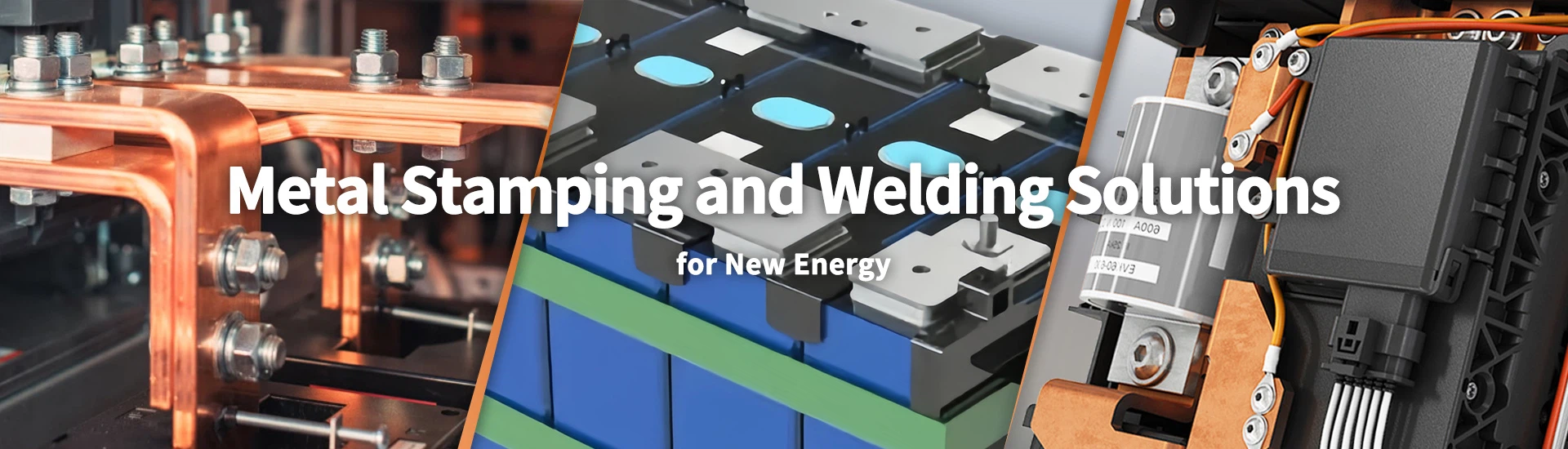
Xiamen Apollo Stamping Welding Technology supplies custom photovoltaic support components for rooftop and ground-mounted solar installations. The product scope includes aluminum mid clamps, end clamps, rail connectors, mounting hooks and metal fastening components. Material and process selection is based on component geometry, installation interfaces, environmental exposure and the dimensional requirements specified in customer drawings.
Apollo supports drawing review, tooling assessment and production planning for custom solar mounting parts. Critical dimensions, hole positions, clamp engagement and surface treatment requirements can be defined before production approval. For repeat orders, inspection criteria and lot identification can be established to support dimensional consistency, incoming quality checks and scheduled deliveries.
For related manufacturing capabilities, see Precision Aluminum Stamping Parts.
-
![Stainless Steel Solar PV Cable Clips]()
Stainless Steel Solar PV Cable Clips
Add to Inquiry -
![Solar Panel Hooks For Tile Roof Mounting]()
Solar Panel Hooks For Tile Roof Mounting
Add to Inquiry -
![Aluminum Short Rail For Solar Roof Mount System]()
Aluminum Short Rail For Solar Roof Mount System
Add to Inquiry -
![Solar Panel Mounting Mid Aluminum Clamp]()
Solar Panel Mounting Mid Aluminum Clamp
Add to Inquiry -
![Solar Panel Roof Mounting System Aluminum Solar Clamp]()
Solar Panel Roof Mounting System Aluminum Solar Clamp
Add to Inquiry -
![Solar Panels Earthing Plates]() Add to Inquiry
-
![Solar Panel Rail Mounting System For Rooftop]()
Solar Panel Rail Mounting System For Rooftop
Add to Inquiry -
![Solar Panel Earthing Lug]() Add to Inquiry
-
![SUS Wire Clamp Solar Cable Clip]()
SUS Wire Clamp Solar Cable Clip
Add to Inquiry -
![Grounding Plate For Solar Panels]()
Grounding Plate For Solar Panels
Add to Inquiry -
![Solar Panel Mounting Middle Clamp]()
Solar Panel Mounting Middle Clamp
Add to Inquiry -
![End Clamp For Solar Panel Mounting]()
End Clamp For Solar Panel Mounting
Add to Inquiry




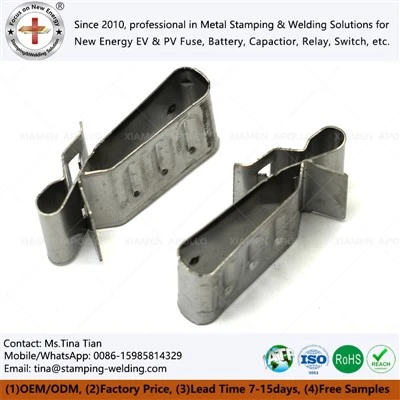
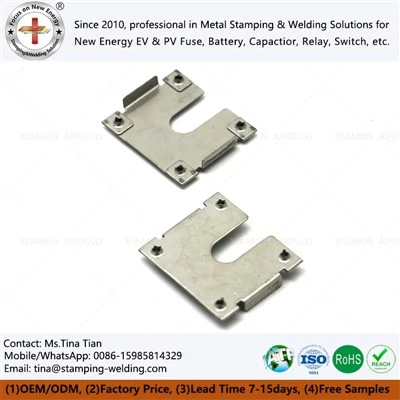
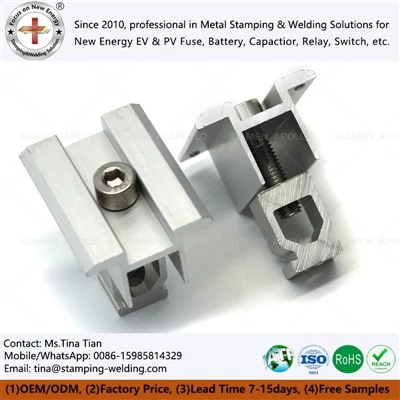

Material Standards, Tooling & Forming Processes
Photovoltaic support components must maintain dimensional compatibility with solar module frames, mounting rails, and fastening hardware throughout installation and outdoor service. Material selection depends on the required mechanical properties, component geometry, corrosion exposure, and structural design loads.
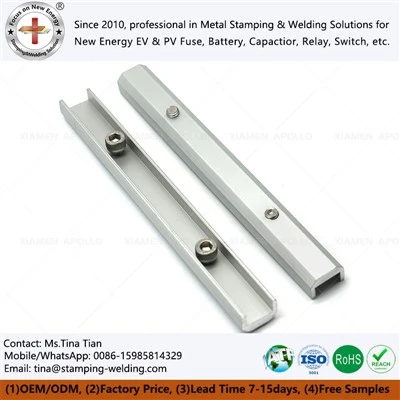
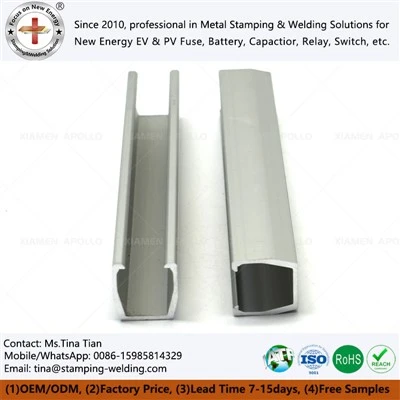
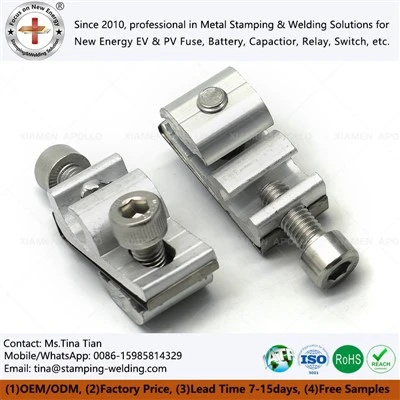
Aluminum alloy is widely used for solar mid clamps, end clamps and mounting rails because of its relatively low density and suitability for extrusion or machining. The specific alloy and temper must be selected according to the component's load-bearing function, forming requirements, and applicable design specifications. Stainless steel may be specified for bolts, nuts, and other fasteners where the required strength and environmental resistance support that selection.
Different component geometries require different production methods. Extrusion is suitable for continuous rail profiles; precision machining can produce defined slots and interfaces; stamping and forming are appropriate for certain sheet-metal brackets and mounting parts. Tooling design should account for springback, burr direction, material thickness, and the dimensional relationship between mating components.
For custom parts, the engineering review should identify the critical dimensions before tooling release. These may include rail-slot width, clamp engagement range, hole spacing, contact surfaces, and the position of fastener interfaces.
Photovoltaic Support Components Specifications
| Parameter | Specification basis | Inspection or verification |
| Aluminum material | Alloy and temper defined by the approved drawing | Material certificate and incoming inspection |
| Stainless steel fasteners | Grade selected according to design and environmental requirements | Material identification and dimensional inspection |
| Component profile | Rail, clamp, or bracket geometry defined by drawing | Profile gauge, optical measurement, or CMM where appropriate |
| Dimensional tolerance | Drawing-specific; ±0.01 mm only where feasible and validated | Calibrated gauges or coordinate measurement |
| Surface treatment | Anodizing or other specified corrosion-protection system | Coating thickness and surface inspection |
| Fastener interface | Thread, slot, hole, and mating dimensions per drawing | Thread gauge and dimensional verification |
| Mechanical performance | Defined by the mounting system's design load and qualification plan | Structural calculation and applicable load testing |
| Corrosion performance | Based on installation environment and specified finish | Test method, duration, and acceptance criteria agreed with the customer |
These are specification categories rather than universal performance guarantees. Final values depend on the selected product, material, manufacturing route, and approved engineering documents.
Tooling and Forming Considerations
Aluminum extrusion and profile machining
Rail profile dimensions, slot geometry and connector interfaces determine whether components fit together correctly. Tooling and machining plans should control profile variation, local deformation, and burrs that could interfere with assembly.
Precision stamping and forming
For sheet-metal brackets and mounting hardware, die clearance, bend radius, and material temper affect edge quality, dimensional repeatability, and crack risk. First-article inspection should confirm the drawing's critical dimensions before production release.
Clamp engagement and fastener alignment
Mid clamps and end clamps must fit the specified module-frame thickness and mounting interface. Incorrect engagement geometry or hole position can create installation problems even when the component's overall length and width are within tolerance.
Production consistency
The inspection plan should identify critical-to-quality dimensions and define the sampling frequency, measuring instruments, and acceptance limits. Tool wear and material-lot variation should be monitored where they can affect assembly fit.
Advanced Joining, Insulation & Surface Treatments
Surface protection and fastening design directly affect the outdoor durability of photovoltaic support components. The appropriate finish depends on the base material, site environment, contact with other metals, and the expected service conditions.
Anodizing is commonly used on aluminum components to create a controlled oxide layer. Its suitability depends on the alloy, surface preparation, coating process, and required film thickness. For steel brackets, a specified coating or metallic corrosion-protection system may be appropriate. The finish must be selected according to the product design and applicable project requirements rather than assumed to be interchangeable across all components.
Where aluminum components contact stainless steel fasteners or other metals, the design should consider moisture retention, electrolyte exposure, and galvanic corrosion. Drainage, interface geometry, and compatible material selection can reduce the risk of localized corrosion in service.
Surface Treatment Selection
| Component | Potential surface treatment | Main engineering consideration |
| Aluminum mid clamp | Anodizing or specified protective finish | Clamp geometry, coating consistency, and surface durability |
| Aluminum end clamp | Anodizing or specified protective finish | Contact interface and outdoor exposure |
| Aluminum solar rail | Anodizing or project-specified finish | Profile integrity, drainage and corrosion exposure |
| Steel mounting bracket | Specified coating or metallic protection | Corrosion resistance and coating coverage |
| Stainless steel fastener | Specified passivation or surface condition where applicable | Material grade, installation environment, and galling risk |
Joining and Assembly Requirements
Many photovoltaic mounting systems use mechanical fastening rather than welded joints at the installation stage. Bolts, nuts, T-screws and rail connectors should therefore be evaluated for thread engagement, tightening torque, assembly clearance and resistance to loosening under the specified service conditions.
Where welded brackets or fabricated metal components are required, the welding procedure should be selected according to the base material, joint design and structural requirements. Weld quality should be verified against the applicable drawing and acceptance criteria.
The engineering review should establish:
Fastener grade and compatible thread specification.
Required tightening torque and installation method.
Contact between dissimilar metals and corrosion-control provisions.
Coating thickness, coverage, and any masking requirements.
Applicable environmental and structural qualification tests.
For custom manufacturing requirements, submit the component drawing through the Custom Metal Stamping Process.
Request Custom Technical Evaluation
Quality Control & Certifications at Apollo
Quality control for photovoltaic support components should verify material conformity, profile geometry, surface finish, and assembly compatibility. The inspection plan must reflect the function of each part: a rail connector has different critical dimensions from a module clamp or roof mounting hook.
Incoming material inspection should verify the specified alloy, temper, thickness, or profile condition. During production, inspection should focus on rail-slot dimensions, clamp engagement, hole positions, formed angles and thread interfaces. Measuring methods should be appropriate to the component geometry and the tolerance required by the approved drawing.
Surface inspection should identify scratches, coating defects, exposed substrate, and other finish-related nonconformities. Where corrosion resistance is a project requirement, the test method, duration, and acceptance criteria should be defined before testing. A salt-spray result should not be treated as a direct prediction of field service life.
For structural applications, mechanical performance should be evaluated against the mounting system's engineering design. Depending on the project, this may involve load calculations, component tests, or system-level verification under the applicable installation and structural requirements.
Apollo's applicable quality-system certifications and inspection capabilities should be confirmed against current documentation before being listed as project commitments. Where required for a customer program, the quality plan can define traceability, control plans, material certificates, and PPAP documentation according to the agreed scope.
Recommended Inspection Plan
| Stage | Inspection focus | Records |
| Incoming material | Alloy, temper, thickness, or profile condition | Material certificate and incoming inspection record |
| First article | Critical dimensions and assembly interfaces | First-article dimensional report |
| In-process forming | Bend angles, profile shape, hole position, and burrs | In-process inspection records |
| Surface treatment | Coating coverage, finish condition and specified thickness | Surface inspection and coating report |
| Fasteners | Thread dimensions, grade, and mating compatibility | Dimensional and material inspection records |
| Structural qualification | Design-defined load or mechanical performance | Approved calculation or test report |
| Final inspection | Drawing compliance, quantity and packaging condition | Final inspection record and lot identification |
Batch Traceability and Packaging
For repeat production, lot identification should connect the finished component to the relevant material batch, tooling revision, and surface-treatment records. This supports root-cause investigation when a dimensional or coating issue is reported.
Packaging should prevent scratches, deformation, and contamination during transport. Aluminum clamps, rail connectors and finished brackets should be separated or protected where direct contact could damage the surface finish. Packaging and labeling requirements should be agreed with the customer before shipment.
Frequently Asked Questions
1. Which materials are commonly used for photovoltaic support components?
Aluminum alloy is commonly used for mid clamps, end clamps, and mounting rails because of its low density and suitability for extrusion or machining. Stainless steel or other specified materials may be used for fasteners and brackets. Final selection depends on structural loads, installation conditions, corrosion exposure, and the approved component design.
2. How should buyers specify tolerances for solar mounting clamps?
Specify the dimensions that control module-frame engagement, rail-slot fit, fastener alignment, and clamp positioning. The tolerance should reflect the function of each feature and the manufacturing process. A blanket ±0.01 mm requirement may be unnecessary or impractical for some extruded or formed components, so critical dimensions should be identified individually.
3. Which surface treatment is suitable for aluminum photovoltaic mounting parts?
Anodizing is a common option for aluminum mounting components, but suitability depends on the alloy, film thickness, site environment, and applicable finish specification. Coastal or high-humidity installations may require additional attention to drainage and dissimilar-metal interfaces. Buyers should define the coating requirements and qualification tests before production approval.
4. How can the structural reliability of photovoltaic support components be verified?
Verification should begin with the mounting system's design loads, installation method, and applicable structural requirements. Component dimensions, material properties, fastener selection, and connection details must match the approved design. Where required, engineering calculations and mechanical tests should document performance under the specified loading conditions; component appearance alone cannot establish load capacity.
Request a Custom Photovoltaic Support Components Quote
Component fit, material selection, and surface protection should be reviewed before tooling and production approval. Submit your drawings and project requirements so Apollo can assess the manufacturing route, critical dimensions, and inspection scope.
Send your 2D drawings in .DWG or PDF format, 3D models in STEP format, or a component specification covering alloy and temper, profile dimensions, coating requirements, fastener interfaces, annual volume, and required delivery schedule.
For structural applications, include the relevant design loads, installation environment, and qualification requirements. These details help distinguish manufacturing tolerances from system-level performance requirements and reduce unnecessary revisions during engineering review.
Apollo can review the submitted information for manufacturability, tooling considerations, and inspection planning. A preliminary DFM review and quotation can be arranged once the drawing and specification package is complete; response time depends on project complexity and the information provided.
We're well-known as one of the leading photovoltaic support components manufacturers and suppliers in China. Please feel free to buy high quality photovoltaic support components at competitive price from our factory. For more information, contact us now.
