

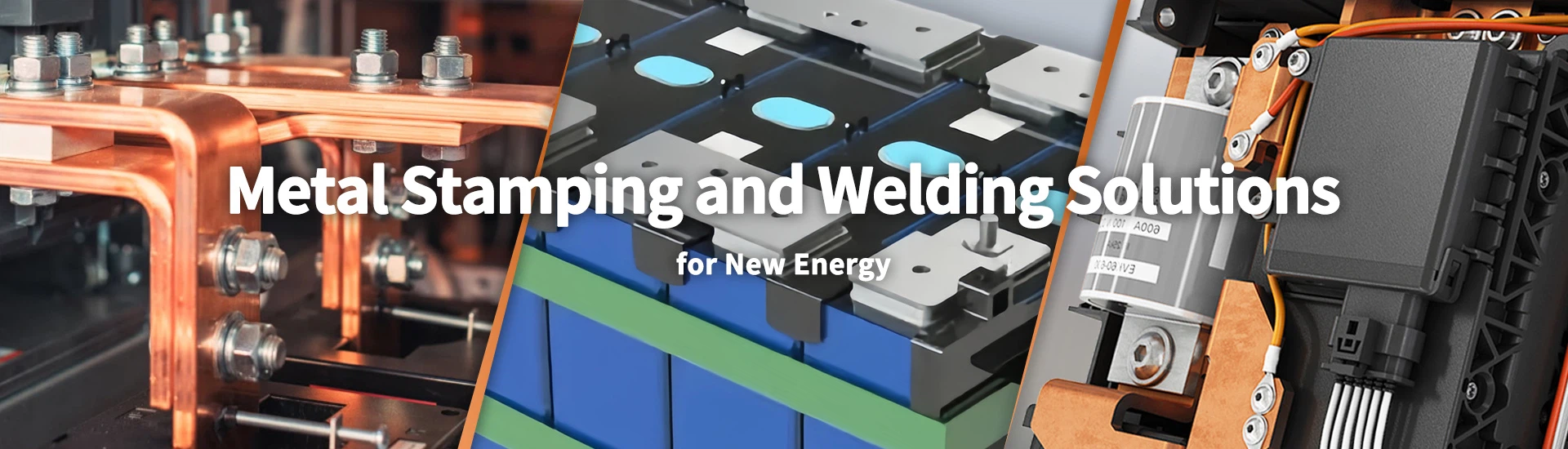
Flexible Braided Wires Manufacturer for Custom Copper Electrical Connections
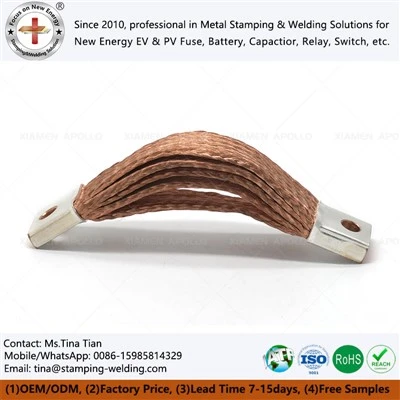
Xiamen Apollo Stamping Welding Technology manufactures flexible braided wires and copper braided connectors for EV battery systems, energy storage equipment, switchgear, transformers, and industrial electrical connections. Using high-conductivity electrolytic copper, our braided conductors are available in bare copper and tin-plated finishes, with strand construction and terminal dimensions specified according to electrical and mechanical requirements.
Apollo supports OEM production from drawing review to terminal fabrication and joining. Customers can specify conductor cross-section, braid width, wire diameter, connection length, mounting holes, and terminal material. Resistance brazing, diffusion welding, and ultrasonic welding can be evaluated according to assembly design, with dimensional and electrical inspection defined before production release.
Request a Factory Direct Quote
Explore Our Flexible Braided Wires Product Catalog
Compare copper braided conductors, grounding straps, and welded terminal connectors for your electrical connection requirements.
-
![Copper Braided Busbars For Electrical]()
Copper Braided Busbars For Electrical
Add to Inquiry -
![Braided Flexible Power Shunts]() Add to Inquiry
-
![Copper Braided Ground Strap Wire Cable]()
Copper Braided Ground Strap Wire Cable
Add to Inquiry -
![Copper Braided Flexible Busbar Connector]()
Copper Braided Flexible Busbar Connector
Add to Inquiry -
![Flexible Conductive Tin Plated Copper Braided Wire Connector]()
Flexible Conductive Tin Plated Copper Braided Wire Connector
Add to Inquiry -
![Flexible Copper Braided Wire Connectors With Welded Ends]()
Flexible Copper Braided Wire Connectors With Welded Ends
Add to Inquiry -
![Braid Copper Flexible Tinned Copper Braided Connector]()
Braid Copper Flexible Tinned Copper Braided Connector
Add to Inquiry -
![Grounding Flexible Tinned Connection Copper Braided]()
Grounding Flexible Tinned Connection Copper Braided
Add to Inquiry -
![Braided Copper Flexible Connectors]()
Braided Copper Flexible Connectors
Add to Inquiry -
![Braided Copper Wire Connector]() Add to Inquiry
-
![Flat Braided Shunt]() Add to Inquiry
-
![Copper Flexible Braided Bus Bar]()
Copper Flexible Braided Bus Bar
Add to Inquiry




Material Standards, Tooling & Braiding Processes
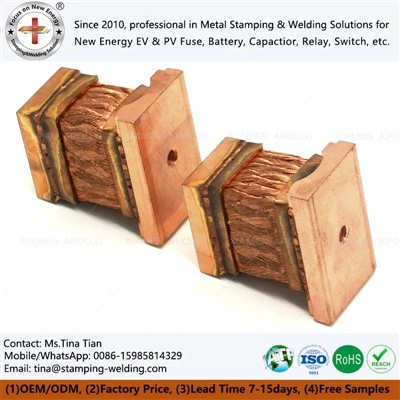
The conductor material determines both electrical loss and mechanical behavior. Apollo uses high-purity electrolytic copper for flexible braided conductors, with material selection based on conductivity, strand diameter, required flexibility, and operating environment. C1100 or equivalent high-conductivity copper can be considered where low electrical resistance is a primary requirement.
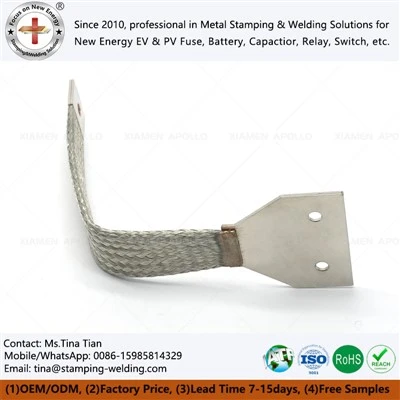
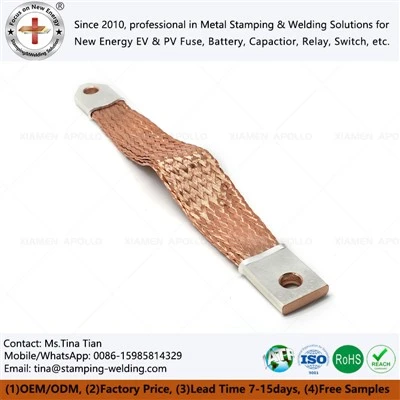
Unlike a rigid copper bar, a braided conductor contains multiple fine copper strands working as parallel current paths. The number of strands, individual wire diameter and braid density affect the conductor's cross-sectional area, flexibility and heat dissipation. These parameters should therefore be specified together with continuous current, peak current, ambient temperature and allowable temperature rise.
Tinned copper is available for environments where oxidation resistance and stable terminal contact are required. Bare copper can be used where the installation environment and maintenance conditions permit exposed copper.
The braid is formed under controlled tension to maintain consistent width and density. Terminal geometry is developed according to the mounting hole, bolt size, contact area, and available installation envelope.
For applications requiring a rigid-to-flexible transition, Apollo can combine braided copper conductors with stamped copper terminals or welded connection ends.
Specifications Table
| Engineering Parameter | Available / Typical Configuration |
| Conductor Material | High-purity electrolytic copper |
| Copper Grades | C1100 / T2 / equivalent copper |
| Conductor Structure | Multi-strand braided copper wire |
| Surface Condition | Bare copper / tin-plated/silver-plated |
| Braid Density | Controlled according to flexibility and current requirements |
| Conductor Cross-Section | Calculated according to continuous and peak current |
| Terminal Material | Copper/copper alloy according to application |
| Terminal Forming | Stamping/cutting/forming |
| Terminal Joining | Resistance brazing/diffusion welding / ultrasonic welding |
| Dimensional Control | Drawing-based inspection |
| Electrical Verification | DC resistance/continuity testing |
| Insulation Option | Fiberglass sleeve / protective tubing |
| Application | EV / ESS/switchgear/transformer / industrial equipment |
Engineering note: Current carrying capacity should not be selected from conductor cross-section alone. Continuous current, duty cycle, ambient temperature, mounting condition, and allowable temperature rise should be evaluated together.
Advanced Joining, Insulation & Surface Treatments
For a flexible braided connection, the transition between the woven conductor and terminal is a primary mechanical and electrical interface. Apollo selects the joining process according to copper thickness, terminal geometry, required conductivity, and mechanical loading.
Resistance brazing can be used for copper braid and terminal assemblies where localized heating and repeatable joint formation are required. Diffusion welding is suitable for configurations requiring a compact solid-state electrical interface. Ultrasonic welding can also be considered for selected fine-strand copper assemblies where low thermal input is preferred.
Terminal dimensions are controlled to maintain the required contact area and mounting geometry. The finished assembly can include drilled or stamped mounting holes, formed terminals, and additional protective structures.
For corrosive or humid environments, tin plating can reduce copper surface oxidation and support more stable contact performance. Silver plating may be considered where the electrical interface requires improved surface conductivity under specified operating conditions.
Where the braided conductor requires additional mechanical or thermal protection, fiberglass insulation sleeves or other protective tubing can be added without restricting the required flexing movement.
Quality Control & Certifications at Apollo
Quality control for Flexible Braided Wires covers the conductor, braid geometry, terminal connection, and final electrical performance rather than only visual appearance.
Incoming copper material is checked against the specified material grade and documentation. During braiding, production controls focus on conductor strand arrangement, braid width, density, and overall dimensional consistency.
For terminal assemblies, inspection can include mounting-hole dimensions, terminal thickness, joining position, joint appearance, and mechanical integrity. Electrical checks can verify continuity and DC resistance against the approved drawing or customer specification.
For projects requiring higher process documentation, Apollo can support PPAP Level 3 documentation with process flow, PFMEA, Control Plan, material certificates, and CPK process capability data.
The quality system is operated under ISO 9001 and IATF 16949 requirements for applicable automotive production. Inspection equipment can include CMM measurement systems and optical measurement equipment for dimensional verification.
Recommended validation items for a flexible braided connection include:
Conductor resistance
Terminal contact resistance
Braid width and thickness
Terminal dimensional accuracy
Joint integrity
Plating thickness where specified
Temperature-rise testing
Mechanical pull or tensile testing
Flexing or vibration validation according to application requirements
For EV and ESS programs, validation conditions should be defined from the actual operating profile rather than applying a generic test value to every connector configuration.
Frequently Asked Questions About Flexible Braided Wires
FAQ
Q: How should I specify Flexible Braided Wires for a high-current application?
A: Provide continuous current, peak current, duty cycle, ambient temperature, allowable temperature rise, conductor length, and installation space. Apollo uses these parameters with conductor cross-section, strand construction, and braid density to determine a suitable configuration rather than assigning one current rating to every braided wire.
Q: Do braided copper wires withstand vibration better than rigid copper bars?
A: The multi-strand braided structure can absorb relative movement and reduce concentrated mechanical stress compared with a rigid conductor. Actual fatigue performance depends on strand diameter, braid geometry, bending radius, terminal transition, and vibration profile, so dynamic applications should be validated using the customer's operating conditions.
Q: Should I choose bare copper or tinned copper braided wire?
A: Bare copper is suitable when oxidation exposure is limited, and the connection environment is controlled. Tinned copper is generally considered when humidity, oxidation, or storage conditions require additional surface protection. The selection should also account for terminal material, joining process, operating temperature, and required contact resistance.
Q: Can Apollo manufacture braided wires with custom terminals?
A: Yes. Apollo can develop the braided conductor and terminal assembly from customer drawings or samples. Terminal geometry can include mounting holes, formed sections, and welded connection areas. The engineering review considers current path, mechanical loading, available space, and joining method before confirming the production configuration.
Request a Flexible Braided Wire Engineering Evaluation
For a new EV, ESS, switchgear, or industrial power connection, send Apollo your 2D/3D CAD drawing (.STEP, .DWG), current requirements, or electrical parameter list.
Include continuous/peak current, conductor length, installation space, terminal dimensions, operating temperature, and movement or vibration conditions where available. Apollo's engineering team can review the conductor structure, braid density, terminal configuration, and joining method and provide a free DFM manufacturability analysis within 24 hours, followed by a factory-direct quotation.
We're well-known as one of the leading flexible braided wire manufacturers and suppliers in China. Please feel free to buy high quality flexible braided wire at competitive price from our factory. For more information, contact us now.
