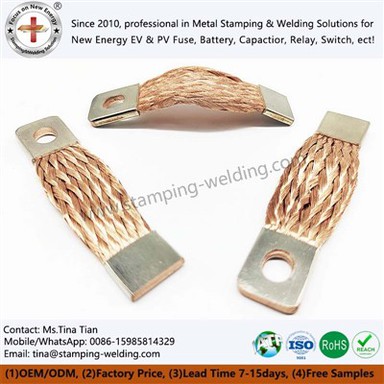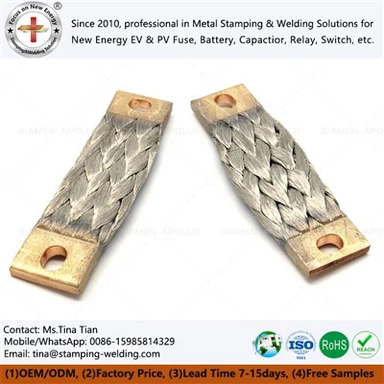


Braided Copper Flexible Connectors
Braided Copper Flexible Connectors are conductive components made of multiple strands of copper wire braided into a flat or circular braid, with copper terminals (such as copper lugs or flat terminals) fixed at both ends by welding or crimping processes. They are used in high-current transmission scenarios and can accommodate dynamic displacement, vibration, thermal expansion, and alignment misalignment between devices. They are widely used in power distribution systems, switchgear, busbar assemblies, and battery packs.
- Fast Delievery
- Quality Assurance
- 24/7 Customer Service
Product Introduction

Braided Copper Flexible Connectors are flexible electrical links that achieve uniform current distribution and absorb mechanical stress through a copper wire braiding structure. They can connect rigid components without affecting electrical continuity, preventing localized overheating and stress concentration, which is crucial for maintaining system integrity and operational safety.
What is the working principle of a braided copper flexible connector? Its core working principle lies in its unique braided structure, which combines the excellent conductivity and high flexibility of copper to achieve the dual functions of current transmission and mechanical adaptation.
Current Transmission
The interwoven fine copper wires form multiple parallel conductive paths, allowing current to flow evenly throughout the connector. This parallel structure reduces the current density of individual copper wires, minimizing resistive losses and preventing localized overheating, which is crucial for high-current applications.
Mechanical Adaptability
The flexible braided structure allows the connector to bend, twist, and stretch in multiple directions. When the connected device experiences thermal expansion and contraction, vibration, or positional misalignment, the connector absorbs mechanical stress through the micro-movements between the copper wires, preventing damage to the connection points or the device itself.
Heat Dissipation
The gaps between the braided copper wires create a large surface area, achieving efficient heat dissipation through air convection. This design ensures the connector maintains stable performance under long-term high-load operation, extending product lifespan.

Selection Recommendations
Determine electrical parameters
Select connectors with a cross-sectional area of 1.5mm²-6000mm² based on the Flexible Braided Electrical Connectors system's operating current (current carrying capacity increases with cross-sectional area); for low voltage (≤1kV), choose ordinary tin-plated connectors; for medium voltage (1kV-35kV), choose high-voltage insulating sleeve connectors with a breakdown voltage ≥3000V AC.
Consider mechanical requirements
For multi-directional bending/frequent movement, choose 0.05mm-0.15mm fine copper wire connectors; for slight bending and fixed connections, choose 0.20mm-0.25mm thick copper wire connectors; for high-frequency vibration scenarios, choose fatigue-resistant connectors to ensure the Flexible Copper Braided Connectors can withstand over 100,000 bends without degradation.
Adaptable environmental conditions
For coastal/chemical/high humidity environments, choose silver-plated/nickel-plated connectors with insulating sleeves; for general industrial environments, choose tin-plated connectors; for high-temperature environments, choose silicone sleeve connectors with a temperature resistance ≥150℃; for low-temperature environments, ensure the Copper Braid Connectors remains flexible and does not crack at -40℃.
Confirm installation and customization requirements
Select terminal type according to equipment interface, and specify hole diameter and terminal size when placing order; if standard Flexible Braided Electrical Connectors do not meet the requirements, relevant parameters can be provided for customized production.

Frequently Asked Questions
Q:1.What is the difference between braided flexible connectors and copper foil flexible busbars?
A:The core difference lies in structure and flexibility: Braided connectors are made of braided copper wire, offering multi-directional flexibility, strong vibration resistance, suitability for dynamic connections, and better heat dissipation; copper foil connectors are made of 0.05mm-0.3mm laminated copper foil, suitable only for sheet bending, with weaker lateral bending resistance, but higher high-frequency current carrying efficiency.
Q:2.How to calculate the lifespan of a braided copper flexible connector?
A:Lifespan is determined by environment, load, and materials. 10-15 years in normal environments, 5-8 years in harsh environments; choosing appropriate surface treatment and insulation materials, and regular maintenance can extend lifespan.
Q:3.Can copper flexible connectors be used in high-voltage applications?
A:They can be used in low-to-medium voltage applications ≤35kV; for high-voltage applications above 1kV, models with silicone/epoxy resin insulating sleeves must be selected, with sleeve breakdown voltage ≥ 1.5 times the system operating voltage. High-voltage models are available upon request.
Q:4.How to correctly install a braided copper flexible connector?
A:Installation steps: 1. Clean the contact surfaces; 2. Align the terminals and tighten to the specified torque; 3. Allow for length to accommodate thermal expansion and contraction and vibration; 4. Install protective/insulating devices for outdoor/corrosive environments; 5. Test connection resistance and insulation performance.
Q:5.What are the key quality inspection indicators for braided copper flexible connectors?
A:Key inspection indicators: 1. Electrical performance (resistivity, connector resistance ≤0.5μΩ, current carrying capacity); 2. Mechanical performance (no wire breakage after 100,000 bends, tensile strength ≥150MPa, etc.); 3. Corrosion resistance (salt spray test meets standards); 4. Dimensional accuracy; 5. Insulation performance (insulation resistance ≥100MΩ, etc.).
Contact Us
If you need to confirm technical parameters, customize Braided Copper Flexible Connectors products according to project requirements, or consult more application details, please contact us for professional engineering support and solutions.

Hot Tags: braided copper flexible connectors, China, manufacturers, suppliers, factory