

Ceramic Body Manufacturer for EV, PV, and New Energy Storage Fuses
Xiamen Apollo manufactures ceramic bodies and insulating tubes for electric vehicle (EV), photovoltaic (PV), and energy storage fuse applications. Available materials include 95% alumina (Al₂O₃), other alumina grades, and selected engineering ceramics. Material selection considers dielectric strength, thermal stability, mechanical strength, and dimensional requirements under specified fuse operating conditions.
For OEM production, Apollo supports drawing-based dimensional review, ceramic forming process selection and secondary precision grinding. Custom configurations include cylindrical, rectangular, and other specified profiles, with controlled inner and outer diameters. Material certificates, dimensional inspection records, and PPAP Level 3 documentation can be arranged according to project requirements and the agreed quality plan.
Request a Factory Direct Quote
Explore Our New Energy Fuse Ceramic Body Product Catalog
Compare ceramic housings and tubes for EV, PV, and energy storage fuses by material grade, geometry, dimensions, and application requirements.
-
![Ceramic Body For High Speed Fuse]()
Ceramic Body For High Speed Fuse
Add to Inquiry -
![Insulated Ceramic Tube in EV Fuses]()
Insulated Ceramic Tube in EV Fuses
Add to Inquiry -
![95% Alumina Ceramic Tube For High Voltage Fuse]()
95% Alumina Ceramic Tube For High Voltage Fuse
Add to Inquiry -
![Ceramic Body For EV DC Fuse]() Add to Inquiry
-
![Ceramic For DC Automotive Fuse]()
Ceramic For DC Automotive Fuse
Add to Inquiry -
![Ceramic Casing For Fuse Links]() Add to Inquiry
-
![Ceramic Body For Photovoltaic PV Solar Fuses]()
Ceramic Body For Photovoltaic PV Solar Fuses
Add to Inquiry -
![Ceramic Casing For EV Charger Fuse Link]()
Ceramic Casing For EV Charger Fuse Link
Add to Inquiry -
![Ceramic Tube For High Voltage Fuse]()
Ceramic Tube For High Voltage Fuse
Add to Inquiry -
![Customized Ceramic Tube]() Add to Inquiry
-
![Insulating Electrical Steatite Ceramic Fused Body]()
Insulating Electrical Steatite Ceramic Fused Body
Add to Inquiry -
![Ceramic Body For Fuse Bolted Series]()
Ceramic Body For Fuse Bolted Series
Add to Inquiry


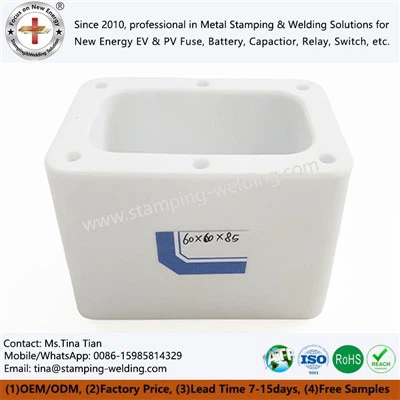
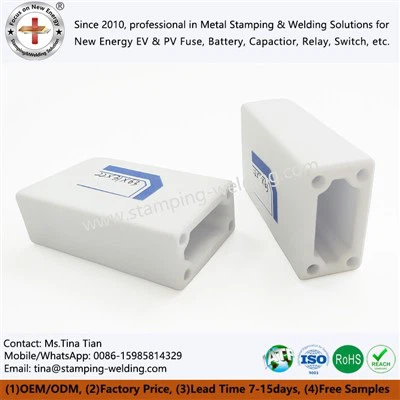


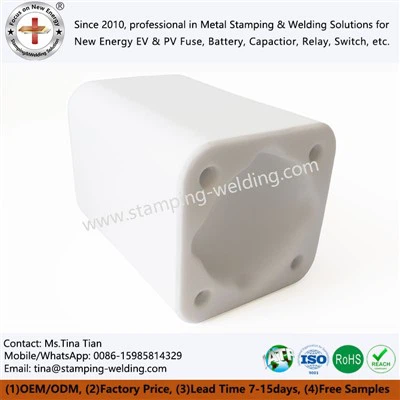
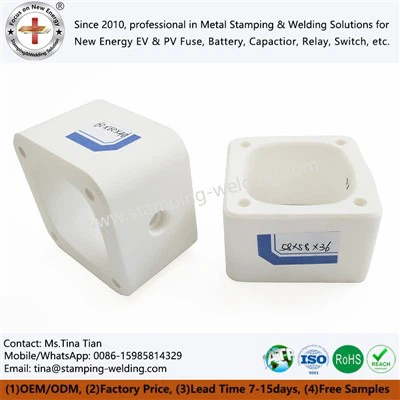
Material Standards, Tooling & Forming Processes
The ceramic body forms the electrical insulating and mechanical enclosure around the fuse element. Its material and geometry must suit the fuse's operating voltage, rated current, fault conditions, thermal environment, and assembly design. A ceramic body is not a universal component: the required wall thickness, internal diameter, creepage geometry and end interface depend on the complete fuse specification.
Alumina Composition and Material Selection
Alumina (Al₂O₃) is used in electrical ceramic components where electrical insulation, thermal stability and mechanical strength are required. Depending on the product specification, the material may be selected at different purity levels. Apollo's published energy-storage fuse ceramic range lists alumina options from 75% to 99.9%, alongside other ceramic materials. This is a range of material options, not a claim that every product uses 95% alumina.
Material selection should consider:
Alumina content and impurities: Composition affects electrical, thermal, and mechanical properties.
Thermal expansion: The coefficient of thermal expansion influences compatibility with metal end caps and brazed interfaces.
Porosity and density: Incomplete densification can affect strength and insulation performance.
Wall thickness and geometry: The body must accommodate the fuse element, internal filler, and required insulation distances.
Surface condition: Glazing, polishing, or grinding may be specified according to sealing, assembly, and electrical requirements.
Forming and Dimensional Control
Ceramic body manufacturing can involve extrusion, dry pressing or isostatic pressing, depending on cross-section, length, dimensional requirements and production volume. After forming, controlled drying and sintering establish the ceramic structure. Secondary grinding, drilling, threading, or end-face finishing may be required to meet the finished drawing.
Unlike metal stamping, ceramic forming must account for shrinkage during sintering. The green-body dimensions cannot be treated as finished-part dimensions. Tool compensation should be based on the actual material system and validated process conditions.
For tubular bodies, the inner diameter, outer diameter, wall thickness, concentricity, and end-face squareness are important. Thin walls may reduce the available mechanical margin, while excess wall thickness can change the internal volume and assembly fit. The design should therefore define critical dimensions rather than relying on a general tolerance for every feature.
Ceramic Body Technical Specifications
| Parameter | Reference specification | Engineering verification |
| Ceramic material | Alumina (Al₂O₃), 75%–99.9% options listed for the product range | Material grade and supplier documentation |
| Ceramic density | Product listing specifies above 3.65 g/cm³ for the referenced energy-storage range | Density test method and material specification |
| Outer diameter (OD) | ±0.05 mm listed as an available option | Drawing-based dimensional inspection |
| Inner diameter (ID) | ±0.10 mm listed as an available option | Bore gauge, optical measurement, or suitable calibrated gauge |
| Ceramic shape | Round, square, oval, or half-tube options | Drawing and first-article inspection |
| Forming method | Extrusion, dry pressing or isostatic pressing, as applicable | Process validation |
| Surface finish | Polished or glazed options | Visual and dimensional inspection |
| Secondary machining | Fine grinding or threading where required | Feature-specific dimensional verification |
| Dielectric strength | Defined by the material grade, geometry, and test method | Specified dielectric test |
| Thermal shock resistance | Defined by the application and qualification procedure | Thermal-cycle or thermal-shock testing |
The dimensional options and forming methods above are based on the published energy-storage fuse ceramic product listing. They should not be assumed to apply to every product in the category.
For material-specific requirements, see 95% Alumina Ceramic.
Advanced Joining, Insulation & Surface Treatments
The joining requirements of a ceramic fuse body depend on the end-cap design and whether the assembly uses mechanical retention, metallization, or a ceramic-to-metal brazed joint. A plain ceramic tube does not automatically require metallization or brazing. These processes should be specified only where the product architecture requires them.
Ceramic-to-Metal Joining
For metallized ceramic components, a compatible metal layer may be applied to a defined area before joining. Mo-Mn metallization is one established route for certain alumina-to-metal assemblies, often followed by a suitable finishing layer and brazing process. The metallization system, surface preparation, and joining cycle must be compatible with the ceramic composition and metal terminal.
Thermal expansion mismatch between ceramic and metal can create residual stresses during cooling and subsequent operation. Joint design should account for the geometry, joining temperature, service temperature range, and mechanical loads. Where a brazed joint is part of the design, inspection should target interface continuity, cracks, incomplete bonding, and other specified defects.
Glazing, Grinding and Surface Protection
Glazing can be specified where a controlled surface finish or environmental barrier is required. Precision grinding may be used to control the inner diameter, outer diameter, end faces or mounting features. These operations must not introduce edge chipping, surface cracks or unacceptable residual damage.
Inspection requirements may include:
Surface examination for cracks, chips and visible defects.
Measurement of critical bore and end-face dimensions.
Verification of coating or glaze coverage where specified.
Dielectric testing using the agreed electrode arrangement and test conditions.
Joint inspection for metallized or brazed designs.
Request Custom Technical Evaluation
Quality Control & Certifications at Apollo
Quality control for ceramic fuse bodies should cover raw material identification, forming, sintering, secondary machining, and final inspection. The control plan must distinguish process variables from finished-part acceptance criteria. A dimension that is achievable on a machined feature may not be suitable as a general tolerance for an as-sintered surface.
Inspection of Ceramic Fuse Bodies
Incoming material verification should confirm the specified ceramic grade and the applicable supplier documentation. During forming and sintering, process monitoring should address dimensional shrinkage, density consistency, and visible defects. After finishing, the inspection plan should focus on the dimensions that affect fuse assembly, sealing, and insulation distances.
Depending on the product drawing and quality agreement, inspection may include:
OD, ID and wall-thickness measurements.
End-face geometry, flatness and concentricity checks.
Visual examination for cracks, chips, warpage and surface defects.
Density or material verification where required.
Dielectric withstand testing using the specified voltage, duration, and test fixture.
Thermal-cycle or thermal-shock qualification for the intended service environment.
Inspection of metallized or brazed interfaces where applicable.
X-ray inspection, CMM measurement and other specialized methods should be specified only when the part geometry, defect risk and actual inspection capability justify their use. The measurement method must be appropriate for brittle ceramic components and the feature being assessed.
Quality Documentation and Supplier Approval
Apollo identifies ISO 9001 and IATF 16949 within its published quality and certification information. The certificate validity, certified entity, manufacturing location, and scope should be verified for the particular supply project before the credentials are used in customer-facing claims.
For automotive or other controlled procurement programs, PPAP Level 3 documentation may be agreed where the customer requires it. A submission package may include:
Process flow diagram.
Process Failure Mode and Effects Analysis (PFMEA).
Control plan.
Material and dimensional records.
Applicable performance test reports.
Process capability evidence for designated critical characteristics.
PPAP documentation does not replace product-specific validation. Dielectric performance, mechanical integrity, and the complete fuse's interruption rating must be evaluated against the relevant customer specification and applicable fuse standard.
Packaging and Batch Identification
Ceramic components are brittle and can be damaged by point loading, edge impact, or vibration during transportation. Packaging should separate individual parts, prevent direct ceramic-to-ceramic impact and protect finished end faces. Lot labels should connect the shipment to the applicable part number, revision, and inspection records.
For recurring production, the control plan should define how changes to ceramic composition, tooling, sintering conditions, or secondary machining are reviewed before implementation. This reduces the risk of unapproved changes affecting dimensional fit or electrical performance.
Frequently Asked Questions
Q: 1. What ceramic material is suitable for EV, PV and energy storage fuse bodies?
A: Alumina is a common option because of its electrical insulation, thermal stability, and mechanical strength. The required purity depends on the fuse design, operating voltage, thermal exposure, and cost constraints. Material selection should be based on specified electrical and mechanical properties, not alumina percentage alone.
Q: 2. What dimensional tolerances are available for ceramic fuse tubes?
A: The published energy-storage fuse ceramic range lists an outer-diameter tolerance option of ±0.05 mm and an inner-diameter option of ±0.10 mm. Final tolerances depend on geometry, forming method, sintering shrinkage, and secondary machining. Critical dimensions should be identified on the drawing and verified during first-article inspection.
Q: 3. Can ceramic fuse bodies use metallized ends or brazed metal terminals?
A: Yes, where the design requires a ceramic-to-metal joint. A compatible metallization system and brazing cycle must be selected for the ceramic grade and metal terminal. Thermal expansion mismatch, joint geometry, and cooling stresses should be assessed, followed by inspection and qualification against the agreed acceptance criteria.
Q: 4. How should dielectric strength and thermal shock resistance be qualified?
A: The test plan should specify the ceramic grade, finished geometry, electrode arrangement, voltage, duration, and acceptance criteria. Thermal shock testing should reproduce the temperature range and cycling conditions relevant to the application. Results for a ceramic coupon or tube alone do not establish the full fuse's rated voltage or interruption capacity.
Request a Custom Ceramic Fuse Body Quote
Send Apollo your 2D drawing, 3D CAD model, or existing ceramic sample details for a manufacturing review. Include the target application (EV, PV or energy storage), ceramic grade, OD/ID dimensions, wall thickness, end-interface design and required electrical or mechanical qualification criteria.
For ceramic-to-metal assemblies, also specify metallization, brazing, or other joining requirements. These details allow the engineering team to evaluate material selection, forming and sintering allowances, secondary machining, inspection methods, and packaging requirements before quotation.
Request a drawing-based DFM review and factory quotation. A preliminary review within 24 hours can be targeted for complete inquiries; timing depends on drawing complexity, material availability, and the information supplied.
We're well-known as one of the leading new energy fuse ceramic body manufacturers and suppliers in China. Please feel free to buy high quality new energy fuse ceramic body at competitive price from our factory. For more information, contact us now.
