

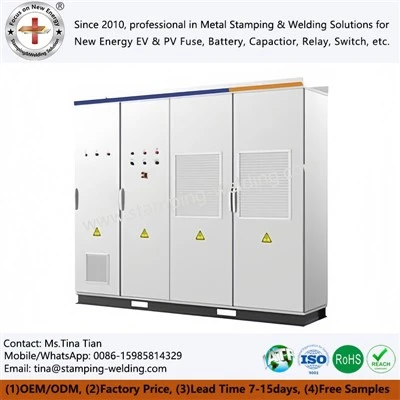
Energy Storage Cabinet Manufacturer for Custom ESS Enclosure Fabrication
Xiamen Apollo Stamping Welding Technology manufactures custom energy storage cabinets and sheet metal enclosure components for battery storage applications. Production processes include CNC laser cutting, precision sheet metal bending, structural welding, and powder coating. Carbon steel, galvanized steel, stainless steel, and aluminum are selected according to cabinet loading, installation environment, corrosion exposure, and project specifications.
For OEM energy storage cabinet projects, Apollo supports drawing review, DFM assessment, tooling coordination and production inspection. Engineers can define panel dimensions, mounting interfaces, door structures, cable openings and assembly tolerances before production. Material certificates, dimensional inspection records, and PPAP Level 3 documentation can be arranged according to project quality requirements.
Request a Factory Direct Quote
Explore Our Energy Storage Cabinet Product Catalog
Review our outdoor, modular, and integrated energy storage cabinet designs for battery storage, renewable energy, and industrial power applications.
-
![Outdoor Energy Storage Cabinet]()
Outdoor Energy Storage Cabinet
Add to Inquiry -
![Modular Integrated Battery Storage Cabinet]()
Modular Integrated Battery Storage Cabinet
Add to Inquiry -
![System Energy Storage Cabinet]() Add to Inquiry
-
![Solar Battery Storage Cabinet]() Add to Inquiry
-
![Battery Bank Cabinet]() Add to Inquiry
-
![Battery Management System]() Add to Inquiry
-
![Integrated Energy Storage Cabinet]()
Integrated Energy Storage Cabinet
Add to Inquiry -
![Solar Battery Enclosure Cabinets]()
Solar Battery Enclosure Cabinets
Add to Inquiry -
![Energy Storage Integrated Cabinet]()
Energy Storage Integrated Cabinet
Add to Inquiry -
![Battery Energy Storage Cabinet]()
Battery Energy Storage Cabinet
Add to Inquiry -
![Battery Storage Cabinet]() Add to Inquiry
-
![Energy Storage System Cabinet]() Add to Inquiry



Material Standards, Tooling & Forming Processes
Energy storage cabinet design starts with the mechanical envelope, equipment weight, installation method, and operating environment. The enclosure must provide mounting support for battery modules and electrical components while preserving access for assembly, inspection, and maintenance. Panel layout should account for cable bend radius, connector clearance, grounding points, and the separation requirements specified by the system designer.
Sheet Material and Structural Design
Carbon steel is commonly considered for cabinet structures requiring stiffness, weldability, and a defined surface protection system.
Stainless steel may be appropriate for specific corrosive environments, while aluminum can be evaluated when weight reduction is important. Final selection depends on structural load, fabrication method, environmental exposure, and project cost constraints.
Sheet thickness should be determined by panel span, reinforcement layout, door weight, fastening arrangement, and the required deflection limit. A thicker sheet does not automatically produce a better enclosure if the design lacks suitable stiffeners, mounting supports or load paths.
Fabrication and Assembly Sequence
CNC laser cutting establishes panel outlines, openings and mounting features. CNC press-brake forming creates flanges, stiffening edges and enclosure profiles. Welding, fastening and mechanical assembly then establish the cabinet frame and access-panel geometry.
Design reviews should pay particular attention to:
Mounting interfaces: Battery racks, electrical panels and service equipment must align with their defined mounting datums.
Door and panel geometry: Flatness, squareness, hinge position, and latch engagement affect closure and sealing.
Weld distortion: Heat input and welding sequence can alter panel alignment and gasket compression.
Cable and service access: Cable entries, lifting points, and maintenance clearances must be compatible with the final installation.
Production repeatability: Forming and fixture arrangements should maintain critical dimensions across production batches.
For projects with multiple cabinet variants, a common frame architecture can be evaluated alongside variant-specific panel openings and internal mounting brackets. This approach may reduce tooling changes and simplify spare-part management, provided the structural and thermal requirements remain satisfied.
Energy Storage Cabinet Engineering Specifications
| Parameter | Design or manufacturing requirement | Verification method |
| Cabinet material | Carbon steel, stainless steel, or aluminum as specified | Material certificate and incoming inspection |
| Sheet thickness | Defined by structural design and customer drawing | Calibrated thickness measurement |
| Dimensional tolerance | Drawing-defined; ±0.01 mm only for validated critical features where required | CMM, optical measurement, or calibrated gauges |
| Cabinet frame | Load path, reinforcement and mounting points per design | Dimensional inspection and specified load test |
| Door and panel fit | Defined clearance, flatness and latch engagement | Assembly inspection |
| Surface protection | Coating system selected for the operating environment | Coating thickness and visual inspection |
| Environmental protection | Target IP rating specified for the complete enclosure configuration | Applicable ingress protection test |
| Cable entries | Gland plates, openings and routing provisions per system design | Drawing and assembly verification |
| Grounding provisions | Bonding points and continuity criteria per electrical design | Ground continuity test where specified |
| Thermal management | Ventilation or cooling interfaces based on system heat load | Thermal test or system-level validation |
The table defines project specification categories, not universal product guarantees. Actual materials, tolerances, load ratings, and test limits must be confirmed against the released drawing and approved inspection plan.
For related enclosure products, review Electrical Cabinet Manufacturing.
Advanced Joining, Insulation & Surface Treatments
Energy storage cabinet durability depends on frame rigidity, joint quality, coating integrity and the performance of door and cable-entry seals. The joining and finishing process should be selected according to the enclosure material, structural loading, exposure conditions, and required service life.
Welding and Mechanical Joining
MIG or TIG welding may be used for compatible metal structures where the joint design and required strength support the process. Welding sequence, fixture design and heat input should be controlled to reduce distortion around door frames, mounting rails and sealing surfaces.
Where removable panels or service access are required, bolted joints, captive fasteners and mechanical mounting features may be more suitable than permanent welding. Fastener material, corrosion compatibility and access for maintenance should be considered during design review.
Weld inspection criteria should define acceptable discontinuities, visual requirements and any additional non-destructive examination required by the project. X-ray inspection should only be specified where justified by the joint design, risk assessment, and acceptance standard; it is not a default requirement for every cabinet weld.
Coating and Corrosion Protection
Powder coating is commonly used for metal enclosures, with the coating chemistry, pretreatment and film thickness selected according to the intended environment. Outdoor installations may require additional consideration of UV exposure, humidity, salt contamination, condensation, and coating damage during transport or installation.
A corrosion protection specification should identify:
Substrate material and pretreatment process.
Coating type, color and specified film thickness.
Adhesion and visual acceptance requirements.
Corrosion test method and exposure duration, where applicable.
Repair procedures for damaged coating and exposed edges.
Salt-spray test duration should not be treated as a direct prediction of outdoor service life. Acceptance criteria must follow the agreed test method and the actual coating system.
Sealing and Environmental Protection
Door gaskets, cable glands, panel joints and ventilation interfaces determine how the assembled enclosure resists dust and water ingress. An IP65 or IP66 rating should only be claimed for a configuration that has been tested or otherwise substantiated under the applicable standard. Openings, cooling equipment and service modifications can change the enclosure's protection performance.
For battery systems with active cooling, the mechanical enclosure must also accommodate the selected cooling equipment, airflow path, drainage provisions, and maintenance access. Thermal management and sealing should be reviewed together rather than specified as separate features.
Request Custom Technical Evaluation
Quality Control & Certifications at Apollo
Quality control for energy storage cabinets should verify the relationship between the released drawing, fabricated structure, surface treatment, and assembled enclosure. The inspection plan should identify critical dimensions, load-bearing interfaces, door alignment, grounding points, and sealing features before production begins.
Dimensional and Structural Inspection
Dimensional checks can include overall height, width and depth, mounting-hole positions, diagonal measurements, panel flatness and door clearances. CMM equipment, optical measurement systems, fixtures and calibrated gauges may be selected according to the part size, measurement uncertainty and required tolerance.
Structural testing should be defined from the actual cabinet use case. Where required, the plan may include static load tests for shelves or mounting rails, lifting-point verification, fastening checks and assessment of deformation under specified loads. Test loads and acceptance criteria must be supplied by the design authority or agreed during engineering review.
Environmental and Electrical Verification
Depending on the product scope, inspection and qualification may include:
Coating thickness and surface appearance.
Adhesion or corrosion testing under the specified method.
Door closure, gasket compression, and latch operation.
Ingress protection testing on the applicable assembled configuration.
Grounding continuity checks where required by the electrical design.
Temperature measurements or thermal validation under defined operating conditions.
Packaging inspection to prevent panel deformation and surface damage during shipment.
An empty metal enclosure should not automatically be described as having passed electrical insulation, thermal-runaway, or complete battery-system safety tests. Such claims require testing appropriate to the assembled system and its intended use.
Quality Documentation and Traceability
Apollo identifies IATF 16949 and ISO 9001 among its quality-system credentials. Applicability to a specific cabinet project, production site, and customer program should be confirmed before these credentials are presented as project-specific approval.
For customers requiring PPAP Level 3, the submission scope should be agreed at the quotation stage. Depending on the program, documentation may include a process flow diagram, PFMEA, control plan, material certificates, dimensional results, and process capability studies for applicable critical characteristics.
Production and Shipment Controls
Cabinet packaging should protect painted surfaces, door edges, lifting points and mounting interfaces. Packaging design should reflect cabinet mass, transport mode, stacking restrictions and the customer's receiving process. Where multiple cabinet variants share a shipment, labels should clearly identify model, revision, and production lot to reduce installation errors.
Frequently Asked Questions
1. What information is needed to quote a custom energy storage cabinet?
Provide the cabinet's overall dimensions, material and sheet thickness requirements, equipment mounting layout, door configuration, cable-entry positions, target IP rating, and expected order volume. If available, include 2D drawings, 3D CAD files, operating environment, and coating specifications. These inputs allow a more accurate DFM review and quotation.
2. Can an energy storage cabinet be designed for outdoor IP65 or IP66 protection?
Outdoor protection depends on the complete enclosure configuration, including doors, gaskets, cable glands, ventilation openings, and service panels. IP65 and IP66 are distinct ingress protection classifications. The required rating should be specified in the project documents and verified using the applicable test method on the relevant assembled configuration.
3. How should cabinet sheet thickness and structural reinforcement be selected?
Selection depends on cabinet dimensions, unsupported panel span, installed equipment mass, mounting locations, lifting requirements, and allowable deformation. Sheet thickness should be evaluated with the frame, bends, and stiffeners as one structural system. Final acceptance criteria should come from the approved design and, where required, load-test results.
4. How can cooling requirements be coordinated with enclosure sealing?
Start with the system heat load, allowable internal temperature, ambient conditions, and the selected cooling method. Ventilation openings, filters, fans, or cooling interfaces must be coordinated with dust and water protection requirements. Thermal validation and ingress protection verification should use the intended enclosure configuration rather than unrelated component-level ratings.
Request a Custom Energy Storage Cabinet Quote
A reliable cabinet quotation starts with the mechanical envelope, installation conditions, and required protection level. Send Apollo your cabinet drawings and project requirements so the engineering team can review fabrication feasibility, assembly interfaces, and inspection needs before production planning.
Please include 2D drawings in .DWG or PDF format, 3D models in STEP format where available, target cabinet dimensions, material and coating specifications, mounting loads, cable-entry requirements, cooling provisions, and annual demand. Identify any required IP rating, corrosion test, grounding test or customer-specific quality documentation.
Apollo can assess sheet-metal fabrication routes, joining methods, dimensional controls and packaging requirements based on the information provided. A 24-hour preliminary DFM review and quotation target may be arranged for complete inquiries; timing depends on design complexity and the information available.
We're well-known as one of the leading energy storage cabinet manufacturers and suppliers in China. Please feel free to buy high quality energy storage cabinet at competitive price from our factory. For more information, contact us now.
