

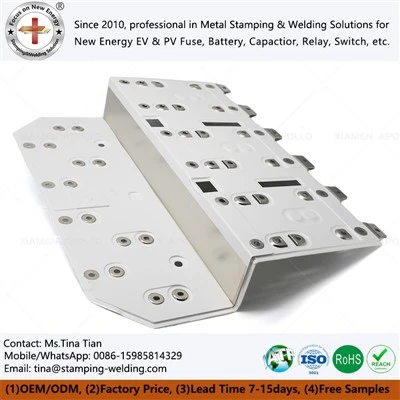
Xiamen Apollo specializes in the production of Laminated Copper Busbars, which have compact structures, low resistance, and high current density, can efficiently transmit electricity, and optimize system performance. They are the best choice for power projects.
-
![Laminated BusBar For Internet Router Backplane]()
Laminated BusBar For Internet Router Backplane
Add to Inquiry -
![Laminated Busbar For Three Level Inverter]()
Laminated Busbar For Three Level Inverter
Add to Inquiry -
![Laminated Shunt And Busbar]() Add to Inquiry
-
![Laminated Bus Bar For Medical Imaging Testing Device]()
Laminated Bus Bar For Medical Imaging Testing Device
Add to Inquiry -
![Laminated BusBar For High Current Circuit Board IGBT]()
Laminated BusBar For High Current Circuit Board IGBT
Add to Inquiry -
![Multi-Layer Composite Structure Connection Bar]()
Multi-Layer Composite Structure Connection Bar
Add to Inquiry -
![Laminated Bus Bar For Industrial Inverter Low-inductance IGBT Phase]()
-
![Inverter Busbar For Rail Traffic]()
Inverter Busbar For Rail Traffic
Add to Inquiry -
![IGBT Laminated Busbar]() Add to Inquiry
-
![Copper Laminated Bus Bars]() Add to Inquiry
-
![Laminated Busbars For Complex Busbar Installations]()
Laminated Busbars For Complex Busbar Installations
Add to Inquiry -
![Laminated Bus Bar For Telecom]() Add to Inquiry



Material Standards, Tooling & Forming Processes
Laminated copper busbars require exceptional raw material purity and cold-forming execution to achieve optimal electrical throughput. We source high-grade C1100 (ETP) and C1020 (OFHC) copper strip foils with a minimum of 100% IACS electrical conductivity.
Our automated multi-station progressive stamping tools process copper foil thicknesses from 0.05mm to 0.5mm, ensuring smooth sheared edges free of burrs (> 0.02 mm burr height strictly rejected) to prevent micro-punctures in inter-layer insulation films.
Precision tooling manufactured on WAIDA PG profile grinders guarantees stamping tolerances within ±0.01mm. Stacking and multi-layer alignment are conducted under vision-guided position fixtures, maintaining mechanical stability prior to molecular joining.
| Parameter / Specification | Standard Value / Technical Metric | Testing / Compliance Standard |
| Base Material Grade | C1100 T2 Pure Copper / C1020 OFHC Copper | ASTM B152 / GB/T 2040 |
| Foil Thickness Range | 0.05mm – 0.5mm (Custom Stacking) | ISO 2286-3 |
| Electrical Conductivity | ≥ 100% IACS (58.0 MS/m) | IEC 60028 / ASTMB193 |
| Dimensional Tolerance | Pitch/Hole Center: ±0.01mm; Length: ±0.05mm | CMM / Nikon Optical Comparator |
| Stray Inductance | < 10 nH (Low-Inductance Design) | High-Frequency LCR Meter Test |
| Dielectric Strength | > 15 kV/mm (PET/Kapton/Nomex Insulation) | IEC 60243-1 |
| Flammability Rating | UL 94 V-0 | Self-Extinguishing UL 94 Flame Test |
Advanced Joining, Insulation & Surface Treatments
To achieve zero-resistance physical joints, Apollo utilizes advanced molecular diffusion bonding (molecular welding). Under elevated temperature and mechanical pressure, copper atoms cross foil interfaces without solder flux, creating a solid metallurgically bonded contact block. This process eliminates intermetallic voids, micro-cavities, and thermal bottlenecks inherent in conventional brazing. For hybrid connection demands, our fiber laser welding and resistance silver-tin soldering cells provide smooth, crack-free joints with zero spatter.
Insulation systems are applied using automated heat-shrink tubing, high-temp Kapton/Nomex film wrapping, or electrostatic epoxy powder coating. All insulated busbars undergo 100% dielectric breakdown testing (>15kV/mm) and dynamic temperature cycling (-40°C to +150°C). Plating options include high-density matte/bright tin (3–8µm) or electroplated silver (3–10µm) over nickel undercoats, tested via X-ray fluorescence (XRF) to resist fretting corrosion and contact oxidation over extended operational cycles.
Request Custom Technical Evaluation
Quality Control & Certifications at Apollo
Quality assurance at Apollo follows strict automotive-grade frameworks under IATF 16949:2016 and ISO 9001:2015 management systems.
Dimensional verification is executed on Zeiss and Hexagon 3D Coordinate Measuring Machines (CMM) with volumetric precision up to 0.0007mm, supplemented by optical profile projectors for rapid multi-hole center checks.
Every production lot undergoes rigorous electrical and mechanical verification:
Thermal Rise & Current Loading: Continuous full-load temperature rise testing up to 2000A.
Dielectric & Withstand Voltage: 100% power-frequency high-voltage insulation testing.
Micro-Resistance Verification: Micro-ohm meter inspection across welded contact terminals (R < 5 µΩ).
Peel & Shear Strength: Mechanical pull testing to ensure no delamination under continuous 3G vibration profiles.
We provide full PPAP Level 3 submission packages including Control Plans, Process Failure Mode and Effects Analysis (PFMEA), Capability Analysis (CPK > 1.67), and raw material mill certificates.
Request A Technical Evaluation
Frequently Asked Questions
Q: How do laminated copper busbars minimize stray inductance in high-frequency SiC/IGBT power converters?
A: By alternating thin conductor layers separated by ultra-thin dielectric films (0.1mm–0.15mm), opposing magnetic fields generated by reverse currents cancel each other out. This tight physical coupling reduces stray inductance below 10nH, suppressing voltage spikes and protecting power semiconductors during ultra-fast switching.
Q: Why is diffusion welding superior to traditional soldering for laminated copper contacts?
A: Diffusion welding joins copper foils at the atomic level without filler metals or flux. This creates a solid metallurgical mass with identical electrical conductivity and mechanical strength as base copper. It eliminates thermal aging, solder joints cracking under vibration, and elevated contact resistance caused by flux inclusions.
Q: What insulation options are available for tight space envelopes in EV battery packs?
A: We offer high-dielectric electrostatic epoxy powder coating, heat-sealable PET/Kapton tape laminations, and custom molded thermoplastic shrouds. Epoxy coating provides uniform 0.3mm–0.8mm edge coverage, meeting UL 94 V-0 flame ratings and continuous operation up to 150°C while maximizing creepage distances.
Q: What documentation is included with high-volume OEM busbar shipments?
A: Every OEM shipment includes material mill certificates, CMM dimensional inspection reports, XRF plating thickness verification, dielectric hi-pot test records, and full PPAP Level 3 documentation (CPK, PFMEA, Control Plan) upon request.
Accelerate Your High-Voltage Busbar Project with OEM Engineering Expertise
Eliminate thermal bottlenecks, lower stray inductance, and secure stable direct-factory supply for your next-generation power electronics. Submit your 2D engineering drawings (.DWG, .PDF) and 3D CAD files (.STEP, .IGES) today. Our senior metallurgical and stamping application engineers will deliver a comprehensive DFM manufacturability analysis, thermal loading review, and transparent factory-direct quotation within 24 hours.
We're well-known as one of the leading laminated busbar manufacturers and suppliers in China. Please feel free to buy high quality laminated busbar at competitive price from our factory. For more information, contact us now.
