

NH Fuse Ceramic Body Manufacturer for Industrial, EV, PV, and Energy Storage Fuse Applications
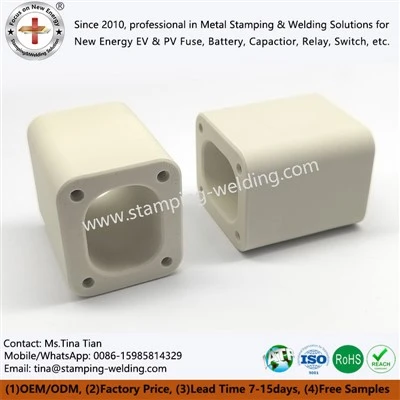
Xiamen Apollo Stamping Welding Technology supplies ceramic bodies for NH fuses and other electrical fuse assemblies. Material options include alumina and steatite ceramics, selected according to dielectric requirements, operating temperature, and mechanical loading. The ceramic housing provides electrical insulation, arc containment, and structural support within the specified fuse design.
For OEM projects, Apollo supports drawing review, ceramic body dimensional assessment and production coordination. Customers can specify NH size, ceramic composition, wall thickness, terminal interface, and surface finish. Engineering evaluation covers forming shrinkage, sintering dimensions, grinding allowances, and inspection criteria before production release.
Request a Factory Direct Quote
Explore Our NH Fuse Ceramic Body Product Catalog
Compare NH ceramic housings, alumina fuse bodies, and related electrical insulation components for your application.
-
![Alumina Ceramic Insulator For NH/Blade Type Fuses]()
Alumina Ceramic Insulator For NH/Blade Type Fuses
Add to Inquiry -
![Fuse Ceramic]() Add to Inquiry
-
![Porcelain Ceramic Tube For Electrical Fuse]()
Porcelain Ceramic Tube For Electrical Fuse
Add to Inquiry -
![Electrical Insulators Of Ceramic Materia]()
Electrical Insulators Of Ceramic Materia
Add to Inquiry -
![Ceramic HRC Fuse Body]() Add to Inquiry
-
![Electrical Insulators Steatite Ceramic]()
Electrical Insulators Steatite Ceramic
Add to Inquiry -
![Fuse Link Ceramic Body]() Add to Inquiry
-
![Fuse Ceramic Tubes]() Add to Inquiry
-
![Fuse Ceramic For Bussmann]() Add to Inquiry
-
![Ceramic Bodies For DC Fuse Link]()
Ceramic Bodies For DC Fuse Link
Add to Inquiry -
![Ceramic Bodies For Fuse]() Add to Inquiry
-
![Ceramic Body For DC Fuse Link]() Add to Inquiry



Material Standards, Tooling & Forming Processes
NH fuse ceramic bodies provide the structural support and electrical insulation surrounding the fuse element. The material must retain its geometry and insulating properties under the thermal and mechanical conditions specified for the complete fuse assembly. Alumina ceramic is commonly selected for applications requiring electrical insulation, heat resistance, and mechanical rigidity.
The required alumina content should be specified on the drawing or material specification. A 95% alumina formulation and a 99% alumina formulation are not interchangeable by default: composition, sintering conditions, porosity, grain structure and finishing affect the final properties. Where steatite is specified, its composition and material properties should be evaluated separately rather than applying alumina data to the part.
Ceramic Forming and Dimensional Control
NH ceramic bodies may use dry pressing, extrusion, or another suitable forming method, depending on their geometry and material formulation. The green body must be designed around the shrinkage expected during drying and sintering. Tool dimensions alone do not establish the final part dimensions.
After sintering, critical interfaces may require grinding or other precision finishing. For square and rectangular NH fuse bodies, inspection may cover:
Internal aperture dimensions and alignment.
Overall length, width and height.
Wall thickness and corner geometry.
End-face flatness and parallelism.
Surface chips, cracks, pores and edge damage.
Fit with metallic end caps, terminals or mounting components.
The applicable tolerance should be assigned to each critical feature on the drawing. A nominal tolerance of ±0.01 mm may be appropriate for selected finished features when the material, geometry, machining process, and measurement method support it; it should not be applied indiscriminately to every as-fired ceramic surface.
NH Fuse Ceramic Body Specifications
| Parameter | Engineering requirement | Verification method |
| Ceramic material | Alumina or specified steatite grade | Material declaration and supplier certificate |
| Alumina content | 95% or 99% when specified | Approved material specification |
| Forming method | Dry pressing, extrusion, or another qualified process | Process documentation |
| Final dimensions | Per approved component drawing | Calibrated gauges, optical measurement, or CMM where suitable |
| Surface condition | No cracks or chips beyond agreed acceptance criteria | Visual inspection and specified defect assessment |
| Flexural strength | Grade-specific requirement | Material test report or agreed test method |
| Dielectric strength | Grade- and specimen-specific requirement | Test under defined electrode, thickness, and conditioning conditions |
| Thermal performance | Based on specified operating and fault-related exposure | Material data and agreed thermal qualification |
| Porosity and density | Limits defined by material grade and drawing requirements | Density testing or other specified method |
The table defines the information to be agreed during engineering review. Actual values should come from the approved ceramic grade, product drawing, and verified inspection data rather than a generic industry range.
NH Geometry and Application Matching
NH fuse bodies are produced in different dimensional formats, including square and rectangular profiles. Selection should follow the required NH size, mounting interface, fuse element layout, and the dimensions of the end fittings. A ceramic body designed for one NH size should not be assumed to fit another size based solely on its external appearance.
For drawings requiring custom aperture dimensions or special terminal interfaces, the engineering review should account for the relationship between as-fired dimensions, grinding allowance, and the final mating fit.
Review the NH Fuse Ceramic Body product range to identify the relevant body type before requesting a drawing-based evaluation.
Advanced Joining, Insulation & Surface Treatments
The joining requirements of an NH fuse ceramic body depend on the terminal design and the method used to retain metallic components. Conventional ceramic bodies may be assembled with mechanical end fittings, while designs requiring a hermetic or brazed metal-to-ceramic interface may need a dedicated metallization and joining process.
Mo-Mn Metallization and Ceramic-to-Metal Joining
For ceramic assemblies designed for brazing, molybdenum-manganese (Mo-Mn) metallization may be used to prepare selected ceramic surfaces for a compatible metal joining system. The metallized layer, subsequent plating if required, braze alloy, and thermal cycle must be qualified as a combined system.
The design review should consider:
Metallization coverage and adhesion.
Surface preparation before brazing.
Ceramic-to-metal thermal expansion mismatch.
Joint geometry and residual stress after cooling.
Leak or bond-integrity requirements, where applicable.
Inspection criteria for voids, cracks and incomplete bonding.
Mo-Mn metallization is not required for every NH fuse ceramic body. It should be specified only when the assembly design calls for a ceramic-to-metal joining interface.
Electrical Insulation and Thermal Qualification
Electrical insulation performance depends on more than the ceramic's nominal dielectric strength. Component geometry, wall thickness, surface condition, contamination, electrode configuration, and test conditions affect the measured result. For high-voltage or high-current fuse applications, qualification should therefore use the actual component geometry or an agreed representative specimen.
Thermal qualification should reflect the intended service environment. Depending on the application, the test plan may include temperature cycling, thermal shock, insulation resistance measurements before and after exposure, and mechanical inspection for cracking or chipping.
For PV and energy storage equipment, the ceramic body must be matched to the complete fuse's operating voltage, current rating, and interruption requirements. The ceramic body alone does not establish compliance with the complete fuse's safety or breaking-capacity requirements.
Process Selection by Ceramic Assembly
| Assembly requirement | Potential process | Main verification item |
| Standard NH ceramic body | Forming, sintering and finish grinding | Dimensions, cracks and surface condition |
| Precision internal aperture | Post-sinter grinding | Bore size, alignment and surface finish |
| Ceramic body with metal interface | Qualified metallization and brazing where specified | Bond integrity and thermal compatibility |
| Insulating body for harsh environments | Material-specific surface or moisture-control measures where required | Insulation performance after environmental exposure |
| Custom EV or ESS fuse component | Drawing-specific forming and finishing route | Fit, insulation requirements, and component qualification |
Request Custom Technical Evaluation
Quality Control & Certifications at Apollo
Quality control for NH fuse ceramic bodies should address raw material identity, forming consistency, sintering defects, final dimensions, and electrical insulation requirements. The inspection plan must distinguish between checks performed on the raw ceramic material, finished individual components, and the assembled fuse.
Incoming Material and Process Inspection
Incoming material verification should confirm the approved ceramic grade and its relevant certificate or test report. During forming and sintering, process records should identify the material batch, process route, and applicable furnace or production parameters. Finished bodies should be inspected for dimensional deviations, cracks, chips, visible pores, and damage around apertures or edges.
For critical dimensions, calibrated gauges, optical measurement equipment or CMM systems may be used where appropriate to the geometry and measurement uncertainty. Ceramic parts require suitable fixturing and handling to avoid damage during measurement.
Electrical and Mechanical Testing
The test plan should be defined according to the product drawing and the qualification requirements of the complete fuse. Depending on the design, it may include:
Dielectric strength testing under specified voltage and duration.
Insulation resistance measurement under defined conditions.
Flexural strength verification for the approved material grade.
Thermal cycling or thermal shock evaluation.
Dimensional inspection of critical interfaces.
Inspection of metallized or brazed joints, if applicable.
A withstand-voltage test on a ceramic specimen is not a substitute for type testing of the complete fuse. Likewise, an internal-defect inspection method should be specified only where it is technically suitable for the ceramic geometry and defect type being assessed.
Quality Documentation and Traceability
Apollo identifies ISO 9001:2015 and IATF 16949 among its quality-system credentials. For programs requiring automotive-style approval, the customer and supplier should agree on the applicable PPAP submission level and deliverables. A PPAP Level 3 package, when required and available for the project, may include the process flow, PFMEA, control plan, material evidence, dimensional results, and process capability data.
Production Lot Control
A practical traceability system should connect ceramic material batches, forming and sintering records, finishing operations and final inspection results. For repeat orders, this information helps determine whether a dimensional shift originates from material variation, sintering behavior or post-sinter machining.
Packaging should protect ceramic bodies against impact, edge chipping, contamination and movement during transport. Inner partitions and cushioning should be selected according to component size, weight, and fragility. Each shipment should carry the agreed part identification and lot information.
Frequently Asked Questions
Q: 1. What is the difference between 95% and 99% alumina ceramic bodies?
A: The alumina percentage indicates the nominal composition, but it does not independently determine every mechanical, thermal, or electrical property. Sintering density, impurities, grain structure, and surface finish also affect performance. The correct grade should be selected using the fuse design requirements and verified material data.
Q: 2. Can an NH fuse ceramic body be customized to ±0.01 mm tolerance?
A: A ±0.01 mm tolerance may be feasible for selected machined features, depending on geometry, material condition, and inspection method. It should not be assumed for every as-fired dimension. Submit the drawing with critical dimensions identified so the supplier can assess grinding allowance, measurement uncertainty and process capability.
Q: 3. How should dielectric strength be specified for an NH fuse ceramic body?
A: Specify the ceramic grade, specimen or component thickness, electrode arrangement, test voltage, duration, and conditioning requirements. Dielectric strength values measured on standardized specimens may not directly represent the finished component. The complete fuse must also undergo the electrical qualification required for its intended rating and application.
Q: 4. Is Mo-Mn metallization required for every fuse ceramic body?
A: No. Mo-Mn metallization is generally relevant when a ceramic surface must be joined to metal through a compatible brazing system. Standard NH fuse bodies may use different assembly methods and may not require metallization. The joining route should follow the drawing, terminal design, and required bond integrity.
Request a Custom NH Fuse Ceramic Body Evaluation
NH fuse ceramic body selection requires agreement on material grade, final dimensions, electrical insulation requirements, and the mechanical interface with the fuse assembly. Send your drawings and operating conditions for a manufacturing feasibility review.
Submit 2D drawings in .DWG or PDF format, 3D models in STEP format, or a specification sheet covering ceramic composition, NH size, critical dimensions, operating voltage, thermal exposure, and any metal-to-ceramic joining requirements.
Apollo can review the supplied information to identify forming and sintering considerations, finishing requirements, inspection methods, and documentation needs. A preliminary DFM review and quotation can be targeted within 24 hours for complete inquiries, subject to drawing complexity and the availability of required technical information.
We're well-known as one of the leading nh fuses ceramic body manufacturers and suppliers in China. Please feel free to buy high quality nh fuses ceramic body at competitive price from our factory. For more information, contact us now.
