

Server Cabinet Manufacturer for Custom 19-Inch Data Center Racks
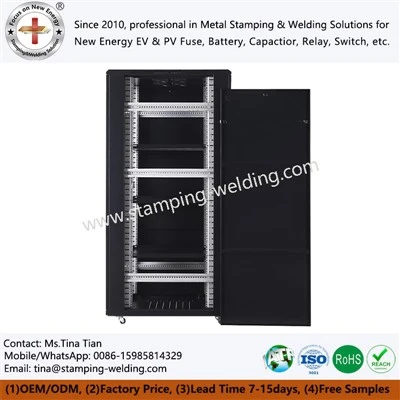
Xiamen Apollo Stamping Welding Technology manufactures custom server cabinets and sheet metal rack enclosures for data centers, network infrastructure, and industrial computing systems. Our fabrication options include cold-rolled steel, galvanized steel, and aluminum, with CNC laser cutting, punching, precision bending, frame welding, and powder coating. Cabinet structures are specified according to rack height, equipment depth, static loading and installation requirements.
Server Cabinet Manufacturing Options
Rack Configurations: 15U, 42U and other project-defined rack heights.
Mounting Interface: 19-inch equipment mounting, based on applicable EIA-310 requirements.
Materials: Cold-rolled steel, galvanized steel and specified aluminum alloys.
Structure: Welded frames, adjustable mounting rails, removable side panels and lockable doors.
Airflow: Perforated doors, fan mounting panels and cable management provisions.
Surface Finish: Electrostatic powder coating with specified RAL colors and coating requirements.
Request a Factory Direct Quote
Explore Our Electrical Cabinet Product Catalog
Compare server racks, energy storage enclosures, EV charging cabinets, and industrial control cabinets for different installation environments.
-
![Outdoor Server Rack]() Add to Inquiry
-
![Wall Mount Rack Enclosure]() Add to Inquiry
-
![Outdoor Network Cabinet]() Add to Inquiry
-
![15u Server Rack]() Add to Inquiry
-
![Network Server Rack]() Add to Inquiry
-
![Network Rack Cabinet]() Add to Inquiry
-
![Small Server Cabinet]() Add to Inquiry
-
![Enclosed Server Rack With Cooling]()
Enclosed Server Rack With Cooling
Add to Inquiry -
![Enclosed Server Rack]() Add to Inquiry
-
![Home Network Rack]() Add to Inquiry
-
![42u Server Rack]() Add to Inquiry
-
![Server Enclosure]() Add to Inquiry



Material Standards, Tooling & Forming Processes
Server cabinets combine structural sheet metal, mounting rails, access panels and cable management features in a defined equipment envelope. Material selection depends on the cabinet's dimensions, specified static load, installation environment, corrosion exposure, and required surface finish.
Cold-rolled steel is commonly used for server cabinet frames, doors and panels because it supports punching, laser cutting, bending and welding. Material thickness should be selected by component function rather than applying one gauge to the entire cabinet. Load-bearing uprights, base frames and mounting rails may require different section geometries or reinforcement from side panels and doors.
For standard rack-mounted equipment, the mounting interface should be designed around the specified rack standard. EIA-310 defines key requirements for 19-inch rack mounting interfaces; the cabinet drawing must also define usable depth, rail adjustment range, U-position spacing, and clearance for equipment handles, connectors, and cable bends.
Apollo can review the customer's cabinet drawings to identify sheet metal forming constraints, bend reliefs, weld access, fastening positions and assembly clearances before tooling or production begins.
Server Cabinet Specifications
| Parameter | Engineering requirement | Verification method |
| Cabinet material | Cold-rolled steel or specified alternative | Material certificate and incoming inspection |
| Sheet thickness | Defined separately for frame, panels, doors and rails | Thickness gauge |
| Rack mounting interface | 19-inch interface where specified; EIA-310 requirements as applicable | Dimensional inspection and mounting gauge |
| Rack height | Specified in rack units, such as 15U or 42U where offered | Dimensional inspection |
| Cabinet depth | Based on equipment depth, connector clearance, and cable routing | Drawing verification |
| Static load capacity | Defined by the approved cabinet configuration and test plan | Load test under specified conditions |
| Door and panel alignment | Drawing-defined gaps, flatness, and closure requirements | Gauge and dimensional inspection |
| Surface finish | Specified powder coating, color and corrosion performance | Coating inspection and agreed test method |
| Grounding provisions | Designated bonding points and required continuity | Electrical continuity measurement |
The table describes the engineering items to specify; it does not establish a universal product configuration. Final values should be confirmed against the selected model and approved drawing.
Forming and Structural Assembly
Server cabinet fabrication generally involves several interdependent processes:
Laser cutting and punching: Create mounting slots, ventilation patterns, cable entries, and fastening holes. Hole position and edge condition must remain compatible with subsequent bending and assembly.
CNC bending: Control bend angles, flange lengths, and panel geometry. Springback compensation depends on material grade, thickness, tooling, and bend radius.
Frame welding: Control weld sequence and heat input to limit distortion of mounting surfaces and door openings.
Rail and panel assembly: Verify rail parallelism, usable mounting depth, fastening access, and alignment of removable panels.
Tooling and fixture control: Use repeatable datums and assembly fixtures to reduce variation between production lots.
For rack configurations focused on network hardware, see Network Server Rack.
Load and Dimensional Design
A server cabinet's nominal dimensions alone do not establish its usable equipment capacity. Engineering review should consider the weight distribution of installed devices, rail attachment points, floor loading, cabinet anchoring, and the required safety margin.
Where load testing is required, the acceptance criteria should define the test load, loading positions, duration, deformation limits, and post-test inspection. Static load results should not be presented as dynamic load ratings unless dynamic performance has been separately evaluated.
Advanced Joining, Insulation & Surface Treatments
The joining and finishing processes affect frame stiffness, panel fit, corrosion resistance and electrical bonding. Server cabinets generally use a combination of welded structural joints, bolted assemblies, captive fasteners and removable panels. The method selected for each joint should reflect the load path, maintenance requirements, and access needed during installation.
Welding and Fastening
Welded frames provide permanent structural connections, while bolted rails, doors and panels allow adjustment or replacement. Welding sequence and fixture design should control distortion around mounting rails, door openings and cabinet corners.
Inspection should address weld appearance, joint continuity where specified, alignment, and any required mechanical testing. Where the cabinet contains detachable panels, the design should provide repeatable locating features and secure fasteners to maintain alignment after maintenance.
Powder Coating and Corrosion Protection
Powder coating can provide a durable external finish when the steel surface is properly prepared. The coating specification should define color, gloss, film thickness, pretreatment, adhesion, and corrosion-test requirements.
For cabinets used in indoor data centers, the finish requirements may differ from those for industrial or outdoor installations. An outdoor cabinet may need additional sealing, corrosion protection, and environmental testing; IP65 or IP66 should only be specified when the completed enclosure has been designed and verified to meet the relevant protection requirements.
Airflow, Cable Routing and Grounding
Thermal management begins with the cabinet layout. Perforated doors, fan mounting positions, cable routing and equipment spacing should be coordinated with the intended cooling system. A cabinet's ventilation openings alone do not establish cooling capacity; thermal performance depends on airflow, heat load, pressure drop, and the surrounding room or cooling infrastructure.
Cable entry locations and vertical management channels should allow power and data cables to be routed without obstructing ventilation or preventing access to serviceable components.
Grounding provisions should identify bonding points for the frame, doors, and relevant conductive panels. Electrical continuity requirements should be established in the design specification and verified using an agreed test method.
For fully enclosed cabinet structures, see Server Enclosure.
Request Custom Technical Evaluation
Quality Control & Certifications at Apollo
Server cabinet quality depends on dimensional accuracy, frame rigidity, mounting compatibility, finish consistency, and assembly repeatability. The inspection plan should be based on the approved drawing and the intended equipment configuration.
Dimensional and Assembly Inspection
Dimensional checks can cover cabinet width, height, depth, mounting hole positions, rail parallelism, door clearances and panel alignment. Optical measuring systems, calibrated gauges, and CMM equipment may be selected according to the size and geometry of the feature being inspected.
Inspection should also verify that removable panels fit correctly, locks and hinges operate as specified, mounting rails remain aligned and cable entries match the approved layout. Where the cabinet includes optional fan trays, PDU brackets, or accessories, these interfaces should be checked against the corresponding installation requirements.
Structural and Electrical Verification
Where required by the project, a load test can evaluate structural behavior under a defined load configuration. The test report should identify the tested cabinet model, load distribution, duration, measurement points, and acceptance criteria.
Grounding continuity tests should follow the agreed electrical specification. Coating inspections may include visual checks, film thickness measurements, and adhesion or corrosion tests where specified. IP protection testing is relevant only when the cabinet is designed as an enclosure with a defined ingress protection rating.
Quality Documentation and Traceability
For projects requiring formal quality documentation, the inspection plan can include:
Approved engineering drawings and revision records.
Material certificates and incoming inspection records.
First-article dimensional inspection reports.
Welding and coating process records where applicable.
Load test results and electrical continuity records when required.
Final inspection reports, packing records, and production lot identification.
Apollo's applicable quality-system certifications and their scope should be confirmed during supplier qualification. IATF 16949, ISO 9001 and PPAP Level 3 should only be cited as applicable to the specific facility, process and customer program after verification. PPAP Level 3 is generally relevant to customer-defined automotive approval processes, not a universal requirement for every server cabinet purchase.
Production Consistency and Delivery
Repeat orders should use controlled drawing revisions, defined inspection points, and documented acceptance criteria. Packaging should protect cabinet corners, coated surfaces, door hardware, and mounting rails from deformation and abrasion during shipment.
For projects with multiple cabinet configurations, a bill of materials and revision-controlled assembly drawing can reduce the risk of incorrect panel, rail, or accessory combinations during production.
Frequently Asked Questions
Q: 1. What information is required to manufacture custom server cabinets?
A: Provide the overall width, height, and depth, rack height in U, mounting interface, equipment dimensions, required static load, material and finish specifications. Include door ventilation, cooling provisions, cable entry positions, grounding requirements, and accessories. A 2D drawing or 3D CAD model allows engineering review before quotation and tooling assessment.
Q: 2. How should the static load capacity of a server cabinet be specified?
A: Define the total installed equipment weight, load distribution, mounting rail configuration, and cabinet anchoring method. The supplier should state whether the rating is static or dynamic and provide test conditions where testing is required. Do not compare load ratings unless the test configurations and acceptance criteria are equivalent.
Q: 3. How can server cabinet airflow be evaluated before production?
A: Review equipment heat dissipation, front-to-back airflow direction, door perforation, fan locations, cable obstruction, and the intended cooling system. For high-density racks, thermal analysis or prototype testing may be necessary. Ventilation openings alone do not prove that a cabinet can maintain a specified operating temperature.
Q: 4. Can a custom server cabinet accommodate standard 19-inch rack equipment?
A: Yes, when the mounting interface is designed for the specified 19-inch rack requirements, and the cabinet provides sufficient usable depth and clearance. Confirm the equipment rail spacing, U-position layout, connector depth, cable bend radius, and accessory positions against the intended server and network hardware before production release.
Request a Custom Server Cabinets Quote
A server cabinet should be specified around the equipment it must support, the available installation space, and the cooling and cable routing requirements. Provide your cabinet drawings and performance criteria so Apollo can assess the fabrication and assembly requirements before production.
Submit 2D drawings in .DWG or PDF format, 3D models in STEP format, or a specification covering rack height, cabinet depth, material thickness, static load, mounting rail layout, door configuration, surface finish, and grounding provisions.
Apollo can review the supplied information for manufacturability, forming and welding considerations, assembly tolerances, and inspection planning. A preliminary DFM review and factory-direct quotation can be arranged once the drawing package and technical requirements are sufficiently complete.
We're well-known as one of the leading server cabinet manufacturers and suppliers in China. Please feel free to buy high quality server cabinet at competitive price from our factory. For more information, contact us now.
