

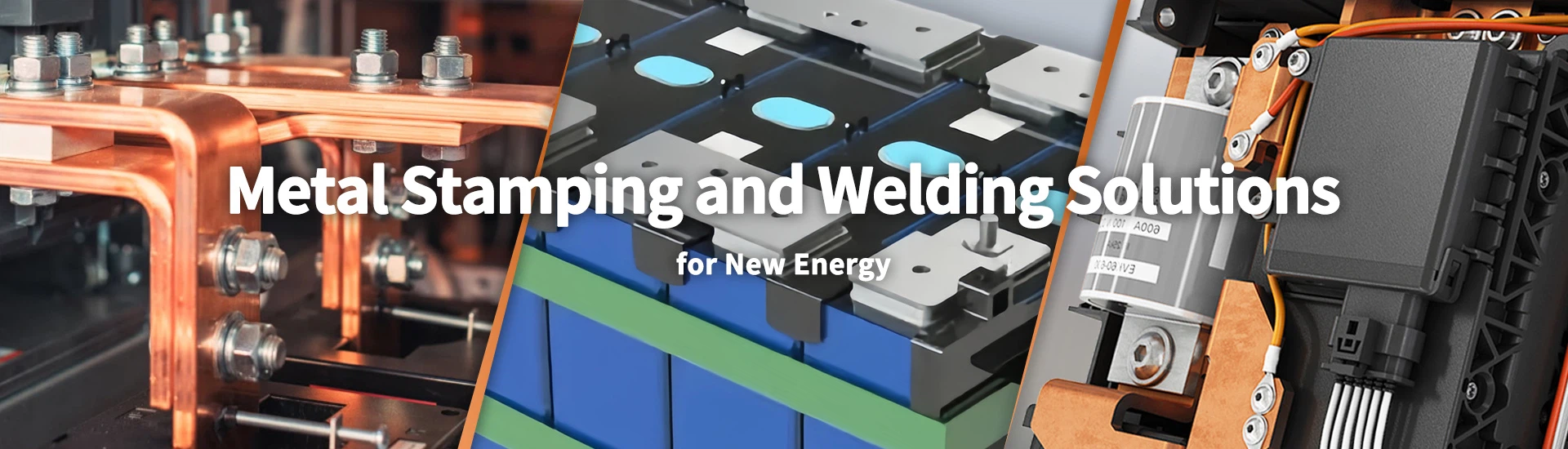
Storage Battery Cell and Pack Manufacturer for Energy Storage Systems
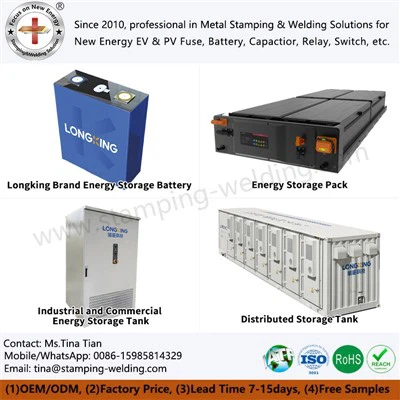
Xiamen Apollo supplies LiFePO4 storage battery cells and energy storage battery packs for residential, commercial, industrial, and utility-scale applications. Product options include 280Ah and 314Ah LFP cells, modular battery packs, and integrated energy storage configurations. Cell specifications are evaluated according to capacity, energy density, internal resistance, cycle life, and operating temperature requirements.
For energy storage projects, Apollo supports battery configuration selection, Pack structural design, and OEM project coordination.
Engineering evaluation covers series and parallel connections, BMS integration, thermal management, electrical insulation, and enclosure protection. Customers can submit system voltage, capacity, installation dimensions, and operating conditions for technical review, quotation, and delivery planning.
Request a Factory Direct Quote
Explore Our Storage Battery Cell and Pack Product Catalog
Compare LFP storage battery cells, modular battery packs, and integrated energy storage products for your project requirements.
-
![Battery Case And Cover]() Add to Inquiry
-
![314Ah Storage Battery Cell And Pack]()
314Ah Storage Battery Cell And Pack
Add to Inquiry -
![Aluminum Battery Box Cover]() Add to Inquiry
-
![Aluminum Case For Powerwall Lithium Battery Pack]()
Aluminum Case For Powerwall Lithium Battery Pack
Add to Inquiry -
![Lifepo4 Power Cells]() Add to Inquiry
-
![Modular Energy Storage For C&I]()
Modular Energy Storage For C&I
Add to Inquiry -
![Solar Home Energy Storage Lithium-ion Battery]()
Solar Home Energy Storage Lithium-ion Battery
Add to Inquiry -
![Lithium Dry Cell Battery Aluminum Shell]()
Lithium Dry Cell Battery Aluminum Shell
Add to Inquiry -
![Aluminum Case For Motor Replacement Lead Acid Battery Pack]()
Aluminum Case For Motor Replacement Lead Acid Battery Pack
Add to Inquiry -
![New Energy Aluminum Battery Cases]()
New Energy Aluminum Battery Cases
Add to Inquiry -
![Car Battery Stop Start EFB Battery]()
Car Battery Stop Start EFB Battery
Add to Inquiry -
![Solar Battery Storage For House]()
Solar Battery Storage For House
Add to Inquiry



Material Standards, Tooling & Forming Processes
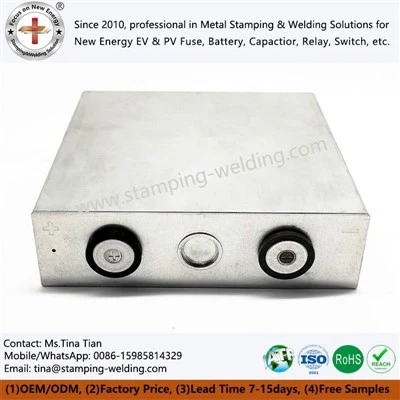
New energy battery projects involve two distinct procurement categories: electrochemical products, including storage battery cells and packs, and the metal components that enclose, protect, and connect them. These categories require different specifications and acceptance criteria. Cell and pack selection depends on electrical performance and system configuration, while enclosure manufacturing depends on material properties, forming geometry, joining quality, and dimensional control.
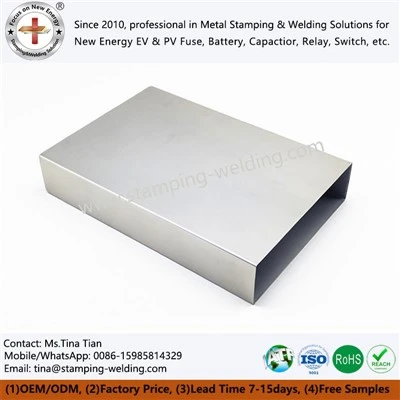
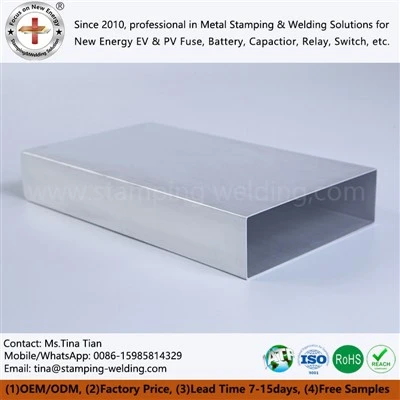
Aluminum Battery Cases and Cover Plates
For prismatic battery enclosures, 3003 aluminum alloy is commonly considered where formability and corrosion resistance are required. Other grades, including 5052 or 6061, may be selected where strength, forming behavior, welding compatibility, or structural requirements justify the choice. The final grade and temper should be confirmed against the approved engineering drawing and applicable material specification.
Deep drawing and multi-stage stamping form the case walls, bottom radii and opening profile. Material thickness, blank dimensions, punch geometry and lubrication affect wall thinning, wrinkling and cracking. Tool design should account for the required drawing ratio, corner radii and springback. For cover plates, critical features may include terminal openings, sealing surfaces, pressure-relief valve seats and insulating component locations.
The case and cover must also be evaluated as a connected assembly. A cover that meets its individual dimensional tolerances may still create sealing or assembly problems if the case opening, weld gap, or terminal alignment is outside the specified range.
Storage Battery Cells and Packs
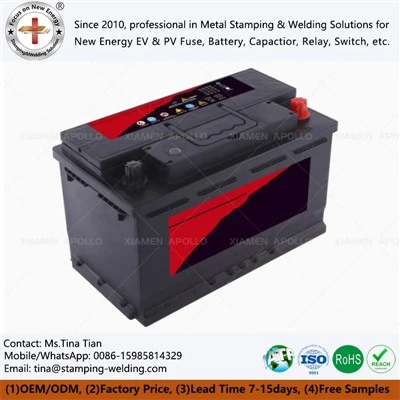
Cell and pack specifications should be established separately from enclosure specifications. Lithium iron phosphate (LiFePO4 or LFP) and other lithium-ion chemistries have different voltage profiles, operating limits, and qualification requirements. Rated capacity alone does not establish interchangeability.
For storage battery cells, procurement documentation should identify:
Cell chemistry and format, such as prismatic or cylindrical.
Rated capacity in Ah and nominal voltage.
Permitted charge and discharge conditions.
Operating and storage temperature ranges.
Cell dimensions, terminal configuration and polarity.
Required safety, transport and performance documentation.
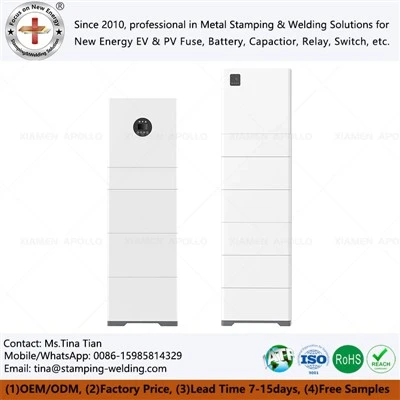
For a storage battery pack, the specification should additionally identify series and parallel configuration, nominal and maximum voltage, continuous and peak current, BMS functions, thermal management, mechanical interfaces and installation conditions.
Technical Specification Table
| Parameter | Battery cell or pack | Aluminum case and cover |
| Product definition | Cell chemistry, pack configuration and electrical rating | Enclosure geometry and structural function |
| Typical material | Electrochemical cell materials defined by the cell manufacturer | 3003, 5052, or other drawing-approved aluminum alloy |
| Key specification | Ah capacity, voltage, current, and operating limits | Alloy grade, temper, thickness, and formed geometry |
| Forming process | Cell manufacturing and pack assembly processes | Deep drawing, stamping, trimming and machining |
| Joining process | Cell interconnection and pack assembly as designed | Laser welding or other qualified joining method |
| Critical checks | Electrical performance, insulation, and required safety tests | Wall thickness, flatness, weld integrity, and dimensional conformity |
| Sealing requirements | Defined by cell or pack enclosure design | Leak-rate limit and test method specified by the customer |
| Traceability | Cell or pack lot and serial identification | Material lot, production batch, and inspection records |
The parameters in this table describe the required specification fields. They are not universal performance limits. The accepted values must be confirmed against the selected cell, pack design, or component drawing.
For enclosure-specific manufacturing details, see Aluminum Battery Case and Cover.
Advanced Joining, Insulation & Surface Treatments
Battery enclosure joining must satisfy the specified structural load, dimensional stability, and sealing requirements. Laser welding is commonly considered for aluminum battery cases and cover plates because it can produce localized joints with controlled heat input.
Actual weld penetration, bead geometry, and distortion depend on alloy, temper, thickness, joint gap, laser settings, and fixture design.
For a prismatic cell cover, the joining plan should define the weld path, permissible discontinuities, inspection method, and leakage acceptance criterion. Terminal joints require separate attention because electrical resistance, mechanical strength, and thermal loading differ from those of the enclosure seam.
Laser Welding and Leak Integrity
Laser welding can join the cover plate to the case and can be used for specified terminal or safety-component joints. Process qualification should establish a suitable parameter window and confirm that the weld does not compromise adjacent insulation or pressure-relief features.
Where the design requires a hermetic enclosure, helium mass-spectrometer leak testing may be used. The target leakage rate, test pressure, fixture configuration, and test method must be agreed upon for the actual product. A value such as this should only be stated as a product requirement when supported by the design specification and validated test capability.
Insulation and Surface Protection
Insulation components around battery terminals must prevent unintended electrical contact between conductive parts and the enclosure. Depending on the design, the assembly may use polymer insulating rings, molded insulating supports, insulating films, or qualified coatings. Material selection should account for operating voltage, creepage and clearance distances, temperature exposure, electrolyte compatibility, and mechanical retention.
Surface treatment for aluminum cases and covers may include anodizing, conversion coating or other specified finishes. The choice should consider corrosion exposure, electrical bonding points, coating adhesion and weld-area requirements. Coating thickness and coverage should not interfere with grounding interfaces, sealing surfaces, or terminal assembly.
Safety Valve and Sealing Nail Integration
Where a cover plate incorporates a pressure-relief valve or sealing nail, the component drawing should specify its location, joining method, and functional acceptance criteria. The safety valve opening pressure must be defined and validated against the battery design. A leak test alone does not demonstrate that a pressure-relief mechanism will open within its specified range.
Request Custom Technical Evaluation
Quality Control & Certifications at Apollo
Quality control for new energy battery products should be divided into electrical product validation and metal component inspection. Battery cells and packs require product-specific electrical, thermal, insulation, and safety verification. Aluminum cases and covers require material traceability, dimensional inspection, weld evaluation, and sealing checks where applicable.
Inspection for Aluminum Cases and Cover Plates
A drawing-based inspection plan should identify critical dimensions, inspection frequency, and acceptance criteria. Depending on part geometry, dimensional verification may use CMM equipment, optical measurement systems, calibrated gauges or dedicated fixtures.
For welded enclosures, inspection can include visual examination, dimensional checks, and a qualified leak test. Destructive weld-section analysis or other non-destructive testing may be specified according to joint design and risk. Pressure-relief valve opening tests should be performed under an approved procedure where the component design requires them.
Recommended control points include:
Incoming alloy grade, material condition, and thickness.
Formed wall profile, opening dimensions and cover flatness.
Terminal-hole position and insulating component interfaces.
Weld appearance, joint continuity and distortion.
Leakage performance against the specified test method.
Traceability between material batches, production lots and inspection records.
Quality Systems and Documentation
Apollo identifies ISO 9001 and IATF 16949 among its quality-system credentials. The applicable certification scope should be confirmed for the manufacturing site and product being quoted.
For automotive projects, PPAP Level 3 documentation may be required by the customer. Depending on the agreed submission level and project requirements, the package may include a process flow diagram, PFMEA, control plan, material certificates, dimensional results, measurement-system evidence and process capability data.
Battery cell or pack compliance documentation must be assessed separately from metal component quality documentation. The enclosure supplier's inspection report cannot substitute for the cell manufacturer's electrical safety validation or the complete pack's qualification records.
Supply Planning and Batch Traceability
For repeat orders, the supply plan should define forecast volumes, release quantities, approved revisions, sample approval milestones, and packaging requirements. Cell and pack orders should also specify manufacturing dates or shelf-life requirements where applicable. For metal components, traceability should connect the material lot and production batch to the relevant inspection results.
Packaging should protect aluminum cases from deformation and prevent scratches, contamination, or damage to sealing surfaces. Battery cells and packs require packaging and transport arrangements appropriate to their chemistry, condition, and applicable dangerous-goods requirements.
Frequently Asked Questions
Q: 1. What information is required to select a storage battery cell?
A: Provide the required chemistry, rated capacity, nominal voltage, dimensions, terminal arrangement, operating temperature range, and charge-discharge limits. For a pack application, also define the series-parallel configuration, continuous and peak current, BMS requirements, and installation environment. These details determine whether the proposed cell is electrically and mechanically compatible.
Q: 2. Which aluminum alloy is suitable for a prismatic battery case?
A: 3003 aluminum is commonly considered for deep-drawn enclosures because of its formability. Other alloys, including 5052 or 6061, may suit different strength or manufacturing requirements. Final selection depends on drawing depth, wall thickness, joining method, corrosion exposure, and required mechanical performance. Confirm the grade and temper before tooling approval.
Q: 3. How is leakage performance verified for a welded battery cover?
A: The required leak-rate limit and test method should be established from the enclosure design. Helium mass-spectrometer testing can be used for specified high-sensitivity applications, while other validated methods may suit different requirements. Test pressure, fixture sealing, calibration, and acceptance criteria must be defined before results can be compared.
Q: 4. Can Apollo supply both storage battery packs and custom aluminum battery enclosures?
A: Apollo's category lists storage battery cells, storage battery packs, aluminum cases and cover plates. For a new project, confirm the exact product scope, cell chemistry, electrical ratings, and sourcing arrangements. For custom metal components, provide drawings, material requirements, annual volume, and inspection criteria so the manufacturing feasibility and quotation can be assessed.
Request a New Energy Battery or Custom Enclosure Quote
Send Apollo your battery cell or pack specification, or your 2D/3D CAD drawings for an aluminum case or cover. Include the required capacity, voltage, chemistry, dimensions, alloy grade, wall thickness, joining method, and applicable inspection criteria.
For enclosure projects, the engineering review can cover material selection, deep-drawing feasibility, weld design, dimensional control, and leak-test requirements. For cell or pack procurement, provide the electrical configuration, intended application, and required qualification documents so the product scope can be confirmed.
Complete technical information helps reduce quotation gaps and avoid tooling or sample revisions caused by missing specifications. A preliminary DFM review and factory-direct quotation can be targeted within 24 hours for complete inquiries, subject to project complexity and confirmation of the product scope.
We're well-known as one of the leading new energy battery manufacturers and suppliers in China. Please feel free to buy high quality new energy battery at competitive price from our factory. For more information, contact us now.
