

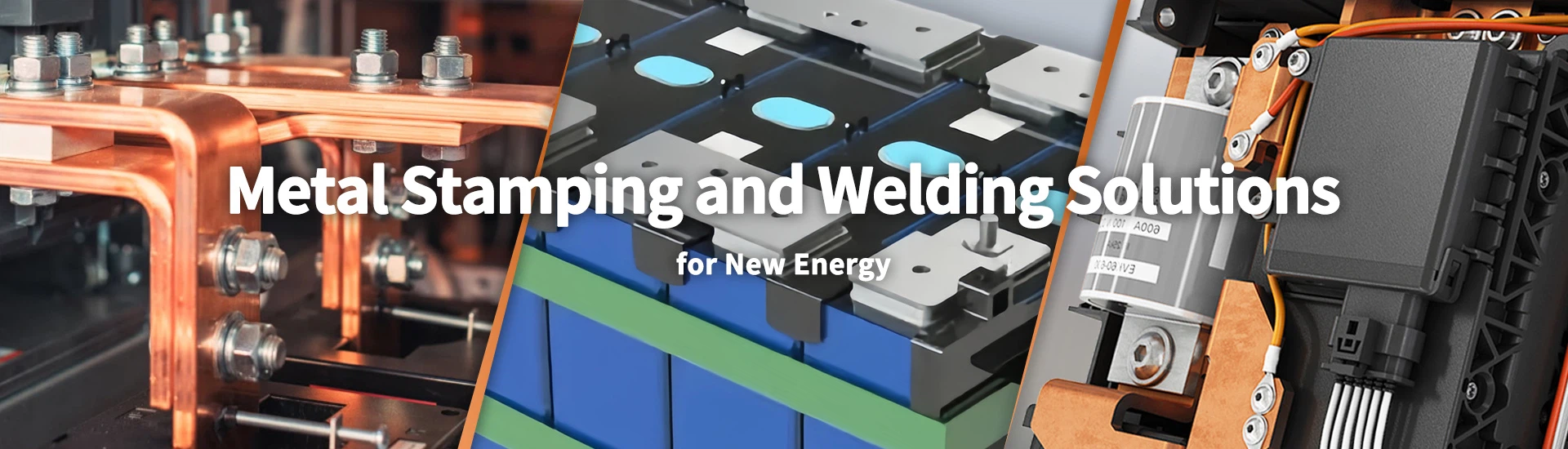
Custom Aluminum Battery Case Manufacturer for EV and Energy Storage Systems
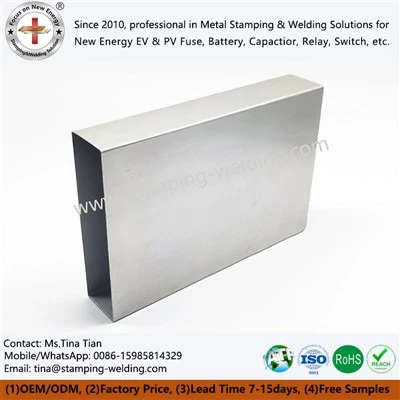
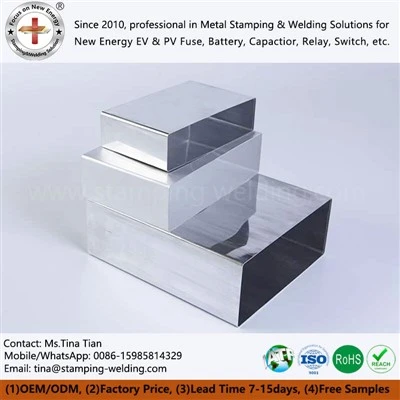
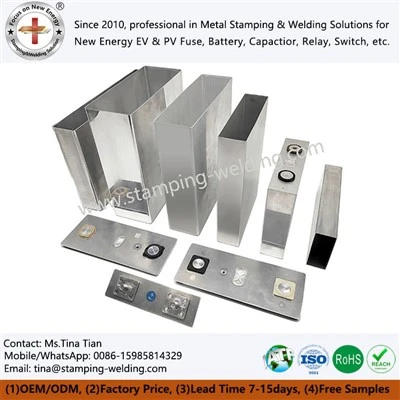
Xiamen Apollo Stamping Welding Technology manufactures custom aluminum battery cases for prismatic lithium-ion cells used in electric vehicles and energy storage systems. Our production focuses on 3003-H14 aluminum alloy, precision deep drawing, dimensional control, and formed shell structures. Material selection and forming parameters are determined by wall thickness, case geometry, and customer assembly specifications.
Battery Cover Plate manufacturing capabilities include:
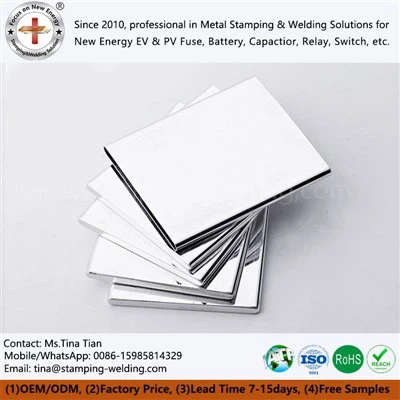
Aluminum Components: 3003-H14 cover plates, electrode plates, and connecting pieces.
Copper Components: T2Y2 copper negative terminals and nickel-plated copper connectors.
Insulation Components: PFA injection-molded parts, PP insulating gaskets, and PET adhesive films.
Safety Components: Explosion-proof valve integration and cover assembly structures.
Surface Treatment: Anodizing and ultrasonic cleaning according to component requirements.
Request a Factory Direct Quote
Explore Our Aluminum Battery Case Product Catalog
Review our aluminum battery case designs for EV power cells and energy storage applications, including custom dimensions and formed structures.
-
![Aluminum Case For Powerwall Lithium Battery Pack]()
Aluminum Case For Powerwall Lithium Battery Pack
Add to Inquiry -
![Aluminum Shell For Lithium Ion Prismatic Cell]()
Aluminum Shell For Lithium Ion Prismatic Cell
Add to Inquiry -
![Lithium Dry Cell Battery Aluminum Shell]()
Lithium Dry Cell Battery Aluminum Shell
Add to Inquiry -
![Aluminum Case For Motor Replacement Lead Acid Battery Pack]()
Aluminum Case For Motor Replacement Lead Acid Battery Pack
Add to Inquiry -
![New Energy Aluminum Battery Cases]()
New Energy Aluminum Battery Cases
Add to Inquiry -
![Aluminum Case For EV Electric Bus LiFePO4 Battery Pack]()
Aluminum Case For EV Electric Bus LiFePO4 Battery Pack
Add to Inquiry -
![Aluminum Case For Lithium-ion Batteries]()
Aluminum Case For Lithium-ion Batteries
Add to Inquiry -
![LiFePo4 Prismatic Battery Aluminum Cells]()
LiFePo4 Prismatic Battery Aluminum Cells
Add to Inquiry -
![Aluminum Li-ion Cells]() Add to Inquiry
-
![Aluminum Case For Primary Lithium Iron Battery LiFeS2]()
Aluminum Case For Primary Lithium Iron Battery LiFeS2
Add to Inquiry -
![LFP Battery Aluminum Case]() Add to Inquiry
-
![LiFePO Battery Pack]() Add to Inquiry





Material Standards, Tooling & Forming Processes
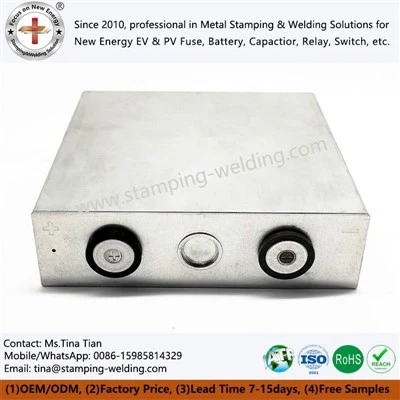
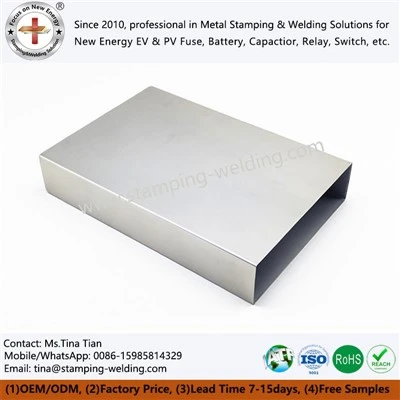
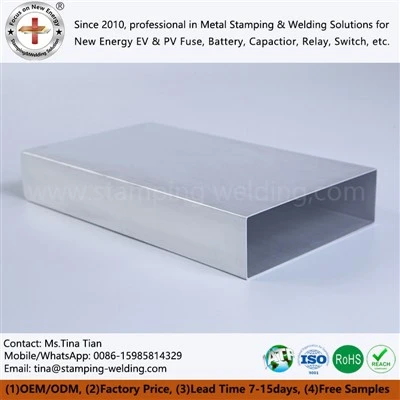
Aluminum battery case performance depends on alloy selection, sheet thickness, temper, forming depth, and the geometry of the finished enclosure. The 3003 and 3005 aluminum alloy families may be considered for drawn battery housings, subject to the required strength, corrosion resistance, formability, and component design. The final alloy and temper should be stated on the approved drawing or material specification.
Deep drawing converts flat aluminum sheet into a three-dimensional housing through controlled material flow between the punch, die and blank holder. Tooling design must account for draw depth, corner radii, blank-holder force, lubrication and material anisotropy. Poorly controlled conditions can cause wrinkling, local thinning, tearing or dimensional variation.
After forming, trimming, piercing and edge finishing establish the interfaces for the cover, terminal features and subsequent assembly operations. For battery housings with narrow dimensional tolerances, inspection should focus on the drawing-defined datums, sealing flange flatness, mounting features and critical wall sections rather than relying on external dimensions alone.
For custom projects, Apollo can review the proposed geometry and manufacturing sequence before tooling release. DFM review should identify potential forming risks, datum schemes, inspection access, and the dimensions that require first-article approval.
Aluminum Battery Case Specifications
| Parameter | Engineering specification | Verification method |
| Base material | 3003 or 3005 aluminum alloy, subject to design requirements | Material certificate and grade verification |
| Material temper | Specified according to forming and mechanical requirements | Material certificate |
| Sheet thickness | Defined by approved drawing | Calibrated thickness gauge |
| Forming process | Deep drawing, trimming, and piercing as required | Process inspection |
| Critical dimensions | Drawing-defined tolerances; ±0.01 mm only where feasible and validated | CMM or optical measurement |
| Wall thickness | Minimum and measurement locations defined by design | Thickness measurement |
| Cover interface | Flange flatness, joint gap, and alignment per drawing | Dimensional gauging |
| Surface condition | As-formed, cleaned, or coated according to specification | Visual and coating inspection |
| Sealing requirement | Defined leakage limit and test conditions, if applicable | Qualified leak test |
These entries define the parameters to be agreed for each project; they are not universal limits for every aluminum battery case.
Deep Drawing and Dimensional Stability
A production drawing should identify the nominal sheet thickness, material temper, critical dimensions, and allowable variation. For deep-drawn parts, the forming simulation or tooling trial should consider material flow and the risk of thinning at corners and sidewalls.
The inspection plan should distinguish between dimensions measured before and after joining. Welding may introduce distortion, particularly around long cover seams and thin flanges. A stable production process therefore needs suitable fixturing, a defined joining sequence, and final inspection of the assembled part.
For OEM programs, the tooling and forming review should also address:
Die clearance and forming radii appropriate to the selected alloy and thickness.
Blank-holder force and lubrication conditions.
Trimming burrs and flange edge quality.
Dimensional repeatability across tooling trials and production lots.
Measurement methods for difficult-to-access internal profiles.
Advanced Joining, Sealing & Surface Treatments
Aluminum battery case joining must meet the requirements of the enclosure design, sealing interface, and operating environment. Laser welding may be selected for cover seams or other defined joints when the material thickness, joint geometry, and process window are suitable. The welding procedure should specify joint preparation, fit-up gap, clamping, heat input, and the inspection method used to verify the finished seam.
For thin-walled aluminum housings, excessive heat input can cause distortion or localized thinning, while inconsistent fit-up can lead to incomplete fusion or porosity. Welding qualification should therefore use representative material, thickness, and joint geometry. Where required, sectioning, visual examination and leak testing provide different forms of evidence; no single inspection method verifies every failure mode.
Weld Seam and Sealing Requirements
The sealing specification should define whether the case is required to be liquid-tight, gas-tight, or compliant with a specific leak-rate limit. These requirements are not interchangeable. A visual inspection may detect surface discontinuities but cannot establish a numerical leak rate.
For helium mass spectrometer leak detection, the test procedure should identify the test configuration, tracer-gas method, instrument setup, background level, and acceptance threshold. A target such as this should only be stated where the product specification and validated test method support that limit.
Where the design includes a safety valve, its opening pressure and functional performance must be defined by the battery system requirements. The housing supplier should not infer a valve setting from the case dimensions alone.
Surface Protection and Assembly Interfaces
Surface treatment should be selected according to the battery chemistry, external environment, electrical isolation requirements, and contact interfaces. Cleaning and pretreatment may be required before coating or bonding. Coatings must not interfere with sealing surfaces, weld zones, terminal contact areas or specified grounding interfaces.
For components that require electrical insulation, the material system and finished coating thickness should be defined by the design specification. Dielectric breakdown voltage and insulation resistance should be verified under the specified test conditions rather than inferred from coating type alone.
Key process controls include:
Weld fit-up and clamping consistency.
Welding parameter monitoring and joint inspection.
Protection of sealing flanges from scratches and deformation.
Defined leak-test conditions and traceable results.
Control of coating thickness and masking around functional interfaces.
Request Custom Technical Evaluation
Quality Control & Certifications at Apollo
Quality control for aluminum battery cases should cover incoming material, formed geometry, joining integrity, and final enclosure acceptance. The inspection plan should be established from the approved drawing, product risk assessment, and customer requirements. Critical dimensions and sealing features should be identified before mass production so that the measurement method, sampling frequency and acceptance criteria remain consistent across production lots.
Dimensional inspection may use CMM equipment, optical measurement systems and calibrated gauges, selected according to component size, geometry and tolerance. Wall thickness should be checked at defined locations, especially where deep drawing produces significant changes in material distribution. Welded assemblies require separate inspection of the joint and the final case geometry.
For housings with specified sealing requirements, helium leak detection or another qualified leak-test method should be used according to the customer's test protocol. Burst-pressure testing, thermal cycling, and environmental exposure should be included only where required by the product design and validation plan.
Apollo identifies IATF 16949 and ISO 9001 among its quality-system credentials. For applicable automotive programs, PPAP Level 3 documentation can be scoped against customer requirements. Typical deliverables may include the process flow diagram, PFMEA, control plan, material certificates, dimensional results, and process capability studies where required.
Recommended Inspection Plan
| Production stage | Inspection focus | Quality record |
| Incoming material | Alloy grade, temper and sheet thickness | Material certificate and incoming inspection record |
| Tooling trial | Forming defects, wall thickness and dimensional stability | Trial report and first-article results |
| Forming and trimming | Cracks, wrinkles, burrs and critical dimensions | In-process inspection record |
| Cover joining | Weld appearance, joint consistency and distortion | Welding inspection record |
| Leak testing | Leakage rate under the specified test conditions | Leak-test report |
| Functional validation | Burst pressure or thermal cycling where applicable | Validation test report |
| Final inspection | Case geometry, interface condition, and packaging | Final inspection report and lot identification |
Material Traceability and Production Readiness
For repeat production, material lot numbers, tooling revisions, welding parameters, and inspection records should be traceable to the finished batch where required by the quality plan. This supports root-cause analysis when dimensional drift, weld defects, or leakage are detected.
Before volume release, the production plan should establish the approved drawing revision, sample approval status, control plan, inspection frequency and packaging requirements. Any proposed change to the alloy, temper, tooling, welding method, or sealing process should follow the customer's change-control procedure.
Frequently Asked Questions
Q: 1. Which aluminum alloy is suitable for a deep-drawn battery case?
A: 3003 and 3005 aluminum alloys may be considered depending on the required formability, strength, corrosion resistance, and finished geometry. The correct alloy and temper must be confirmed against the drawing and forming evaluation. Material selection should also account for wall thickness, draw depth, and downstream joining requirements.
Q: 2. How can manufacturers prevent cracks and wrinkles during aluminum battery case forming?
A: Tooling radii, blank-holder force, lubrication, material temper, and draw depth must be evaluated together. Forming trials should inspect corners, sidewalls, and flange regions for tearing, wrinkling, and local thinning. The approved process window should be documented before production quantities are released.
Q: 3. What leak-rate requirement should be specified for a welded aluminum battery housing?
A: The required leak rate depends on the enclosure design, internal environment, and customer validation standard. A helium leak target should only be adopted when specified and verified by a suitable test method. Test configuration, instrument capability, and acceptance criteria must be documented.
Q: 4. Can Apollo manufacture custom aluminum battery cases with welded covers and safety-valve interfaces?
A: Apollo can review drawings for aluminum battery housings and related metal components to assess forming, joining, and inspection requirements. Submit the case dimensions, material specification, weld locations, sealing criteria, and annual volume. Safety-valve opening pressure and functional acceptance criteria must be supplied by the product design authority.
Request a Custom Aluminum Battery Case Quote
Aluminum battery case tooling and joining processes should be evaluated against the actual component geometry, material specification, and sealing requirements before production release.
Submit your 2D drawing in .DWG or PDF format, 3D model in STEP format, or technical specification. Include the alloy and temper, sheet thickness, critical dimensions, cover-joint configuration, required leak rate, any burst-pressure criteria, and estimated annual demand.
Apollo can review the submitted information for DFM considerations, tooling feasibility, process selection, and inspection planning. A preliminary review and quotation can be targeted within 24 hours for complete inquiries, subject to drawing complexity and the availability of the required technical information.
We're well-known as one of the leading aluminum battery case manufacturers and suppliers in China. Please feel free to buy high quality aluminum battery case at competitive price from our factory. For more information, contact us now.
