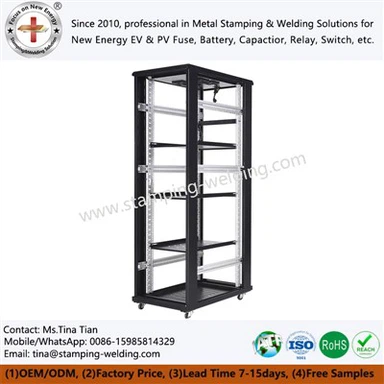
Comprehensive Industry Overview: From Principles to Selection and Trends of Fiber Optic Cabinets
Oct 29, 2025
Fiber Optic Cabinets play a critical role in today's optical-network infrastructure, yet many project-owners and procurement professionals lack a full understanding of their industry context. Below is a structured overview covering five key sections: definition & core functions; structural composition & working principle; selection & installation best-practices; industry challenges and emerging trends; and future development directions.
Definition & Core Functions
A Fiber Optic Cabinets solution is essentially a centralized enclosure that receives optical cable input, manages splicing/distribution, and safely routes fibers to downstream branches. From an operational standpoint this device provides:
Protection Function: It houses surge protection, circuit breakers or fuse modules within the fdh cabinet, shielding connected fibers and components from fault currents or short-circuit events.
Control & Distribution Function: Within the fiber optic distribution cabinet, optical modules, splitter trays and adapter panels are managed in an organized way, enabling downstream network segments to be switched, monitored or reconfigured.
Monitoring & Management Function: Modern fibre distribution cabinet installations incorporate sensors, metering modules or data-interfaces so that voltage, current, fiber count or link-status can be visualised via a network-management system.
Distribution Function: The core role of the high distribution cabinet is to take in the main trunk fiber line, split or branch it, and distribute it efficiently to various terminal loads while maintaining performance and servicing flexibility.
Understanding these functions helps procurement and engineering teams match project requirements with the correct cabinet type, capacity and configuration.

Structural Composition & Working Principle
A typical Fiber Optic Cabinets unit comprises the following major structural modules and underlying principles:
In-feed bus bar or input module: This is where the main fiber or cable trunk enters the unit, then is fed into the internal backbone of the fdh cabinet.
Switch/Breaker/Control unit: In the fiber optic distribution cabinet, this provides switching, fault isolation and protection mechanisms for each distribution branch.
Branch-out or feeder unit: The unit divides signal or power/fiber paths from the main bus to branch circuits or further splices within the fibre distribution cabinet.
Measurement & monitoring module: Equipped with CT/PT or optical sensors, the high distribution cabinet monitors electrical/optical parameters and feeds data to the operations centre.
Insulation & isolation system: The unit features physical barriers, insulating materials and grounding systems to ensure safety for operators and equipment.
Enclosure & grounding structure: The external shell of the Fiber Optic Cabinets provides mechanical support, protection from environmental elements and safe grounding for the overall system.
In operation, the sequence can be summarised as: Input → Internal Backbone → Branch Distribution → Load - with protection, monitoring and management embedded throughout.

Selection & Installation Key Considerations
In selecting and installing a Fiber Optic Cabinets solution, engineering teams and procurement specialists should evaluate:
Clear specification of project demands: Define voltage/fiber count, number of outgoing circuits, load type, expansion headroom and environment (indoor vs outdoor). This ensures the fdh cabinet is sized and rated correctly.
Installation environment analysis: For the fiber optic distribution cabinet, confirm that the location allows proper ventilation, minimal humidity, no corrosive gases and has sufficient service clearances.
Structural integrity and wiring quality: The enclosure must be level and robust; wiring inside the fibre distribution cabinet should be secured, labelled and properly terminated; grounding connections must meet code.
Cable management and routing: In the high distribution cabinet, ensure cables are routed with minimal bend-radius, labelled clearly, and organised to simplify future maintenance.
Safety and service-access design: The cabinet should have clear access doors, serviceable hinges/locks, adequate spacing for technicians, and front/rear clearance for maintenance of the Fiber Optic Cabinets.
Failure to address these factors can increase downtime, reduce longevity and raise total cost of ownership.
Industry Challenges & Emerging Trends
The Fiber Optic Cabinets market is undergoing several challenges and shifts which are shaping the outlook:
- Higher reliability demands: As network service levels rise, the fdh cabinet must support fault isolation, fast switching and minimal downtime.
- Smart and digital upgrades: More fiber optic distribution cabinet units now include remote monitoring, fault-prediction capabilities and IoT interfaces to support predictive maintenance.
- Energy efficiency and sustainability requirements: Cabinets increasingly must comply with green-build standards, use lower-loss materials and support efficient cooling.
- Space constraints and load growth: With densification and data-centre expansion, the fibre distribution cabinet must achieve higher fiber densities in tighter footprints.
- Standardisation and multi-region compatibility: Global roll-outs require the high distribution cabinet to conform to diverse regional standards while remaining system-agnostic.
These trends mark the transition of conventional cabinets into intelligent, modular, future-proof infrastructure components.

Future Development Directions & Recommendations
Looking ahead for Fiber Optic Cabinets, several strategic development directions can guide procurement and design professionals:
Modular architecture: Develop cabinets where modules (splice trays, splitter units, monitoring boards) can be swapped or added easily, making future expansions more cost-effective.
Integrated remote monitoring: Equip units with sensors for temperature, load, status and health metrics, enabling remote diagnostics of the fdh cabinet rather than reactive service calls.
Green materials and structural optimisation: Use corrosion-resistant coatings, flame-retardant plastics and improved thermal management in the fiber optic distribution cabinet to improve longevity and reduce energy usage.
Enhanced safety and human-machine interface: Incorporate secure locks, clear labelling, service windows and ergonomic design to reduce error rates in the fibre distribution cabinet.
Versatility across scenarios: Ensure the high distribution cabinet range covers indoor, outdoor, urban pole-mount and telecom-closet use cases, simplifying supply-chain complexity for different project types.
For procurement teams embarking on large-scale deployments, the choice of a cabinet system should not only address present requirements but anticipate future scalability, operation & maintenance demands, and evolving network architectures.
Contact us