Fuses: How They Work, Key Features, Production Process and Applications
Sep 23, 2025
Products Description
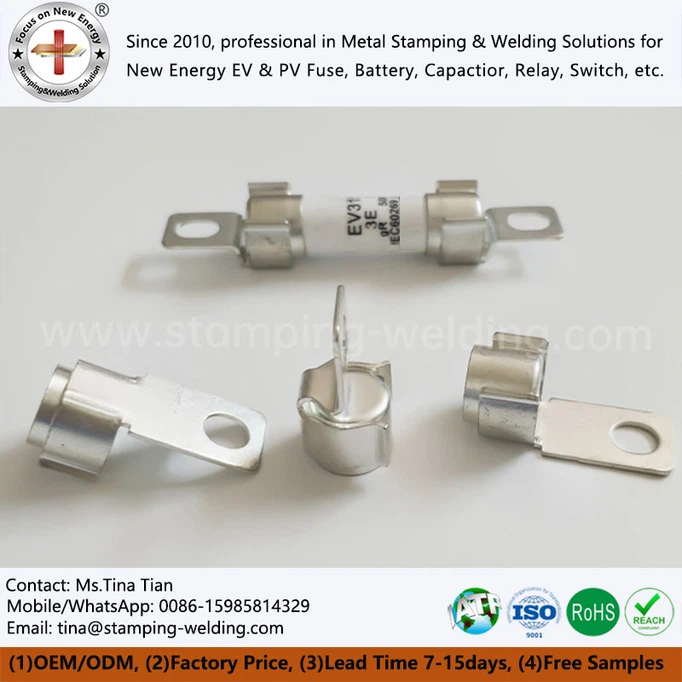
Fuses serve as crucial elements for circuit safety protection, finding extensive application in new energy, industrial control, automotive electronics, and other domains. With the global power system undergoing upgrades and the continuous expansion of the new energy industry, the demand for high - performance Fuse Contact Knife Caps, which plays a vital role in fuse functionality, is on a steady rise.

Products Description
Step 1: Normal operation
When the current in the circuit is within the rated range, the End Cap and Contact's metal part (called the element) produces little heat. The heat spreads out through the fuse's outer case quickly. The element's temperature stays below its melting point, so the circuit stays on.
Step 2: Reacting to overload
If there is an overload in the circuit (like a short circuit or sudden high voltage), the current goes above the rated value. The element heats up fast. Its temperature rises to the melting point, and it starts to soften and melt.
Step 3: Cutting off the circuit
After the element melts, the circuit breaks. At the same time, the End Cap and Terminal Welding Components's arc-extinguishing part puts out the electric arc from the melting. This stops the arc from damaging other parts. Finally, the faulty circuit is cut off, and the equipment is protected.
Key Features of Fuses
- Fast response: When there is an overload, fuses react quickly. Most Fuse Contact Knife Caps can melt and cut off the circuit in milliseconds. This stops damage to expensive equipment in time.
- Simple structure: Fuse Cap and Contacts have few parts. They are easy to install and use. They do not need complex maintenance, which saves time and money for users.
- Strong adaptability: Fuse Cap and Contacts can work in different environments. They can handle high or low temperatures (from -40℃ to 125℃ for most types). They also resist vibration and dust, so they fit industrial and automotive needs.
- Low cost: Compared with other circuit protection devices (like circuit breakers), Fuse Contact Knife Caps are cheaper. They are good for large-scale use in factories and electronic products.
Fuse Production Process
Step 1: Making the element
Workers use metal materials (like copper strips or alloy wires). They press or pull the materials into specific shapes (like variable-section elements to speed up melting). The size error must be less than ±0.01mm.
Step 2: Making the outer case
Ceramic cases are made by high-temperature sintering (at 1200℃ to 1400℃). Glass cases are made by blowing. Metal cases are made by pressing and polishing.
Step 3: Assembling parts
Workers put the element, arc-extinguishing material (like quartz sand) and terminals into the case. They make sure the element is in the center and the terminals connect well (to avoid high contact resistance).
Step 4: Sealing the case
For closed Copper End Caps, workers seal the case (like using epoxy resin for ceramic cases). This stops dust and water from getting in. It also makes the case stronger.
Step 5: Testing performance
Every Copper End Cap is tested. Workers check its melting current, arc-breaking ability and temperature resistance. For example, the element should not melt in 1 hour when the current is 1.2 times the rated value. It should melt in 1 minute when the current is 2 times the rated value.
Step 6: Marking and packaging
Workers print key information on the case (like rated current, voltage and arc-breaking ability). They use anti-static packaging to stop damage during transport.

Fuse Applications
- New energy field
PV inverters: Copper Cap and L-Type Termials here need to handle high voltage (1000V to 1500V) and high current (50A to 100A). They use ceramic cases and quartz sand to stop arcs. This protects inverters from short circuits in PV arrays.
Energy storage systems: Copper Cap and L-Type Termials protect battery circuits. They need to handle high temperatures (-40℃ to 85℃) and vibration. This stops battery overheating from causing safety problems.
- Industrial control field
Inverters and servo motors: Small surface-mount Copper Cap and Fuse End Blade Femules are used here. They are small and react fast (melting time ≤1ms). They protect control circuits from overloads.
High-voltage power equipment: Copper Cap and Fuse End Blade Femules with high arc-breaking ability (≥50kA) are used. They fit 10kV to 35kV power grids. They stop short circuits from spreading.
- Automotive electronics field
Traditional fuel cars: Plug-in Fuse Contact Knife Caps are used for low-voltage circuits (like lights and air conditioners). Their rated current is 5A to 30A.
New energy cars: High-voltage Cap and Contact for Battery Pack Fuses are used for high-voltage circuits (like motor controllers and battery packs). They have a rated voltage of 500V to 1000V. They resist vibration and high/low temperatures.

Contact us