


In Depth Insight into the Braided Copper Flexible Wire Connectors
Nov 15, 2025
In modern industrial electrical and automation systems, connection components must not only carry current but also cope with combined mechanical and thermal stresses such as vibration, displacement and thermal expansion. This article systematically explores the industry knowledge surrounding Flex Connector, covering structure, materials, manufacturing process, application scenarios and selection strategies-helping procurement and system-design professionals deepen their understanding.

Structural Design Insights
Multi-strand braided architecture
A braided copper flexible wire connector uses many ultra-fine copper strands woven together, rather than a single thick conductor or simple bundle. This high strand count and dense braid enhance flexibility and fatigue endurance.
Termination design
Typically, both ends of the connector incorporate crimped sleeves, welded lugs or mechanical ferrules. End-sections are often tin- or nickel-plated to improve connection reliability and prevent oxidation.
Dynamic compensation capability
The braided copper flexible wire connector structure absorbs vibrations, displacements and thermal expansions/contractions by distributing stress across the many fine strands-reducing risk of damage at terminals or conductors.

Material Selection & Performance
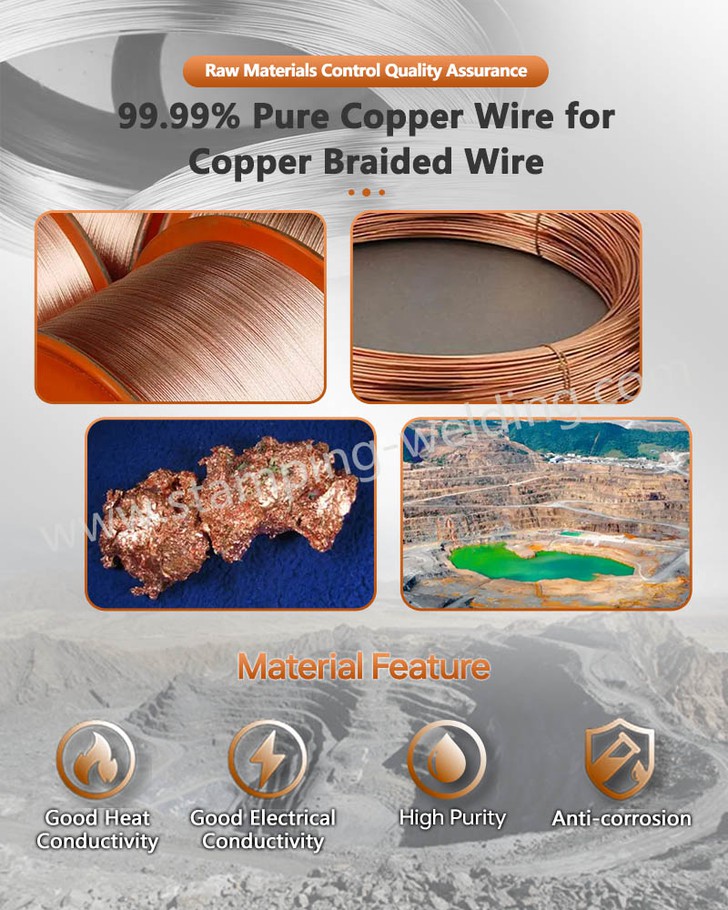
High-conductivity copper core
The Braided Wire Flexible Copper usually employ high-purity copper (such as electrolytic copper) to ensure low resistance and strong current-carrying capacity under demanding conditions.
Fine-strand construction
In the braided copper flexible wire connector design, individual strand diameters may reach 0.07 mm to 0.20 mm, enabling high strand count and improved flexibility, which significantly enhances fatigue life.
Surface treatment and protective layers
To cope with corrosive, humid or marine environments, the Copper Stranded Flexible Connection may receive tin or nickel plating, or an external sheath (PVC, silicone, braided textile) to increase durability and protect against oxidation.
Adaptation for harsh environments
Whether facing high temperature, low temperature, vibration, moisture or chemical attack, the material system of a braided copper flexible wire connector is tailored accordingly to meet demanding industrial requirements.
Manufacturing Process Overview
Raw-material preparation
Copper wires are drawn, annealed and cleaned to ensure the strands have consistent flexibility and no defects for the Braided Tin Coated Copper Flexible Wire Connectors.
Braiding process
Using multi-carrier braiding machines (for example 24-carrier or 32-carrier setups), the strands are interwoven to form the required braid build of the braided copper flexible wire connector. Braid density, angles and strand diameter ratios are key parameters.
Termination and finishing
The Copper power braid are completed with end-terminals (crimp, weld, mechanical) and often undergo plating or treatment to enhance electrical and mechanical reliability.
Testing and quality control
Finished Braided Tin Coated Copper Flexible Connectors undergo resistance testing, fatigue testing (bend and vibration), surface treatment inspection and other checks to ensure reliability in service.
Packaging and delivery
For the Round Braided Stranded Flexible Cords, to protect the delicate braid structure during logistics, anti-moisture and anti-vibration packaging is used, with labels specifying length, cross-section, batch number, etc.

Application Scenarios
Dynamic-motion machinery
In robotic arms, sliding platforms, machine tools, rail vehicles and other high-movement systems, Flex Connector excel where rigid wires would fail from fatigue.
Heavy industry, rail, marine equipment
These sectors face frequent vibration, thermal cycling and constrained spaces. Braided Wire Flexible Copper, with their enhanced flexibility and fatigue resistance, offer superior connectivity.
Electrical control cabinets & grounding systems
Within switchgear, drive cabinets or grounding loops, Copper Stranded Flexible Connection are increasingly used as flexible bus-bar jumpers, grounding straps or shielding links thanks to their conductivity and mechanical adaptability.
Compact, complex installations
With growing automation and equipment miniaturisation, wiring must fit tight spaces and dynamic paths. Here, braided copper flexible wire connectors offer a compelling solution for "space-limited + motion-intensive" layouts.

contact us


