Knowledge analysis of filter capacitor industry
May 28, 2026
product definition
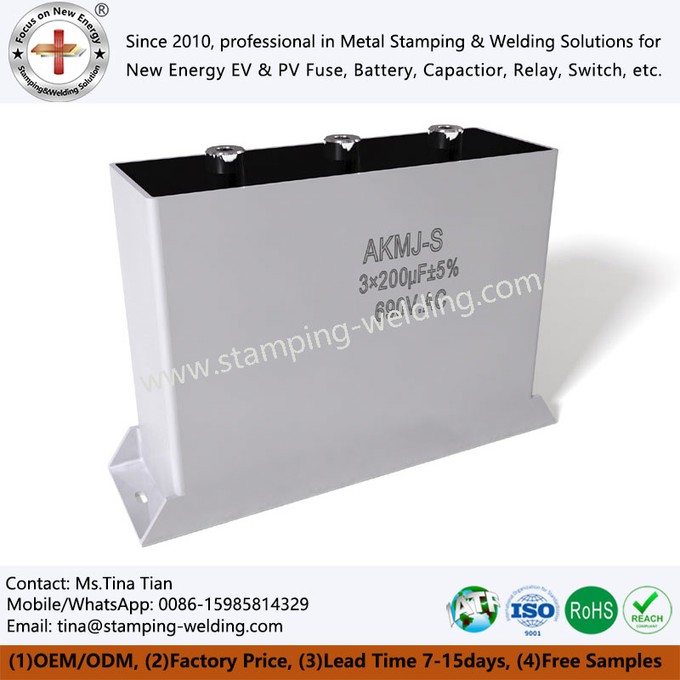
Filter capacitor is a key electronic component used in circuits to filter out high-frequency noise and smooth the pulsating voltage after rectification. Its core working principle is to use the charging and discharging characteristics of capacitors to store electrical energy when the voltage rises and release electrical energy when the voltage decreases, thereby "shaving peaks and valleys" of the originally fluctuating DC voltage and outputting a relatively stable current waveform. In power electronic systems, filter capacitors play the role of "signal cleaner", which is directly related to the working stability of subsequent circuits and the service life of equipment. From a structural point of view, the filter capacitor is composed of an internal electrode and dielectric system and an external protective metal shell. The shell not only plays a role in mechanical protection and sealing, but also participates in heat dissipation and electromagnetic shielding. Among the many packaging forms, Capacitor Aluminum square case and Capacitor aluninum case have become the mainstream housing solutions for large-capacity filter capacitors due to the lightweight, good thermal conductivity and processing plasticity of aluminum. The aluminum shell can effectively conduct the heat generated by the internal loss of the capacitor to the external environment, preventing capacitance attenuation or dielectric breakdown caused by excessive temperature rise. At the same time, its high mechanical strength can protect the internal core from vibration and impact damage.

Material advantages
The reason why aluminum has become the first choice material for filter capacitor housings is due to its high adaptability to the working environment of the capacitor. The first is the thermal conductivity - the thermal conductivity of aluminum is about 237W/(m·K), which is much higher than that of plastic or composite materials. This means that the Joule heat inside the capacitor can be quickly dissipated through the aluminum shell. For power filter capacitors that operate at full load for a long time, this characteristic directly determines the rated service life of the product. The second is the electromagnetic shielding capability. The aluminum shell can effectively block external electromagnetic interference from entering the capacitor and also prevents the electromagnetic noise generated by the capacitor itself from radiating to surrounding circuits. This is particularly important in equipment containing switching devices such as frequency converters and inverters. The third is the flexibility of the forming process.
Through drawing, stamping or welding processes, the aluminum shell can be manufactured into a variety of cross-sectional shapes such as cylindrical, square, rectangular, etc. to adapt to different spatial layouts of the whole machine. Power Converter Capacitor Aluminum Can and Storage Capacitor Aluminum Can are two typical application forms - the former is mostly used in the input and output filtering links of power converters, and the shell design focuses on high-frequency impedance characteristics; the latter is used for voltage stability of energy storage systems, and the shell emphasizes mechanical strength and sealing durability. The surface of the aluminum shell is usually chemically passivated or anodized to enhance corrosion resistance and improve bonding with the potting material to ensure that the shell does not rust in humid or salt spray environments.

Manufacturing process and technical points
The manufacturing of filter capacitor aluminum casing involves multiple processes such as aluminum stretching, curling, cleaning, drying and air tightness testing. The quality control of each process directly affects the reliability of the final product. Stretch forming is the core part of shell manufacturing - the circular aluminum plate is gradually formed into a cylindrical shell with the required depth and diameter through multiple passes of stamping and stretching. During the stretching process, the gap between the punch and the die and the lubrication conditions need to be strictly controlled to avoid uneven wall thickness of the shell or drawing scratches on the surface. For deep cylindrical shells with a height-to-diameter ratio exceeding 1.5, more than three intermediate annealing treatments are usually required to eliminate work hardening and restore the plasticity of the aluminum. The manufacturing of Aluminum Can for High Voltage Film Capacitors has higher requirements on the stretching process, because high-voltage applications require uniform shell wall thickness and no micro-cracks, otherwise partial discharge may occur when withstanding high electric field intensity for a long time. Aluminum Can for Metalized Film DC Filter Capacitors pay more attention to the smoothness and cleanliness of the inner wall of the casing - any residual oil or aluminum shavings may contaminate the metallized film inside the capacitor, leading to a drop in withstand voltage or early failure.
In the crimping process, the open end of the shell is rolled into a smooth edge, which on the one hand facilitates matching with the end cap or sealant plug, and on the other hand prevents sharp edges from scratching the operator or adjacent components. The cleaning and drying process is crucial. Environmentally friendly hydrocarbon cleaning agents must be used in the ultrasonic tank to completely remove the residual stretching oil and metal particles during the stretching process, and then fully dried in clean hot air. Finally, each batch of shells must undergo a random inspection of air tightness - the shells are sealed, immersed in water and filled with compressed air to observe whether there are continuous bubbles escaping to ensure that there are no penetrating pinholes or cracks in the shells.

Application scenarios
The selection of filter capacitors in actual projects requires comprehensive consideration of multiple parameters such as capacity, voltage level, frequency characteristics, equivalent series resistance, temperature and lifespan. In terms of capacity selection, the basic capacitance is determined based on the relationship between the load current and the allowable ripple voltage. Generally speaking, the larger the capacity, the better the filtering effect, but it will also increase the volume and cost, and a balance needs to be struck between technical indicators and economy. In terms of frequency characteristics, in high-frequency circuits such as switching power supplies and frequency converters, filter capacitors need to maintain low equivalent impedance in the frequency range of tens of kilohertz to several megahertz. This requires the selection of a dielectric type with excellent high-frequency characteristics and a low-inductance lead-out structure. Equivalent series resistance is a key indicator to measure capacitor loss. The smaller the ESR, the lower the self-heating of the capacitor.
This is especially critical for high-power power electronic equipment that requires long-term continuous operation. Temperature is directly related to life. The life of aluminum electrolytic capacitors decreases exponentially as the operating temperature increases. Rated ripple current and maximum hot spot temperature are usually used as the basis for life prediction. In large-capacity power electronic devices such as high-voltage DC transmission and static var compensator, the Film Capacitor Aluminum Can packaging form is widely used because metallized film capacitors have higher voltage resistance and lower dielectric loss than aluminum electrolytic capacitors, and can better withstand high-frequency switching ripple current. In AC power systems, Metalized Film Cylindrical AC Shunt Capacitor Aluminum Can is used for parallel compensation, improving power factor and reducing line losses by providing capacitive reactive power. Its cylindrical aluminum shell design is conducive to compact arrangement in the capacitor cabinet, and the heat dissipation ribs on the surface of the aluminum shell can increase the heat dissipation area.
contact us
If you are developing a new Filter Capacitor Aluminum Can model or looking for alternative suppliers, you are welcome to submit shell drawings and technical specifications. Our engineering team will evaluate manufacturability and give structural optimization suggestions.