Manufacturing Process of Copper Caps for Electric Vehicle Fuse: Key Factors for Improving Durability and Performance
Aug 23, 2024
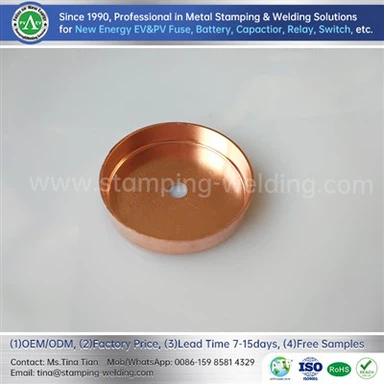
With the rapid growth of electric vehicles (EVs) in the global market, the demand for efficient and reliable EV fuses is also increasing. As one of the key components of the fuse, the durability and performance of the copper cap directly affect the overall quality of the fuse and the safety performance of the electric vehicle. In the process of manufacturing copper caps, the use of appropriate processes and technologies can significantly improve their durability and performance. This article will explore these key manufacturing processes in detail and analyze their impact on the quality of copper caps.
1. Material Selection: Optimizing Copper Alloy Composition
The durability and performance of copper caps are first affected by the choice of materials. Although pure copper has excellent conductivity, its mechanical properties are weak, especially in high temperature and high current environments. Therefore, many manufacturers choose to use copper alloys, such as copper-tin alloy (bronze) or copper-zinc alloy (brass), to improve the mechanical strength and corrosion resistance of copper caps.
1.1 Advantages of Copper Alloys
Copper alloys not only retain high conductivity, but also have higher hardness and better wear resistance. These characteristics enable copper caps to better resist mechanical wear and electrochemical corrosion in long-term use. In addition, trace elements in the alloy, such as nickel or chromium, can further improve the oxidation resistance of the copper cap and extend its service life.
1.2 Optimizing alloy formula
In order to find the best balance between performance and durability, manufacturers can optimize the characteristics of the copper cap by adjusting the alloy composition ratio. For example, increasing the tin content can significantly improve the strength and hardness of the copper alloy, while adding nickel in appropriate amounts can improve the corrosion resistance and heat resistance of the alloy. This customized alloy formula can be adjusted according to different application requirements to produce more targeted high-performance copper caps.
2. Precision forging: improving structural integrity
Precision forging is one of the key processes for manufacturing high-strength copper caps. Through forging, the copper alloy material is plastically deformed under high temperature and high pressure, making the grain structure of the material denser and more uniform. This uniform grain structure can not only improve the mechanical strength of the copper cap, but also reduce the defects inside the material, thereby improving its durability.
2.1 Choice of hot forging and cold forging
Depending on different application requirements, manufacturers can choose hot forging or cold forging process. Hot forging is forging at high temperature, which is suitable for copper caps that need to be deformed significantly. It can effectively reduce the hardness of the material and facilitate subsequent processing. Cold forging is forging at room temperature, which is suitable for copper caps that require high surface quality and dimensional accuracy. Copper caps after cold forging usually have higher strength and wear resistance.
2.2 Multiple forging process
In order to further improve the structural integrity and performance of copper caps, manufacturers can adopt multiple forging processes. Through multiple forging, the grains of copper alloys can be further refined, the uniformity and density of the material can be improved, and the strength and durability of the copper caps can be enhanced. This process is particularly suitable for copper caps of electric vehicle fuses that need to withstand high mechanical and electrical stresses.
3. Precision machining: ensuring dimensional accuracy and surface quality
After forging, the copper caps need to undergo a series of precision machining processes to ensure their dimensional accuracy and surface quality. These machining processes include turning, milling, drilling and polishing, which not only affect the appearance quality of the copper caps, but also directly affect their matching performance with other parts of the fuse.
3.1 Precision turning and milling
Turning and milling are key processes for machining the geometry of copper caps. High-precision turning and milling can ensure that the dimensional tolerance of the copper cap is within the design requirements, thereby ensuring that the copper cap fits tightly with other parts of the fuse to prevent loosening or poor contact during use.
3.2 High-precision drilling
In some fuse designs, the copper cap may need to be drilled to install connectors or conductive wires. High-precision drilling technology can ensure the dimensional accuracy and positional accuracy of the aperture, preventing installation problems caused by aperture errors. In addition, precise drilling can also reduce stress concentration and prevent the copper cap from cracking or breaking under high current or high temperature.
3.3 Surface polishing and treatment
In order to improve the oxidation resistance and conductivity of the copper cap, manufacturers usually polish and treat its surface after processing. Polishing can remove burrs and tiny defects on the surface of the copper cap, making its surface smoother, thereby reducing contact resistance and improving conductivity. In addition, surface treatment (such as tin plating, nickel plating, etc.) can further improve the oxidation resistance of the copper cap and extend its service life.
4. Heat treatment process: Optimizing material properties
Heat treatment is a crucial link in the manufacturing process of copper caps. Through a reasonable heat treatment process, the internal structure of the copper alloy can be optimized, and its mechanical properties and durability can be improved. Common heat treatment processes include annealing, quenching and tempering.
4.1 Annealing treatment
Annealing is to eliminate the residual stress inside the material by heating and slowly cooling, and improve the processability and ductility of the copper cap. The annealed copper cap has better toughness and fatigue resistance, and can maintain stable performance in long-term use.
4.2 Quenching and tempering
Quenching is to quickly heat the copper cap to a high temperature and then quickly cool it to increase its hardness and strength. However, the quenched copper cap may have the problem of increased brittleness, so tempering treatment is usually required. Tempering is a heat treatment performed at a lower temperature, which can eliminate the internal stress generated during the quenching process, improve the toughness and impact resistance of the material, and thus improve the comprehensive performance of the copper cap.
5. Surface treatment: improving corrosion resistance and contact reliability
In order to further improve the durability of copper caps, especially the performance in high temperature, high humidity and high corrosive environments, the surface treatment process is crucial. Common surface treatment methods include electroplating, coating and chemical treatment.
5.1 Electroplating process
Electroplating is a process of depositing a layer of metal or alloy on the surface of copper caps through electrolytic reaction. Common electroplating materials include tin, nickel and gold, which can significantly improve the corrosion resistance and conductivity of copper caps. For example, tin plating can prevent copper caps from oxidizing in humid environments and improve their welding performance, while nickel plating can enhance the wear resistance and high temperature resistance of copper caps.
5.2 Coating and chemical treatment
In addition to electroplating, coating and chemical treatment are also commonly used surface treatment methods. The coating process can form a corrosion-resistant and wear-resistant protective layer on the surface of the copper cap, such as epoxy resin coating or polymer coating. Chemical treatment forms a dense oxide film on the surface of the copper cap through chemical reaction, thereby improving its oxidation resistance and chemical corrosion resistance.
6. Quality Control and Testing: Ensure Product Consistency and Reliability
During the manufacturing process of copper caps, strict quality control and testing are the key to ensure product consistency and reliability. Through sophisticated testing equipment and strict testing processes, manufacturers can promptly detect and correct defects in production, thereby ensuring that each batch of copper caps meets the design standards and performance requirements.
6.1 Nondestructive Testing
Nondestructive testing is a testing method that does not destroy the workpiece, and is often used to detect internal defects and surface defects in copper caps. For example, ultrasonic testing can effectively detect cracks and pores inside the copper cap, while X-ray testing can identify structural defects and impurities inside the copper cap. These testing methods can detect potential problems at an early stage, thereby preventing unqualified products from entering the market.
6.2 Performance Testing
After the copper cap is manufactured, a series of performance tests are required to verify its durability and performance. For example, the high temperature and high humidity test can be used to evaluate the oxidation resistance of the copper cap, and the current impact test can be used to verify its arc resistance and thermal fatigue resistance. In addition, durability testing is also crucial, which can simulate the long-term performance of the copper cap under actual use conditions, thereby ensuring that it maintains a stable working state throughout its service life.
The manufacturing process of copper end caps for electric vehicle fuses directly affects their durability and performance. From material selection to precision machining, to heat treatment and surface treatment, every link is critical. By optimizing these processes, manufacturers can significantly improve the mechanical strength, electrical conductivity and corrosion resistance of copper end caps, thereby providing more reliable and durable fuse solutions for electric vehicles. Strict quality control and performance testing ensure the high consistency and high reliability of each batch of copper end caps, providing a solid guarantee for the safe operation of electric vehicles.
We are a company that produces copper end caps for electric vehicle fuses. We use high-quality raw materials, advanced equipment and a professional production team to provide you with high-quality copper end caps for electric vehicle fuses. If you are interested in our products, you can click on the link below to learn more:

If you are interested in learning more about our copper end caps or have specific application requirements, we encourage you to contact us. Our team of experts is ready to provide you with product selection, customization and other consulting services. We look forward to helping you find the perfect solution for your electric vehicle fuse needs.