Technical Guidelines for Electrical Copper BusBar Application
Feb 24, 2026
Core characteristics and material selection points of Electrical Copper BusBar
The core advantages of Electrical Bus Bar are focused on high conductivity, good heat dissipation, and reliable electrical connection performance, which is also the key reason why it has become an ideal choice for high current power transmission. In practical engineering applications, the material selection of Ground Bus Bar needs to be based on performance requirements, cost budget, and application scenarios. Currently, the mainstream materials and characteristics are clearly compared: copper (T2) has a conductivity of up to 101% IACS, a thermal conductivity of 391 W/(m · K), and a tensile strength of ≥ 220 MPa. Although it is expensive, it is suitable for situations with the highest requirements for electrical conductivity; Brass (H62/H65) has a conductivity of only 28% IACS and a thermal conductivity of 120 W/(m · K), but a tensile strength of ≥ 340 MPa, making it suitable for scenarios with high mechanical strength requirements; Aluminum (1350) has a conductivity of 61% IACS, is affordable and lightweight, and is commonly used in weight sensitive applications. It is worth noting that under the same current carrying capacity, the cross-sectional area of BusBar Electrical is only 62% of aluminum busbars, and the connection points are more reliable and the operating temperature rise is lower, making it the preferred material for most high-end distribution systems.

Design and Installation Specification for Electrical Copper BusBar
The design and installation of Copper Solid Bus Bar directly affect the stability of system operation, and it is necessary to focus on three core aspects: size selection, connection method, and installation spacing. In terms of size selection, it is necessary to consider the rated current, ambient temperature, installation method, and side by side installation effect: a safety margin of 25-30% should be reserved for the design current, and the cross-sectional area should be appropriately increased or the current carrying capacity should be reduced in high-temperature environments. The heat dissipation effect of vertical installation is 10-15% worse than that of horizontal installation. When multiple Power BusBars are arranged side by side, the decrease in current carrying capacity caused by proximity effects should be considered. In terms of connection methods, bolt connections are simple, reliable, easy to install and maintain, and are the standard choice for most occasions, but regular inspections are needed to prevent loosening; Welding connection is a permanent connection with low contact resistance, suitable for fixed and unchanging installation scenarios, but the disadvantage is that it is not easy to disassemble and repair; The crimping connection has high reliability and low contact resistance, and is mostly used for the connection point between cables and BusBar Copper, requiring the use of professional tools; Silver soldering has the lowest contact resistance and the best conductivity, but it is costly and requires strict process requirements, making it suitable for high current and high reliability applications. The installation spacing should follow clear standards: the minimum spacing between adjacent busbars should be ≥ 80% of the busbar width, the spacing between busbars of different phases should be ≥ 1.5 times the busbar width, the distance between the busbar and the metal shell should be ≥ 100% of the busbar width, and the spacing between support points should not exceed 24 times the busbar width.
Common Problems and Solutions of High Voltage BusBar System
During long-term operation, the BusBar Voltage system is susceptible to various problems caused by installation quality, environmental factors, and operating conditions. It is necessary to accurately identify the causes and take targeted solutions. Overheating problems are often caused by loose connection points and overloaded operation. Regular infrared detection can be used to identify potential hazards, and torque wrenches can be used to ensure that the connection points are tightened and avoid excessive local temperature rise; The corrosion problem mainly originates from humid environments or contact with dissimilar metals. Tin plating can be used to enhance corrosion resistance, and regular maintenance should be strengthened to reduce environmental erosion of BusBar Electric; Vibration loosening is often caused by mechanical vibration and temperature cycling. The use of locking washers and spring washers can effectively fix the busbar and prevent loose connections; Eddy current loss is caused by the generation of eddy currents during high current transmission. By using methods such as dividing Power Bar BusBar and using laminated structures, eddy current loss can be effectively reduced and system operating efficiency can be improved.
Power in Contacts Innovative Applications and Industry Standards
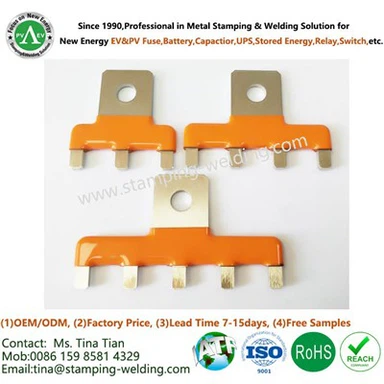
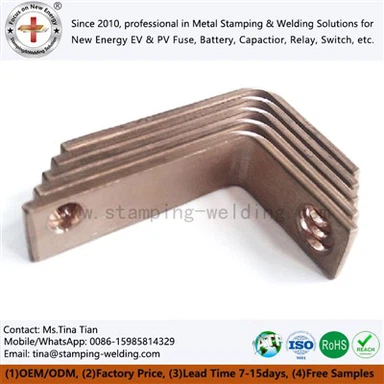
With the development of power systems towards high power, compactness, and intelligence, the application forms of Bus Electronics continue to innovate and adapt to more complex scene requirements. The laminated busbar duct is made by laminating multiple layers of copper busbars and insulation materials. The highly integrated structure can save 70% of installation space and has advantages such as low impedance, reduced electromagnetic interference, convenient installation, and IP54 protection level; The water-cooled Positive Bus Bar is designed for high current applications, utilizing the cooling effect of water to increase current carrying capacity by 2-3 times, reducing copper material usage and space occupation. It is widely used in industries such as electrolysis and smelting; The flexible AC BusBar is composed of multiple layers of thin copper sheets stacked together, which has good anti vibration performance, can adapt to thermal expansion and contraction, simplify installation difficulty, and reduce stress concentration. It is suitable for situations where vibration or thermal deformation needs to be dealt with. At the same time, the design and application of PCB Bus Bars must strictly follow industry standards. Currently, mainstream standards include GB/T 5585 "Specification for Copper and Copper Alloy Busbars for Electrical Use", ASTM B187/B187M "Standard Specification for Copper Busbars", IEC 60947-1 "Low Voltage Switchgear and Control Equipment", etc., which need to be combined with local electrical specifications to ensure safe and compliant operation of the system.

contact us
If you have any questions regarding the selection, design, installation, or innovative application of Electrical Copper BusBar, or have related procurement and customization needs, please feel free to contact us at any time. We will provide professional technical support and precise solutions to assist in the safe and efficient progress of your project.