The role and future of Pack aluminum housing in the battery industry
Apr 20, 2026
Industry background and market development drivers
With the widespread use of lithium iron phosphate (LFP) batteries in energy storage systems, new energy vehicles, and industrial backup power sources, the market demand for Pack aluminum housing continues to grow rapidly. Unlike soft pack and cylindrical battery structures, prismatic battery cells require a rigid shell to fix the internal stacking structure, stabilize the overall thermal environment, and maintain the structural integrity of the battery module for a long time. LFP material itself has a high safety factor, excellent thermal stability, and ultra long cycle life, making it highly suitable for application scenarios that emphasize operational reliability.
In complex working conditions and large integrated modules, Automotive battery aluminum cases can effectively buffer mechanical stress, adapt to changes in core volume, and achieve stable overall thermal management. The excellent recyclability of aluminum materials is in line with the global trend of circular economy development, helping the battery industry upgrade towards green and low-carbon direction, and further promoting the large-scale application of aluminum shells in the LFP battery field.

Core technological advantages of Pack aluminum housing
The Aluminum case for new energy carriers has outstanding comprehensive performance advantages and is an important guarantee for the stable operation of prismatic LFP cells. In terms of mechanical protection, the aluminum alloy shell has sufficient rigidity, which can effectively buffer the expansion and contraction of battery cells during charging and discharging cycles, resist external impact and high-frequency vibration, and meet the strict requirements of vehicle and industrial equipment use.
In terms of thermal management, aluminum has excellent thermal conductivity. Lithium battery aluminum cases can quickly conduct and dissipate the working heat of battery cells, balance internal temperature, reduce local hot spot hazards, stabilize battery operating conditions, and extend overall service life. At the same time, aluminum alloy has a lower density, which can significantly reduce weight compared to steel shells, improving the vehicle's range and energy density of energy storage devices.
By relying on the naturally formed oxide protective layer on the surface, Battery aluminum cases have good corrosion resistance and can resist electrolyte erosion and the influence of humid environments. In addition, the high recycling rate of materials can not only control long-term usage costs, but also reduce industrial energy consumption and resource loss.

Key points of material selection and structural design
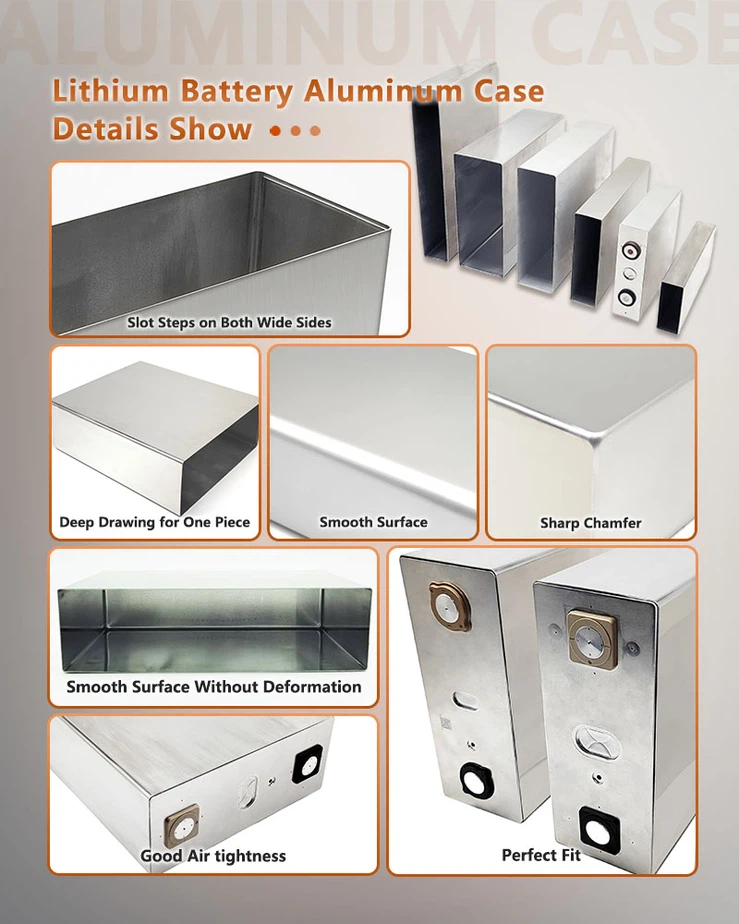
Prism shaped LFP battery specific New energy aluminum battery cases are mostly made of 6061 and 6063 series aluminum alloy materials, which balance structural strength, conductivity, and molding processability. The material purity meets the standard and complies with international environmental regulations such as RoHS and REACH. Relying on precision CNC machining technology, strict control of shell size tolerances and high assembly fit can reduce module assembly gaps and optimize overall space utilization.
In terms of structural design, laser welding and precision sealing processes are often used for the shell end caps to ensure overall airtightness. Partial shell integrated pressure relief protection structure can release pressure in a timely manner when internal pressure is abnormal, improving overall safety level. Optimize the arc design of the shell edge to avoid diaphragm damage during assembly. Combined with surface treatment processes such as anodizing and electrophoresis, the anti-corrosion ability and surface quality of Aluminum battery casing are further enhanced. At the same time, installation points, wiring cuts, and heat dissipation structures can be customized according to integration requirements.
Industry Value and Future Development Trends
Against the backdrop of accelerating global energy transition, LFP batteries with high safety and cost-effectiveness have become the core choice for energy storage and new energy tracks, and the Battery shell, as a key structural component, directly determines the cell protection capability, heat dissipation efficiency, and long-term operational stability. Reasonable aluminum shell structure design and high-quality aluminum application can comprehensively improve the safety, consistency, and durability of prismatic LFP batteries.
With the continuous expansion of downstream energy storage and new energy vehicle industries, the market demand for lightweight, high sealing, and high-precision Rechargeable aluminum shells will steadily increase. In the future, combining alloy material upgrades, precision machining optimization, and functional structural innovation, the EV car battery shell will continue to iterate and upgrade, providing more reliable supporting solutions for energy storage equipment, new energy vehicles, industrial power supplies, and other scenarios, and continuously helping the battery industry achieve high-quality and sustainable development.
Contact us
If you need to purchase customized Pack aluminum housing, please feel free to consult and negotiate with us at any time. We can provide multi specification shell solutions and precision machining services to fully match the supporting needs of various lithium battery projects.