



EV Laminated Busbars
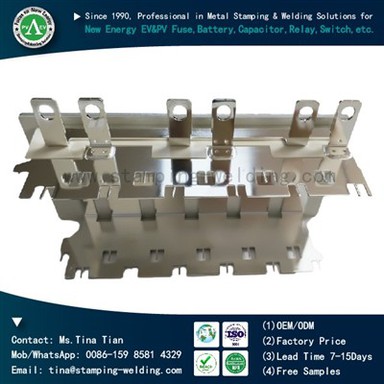
EV Laminated Busbars is a core connection and insulation component. It is developed specially for new energy vehicle capacitor systems. It uses high-performance PET insulation paper as the key insulation base material. It is combined with high-conductivity metal busbars (usually copper or aluminum). The combination is done through a precise lamination process. This component is mainly used for current transmission and circuit connection inside and outside the capacitor of new energy vehicles. At the same time, it provides reliable insulation protection.
- Fast Delievery
- Quality Assurance
- 24/7 Customer Service
Product Introduction
Product Introduction
From the perspective of product structure, EV Laminated Busbars usually has a multi-layer structure. The core part is the conductive busbar layer in the middle. It is responsible for carrying and transmitting the large current generated during the operation of new energy vehicle capacitors.
In terms of product specifications, customized production can be carried out according to the needs of different new energy vehicle models and different capacitor systems.
From the perspective of industry positioning, as new energy vehicles develop towards higher voltage, higher power and longer range, capacitors - as key components for energy storage and regulation - put higher requirements on the current-carrying capacity, insulation performance, high-temperature resistance and reliability of busbars.

Core Product Features
Multi-layer Composite Structure
It takes high-purity conductive busbars (copper purity ≥99.95%, aluminum purity ≥99.8%) as the core for current transmission. The upper and lower layers are combined with PET insulation paper of 0.05-0.2mm thickness. Some high-end models have an anti-corrosion protective coating on the outer layer. The structure is tight and has low risk of delamination. It is suitable for the compact installation space of new energy vehicle capacitors.
Precise Specification Adaptability
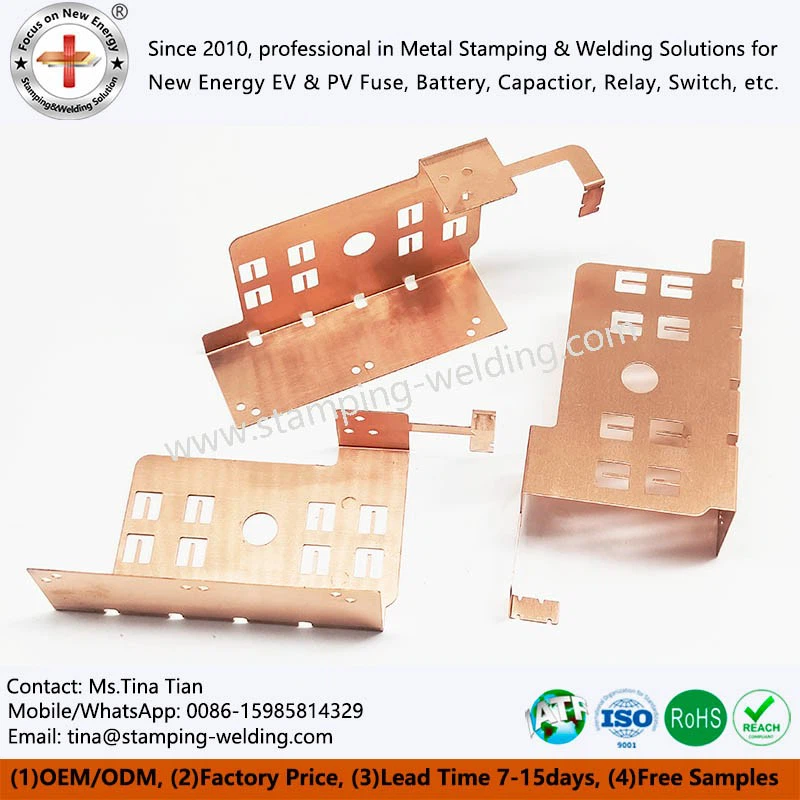
The Car Battery Bus Bar has a thickness of 0.5-5mm and a width of 10-100mm. Its length can be customized according to needs. It supports processing such as punching and bending. It can match the installation size requirements of different capacitor systems in pure electric and hybrid vehicles.
All-environment Adaptability
The PET insulation paper can withstand a long-term temperature of 120℃ and a short-term temperature of over 150℃. Its thermal shrinkage rate is less than 1% at 120℃ for 1 hour. It is also resistant to corrosion from battery electrolytes and lubricating oils. EV BusBar can work stably under operating conditions of -40℃ to 120℃.
Core Product Advantages
Dual Electrical Protection
The PET insulation paper has a volume resistivity of more than 10¹⁶Ω·cm and a surface resistivity of more than 10¹⁵Ω. Capacitor Busbar can withstand the working voltage of hundreds to thousands of volts of new energy vehicle capacitors. Its dielectric loss factor is less than 0.01 (50/60Hz), which reduces electrical energy loss and indirectly improves vehicle range.
High Load-bearing and Risk Resistance
The EV Laminated Busbars has low resistivity (copper ≤0.0172Ω·mm²/m, aluminum ≤0.0282Ω·mm²/m). With an optimized cross-sectional design, it can carry instantaneous large currents of hundreds to thousands of amperes. It also has good heat dissipation performance to avoid high-temperature overheating.
Strong Mechanical Stability
The PET insulation paper has a longitudinal tensile strength of more than 150MPa and a tear strength of more than 20kN/m. It is combined with the busbar through a precise lamination process. It can resist vibration and impact during vehicle driving and prevent damage or delamination of the insulation layer.
Environmental Compliance
The EV Capacitor Busbar does not contain substances restricted by RoHS such as lead and mercury. No harmful emissions are produced during production. After scrapping, the PET insulation paper and metal busbar can be separated and recycled. It meets the environmental requirements of the new energy vehicle industry.

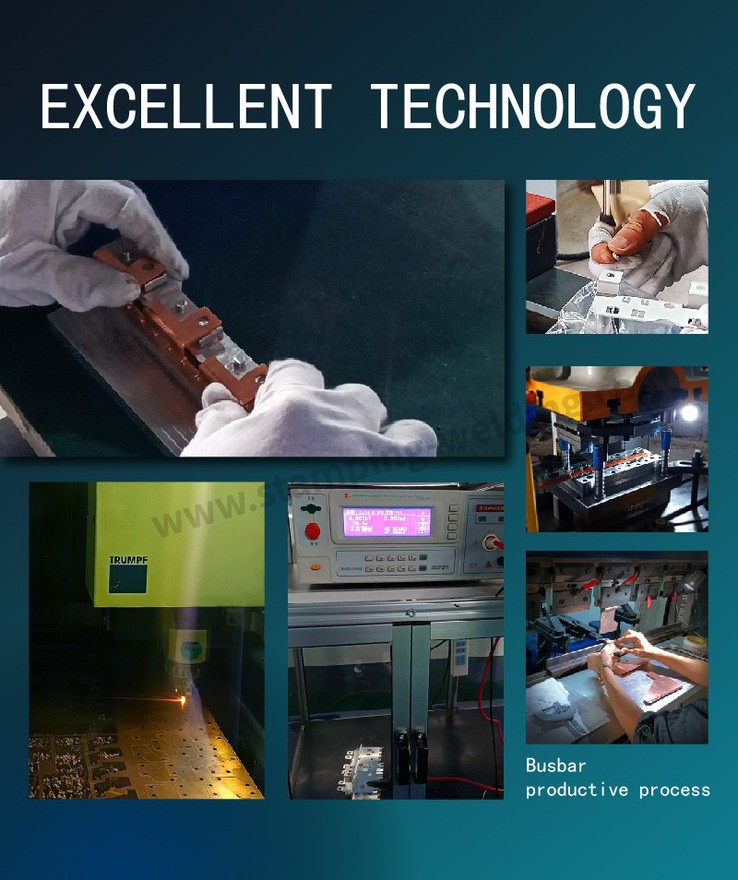
Precision Production Process
Raw Material Screening
The PET insulation paper needs to pass dielectric loss and temperature resistance tests. The EV Capacitor Busbar is tested for purity and resistivity. Unqualified raw materials are directly rejected.
Lamination Composite Process
The EV Laminated Busbars and PET insulation paper are pressed at a constant temperature under 120-150℃ and 5-8MPa pressure. This ensures that the interlayer bonding strength is more than 5N/cm.
Precision Processing and Testing
It is cut and bent according to customer needs. Then, through equipment such as high-voltage dielectric loss testers and vibration testing machines, all insulation performance and mechanical strength are tested. Only qualified products can leave the factory.

Core Application Scenarios
| Pure Electric Vehicle Capacitors | The EV Laminated Busbars is used for series/parallel connection of capacitor units and energy transmission between capacitors, controllers and power batteries. It ensures the supply of large currents during startup and acceleration, and the efficiency of braking energy recovery. |
| Hybrid Vehicle Capacitors | It connects capacitors to motor controllers (to carry startup peak currents), engine startup systems (to reduce battery load), and energy recovery systems (to efficiently store braking electrical energy). |
| Automotive Fast Charging Systems | It adapts to the requirements of fast charging systems for voltages above 500V and currents above 100A. It achieves safe current conduction and insulation in a compact space, helping to improve fast charging efficiency. |
Contact us

Hot Tags: ev laminated busbars, China, manufacturers, suppliers, factory