Copper busbar technical specifications and application guide
May 18, 2026
Product Definition and Classification
Copper bars, are long conductors with rectangular or rounded cross-sections made of high-conductivity copper materials. They are high-current conductive products. According to the different material states, copper busbars are divided into hard copper busbars (TMY) and soft copper busbars (TMR). The hard products are cold work hardened and the Vickers hardness is controlled at 80-120HV. They are suitable for occasions that require higher mechanical support strength; the soft products have excellent bending performance, and the bending radius can reach 1.5 times the material thickness, which facilitates wiring installation in complex spaces. Copper busbars can be further subdivided into three types according to their cross-sectional geometry: rounded corner type, rounded edge type, and fully rounded edge type. Among them, the rounded corner design can effectively avoid tip discharge phenomena and improve electrical safety performance in high-voltage application environments. Common material grades include red copper (T1, T2), phosphorus deoxidized copper (TP1, TP2) and oxygen-free copper (TU0, TU1). Different materials have differences in conductivity, processing performance and corrosion resistance. Designers need to make reasonable selections based on specific working conditions. In the application scenario of Copper Ground Bus Bar, the copper bar serves as the core conductor of ground protection and assumes the important function of rapid discharge of fault current.
Production process
The typical production process of copper bars includes main processes such as casting, hot rolling, pickling, cold rolling, annealing and shearing. Among them, the process parameters of the cold rolling and annealing processes directly determine the hardness state and internal structure uniformity of the final product. For hard copper strips, appropriate cold work hardening treatment is required after cold rolling, without complete recrystallization annealing, in order to maintain high strength and hardness; soft copper strips need to be fully annealed to restore the grains and eliminate processing stress, thereby obtaining good ductility. Surface treatment is an important step in improving the environmental adaptability of copper busbars. Common processes include tin plating, embossing, and coating with insulating paint.
For example, the thickness of the tin plating layer is generally required to be no less than 3 μm, and the porosity of the plating layer should be controlled below 5 per square centimeter to ensure long-term reliability in humid or corrosive environments. The processing error of the fillet radius usually does not exceed ±0.2mm, and the chamfer angle deviation is within ±2°. The quality inspection is carried out in accordance with the GB/T 5585.1-2005 standard. The inspection items cover dimensional tolerance (allowable deviation of width ±1%, allowable deviation of thickness ±0.02mm), conductivity test (using eddy current conductivity meter, measurement error does not exceed ±1%IACS) and bending test (hard copper surrounds a mandrel with a diameter 2 times the thickness of the copper bar and no cracks will appear on the surface after bending 180°). Among modern detection methods, special testing devices can automatically complete performance tests such as contact resistance and temperature rise, which is significantly more efficient than traditional manual detection methods. For Custom BusBar requirements, it is often necessary to add customized inspection items with special dimensional accuracy or surface treatment technology in addition to the standard inspection process to ensure the matching of the product with the specific electrical system.

Application scenarios
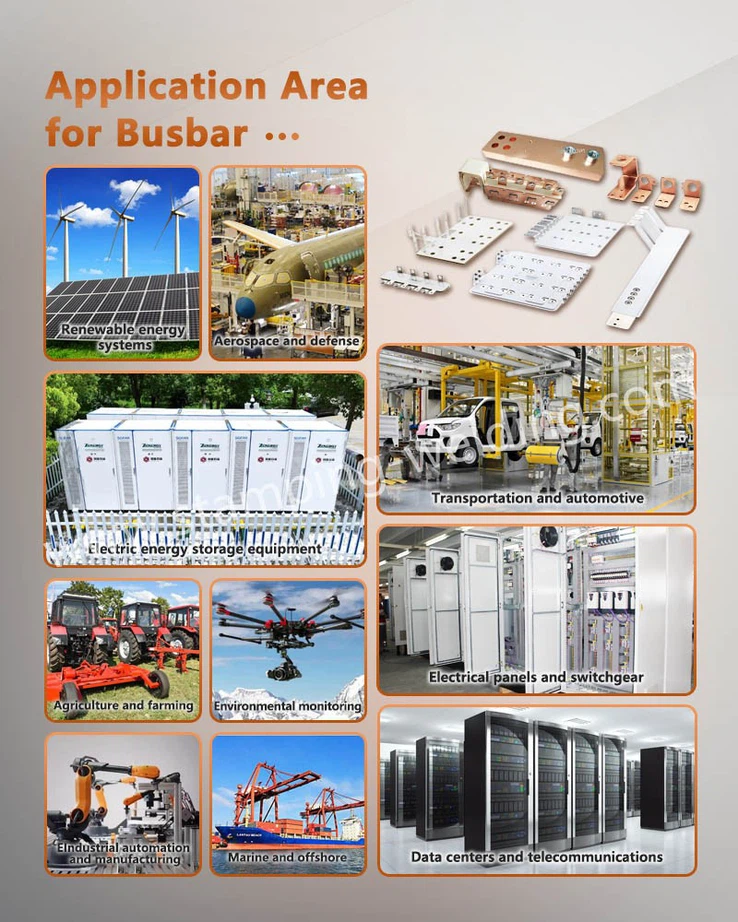
With the rise of new energy vehicles and modular data centers, the demand for copper busbars has become increasingly refined. In addition to conventional phase line copper bars, Positive Bus Bar and Negative Bus Bar in DC systems are widely used in battery packs and energy storage systems. At the same time, in order to adapt to the complete sets of equipment of mainstream electrical giants, the industry's compatibility and accuracy requirements for BusBar for Eaton and Copper BusBar for Siemens are also constantly increasing.
Whether it is a Copper Ground Bus Bar for grounding or a complex Custom BusBar, it needs to reach extremely high standards in conductivity, mechanical strength and processing accuracy to meet the dual pursuit of safety and efficiency in modern power engineering. The copper busbar is mainly responsible for the high current transmission task of the primary circuit, covering the full link connection from the transformer to the distribution cabinet to the terminal electrical equipment. Inside the power distribution cabinet, the U, V, W three-phase and PE protection busbars are all made of copper bars. The phase and color markings strictly follow the IEC standards: the A/U phase is painted in yellow, the B/V phase is painted in green, the C/W phase is painted in red, the neutral line (N) is light blue, and the protective line (PE) is yellow and green. Visual differentiation reduces the risk of misoperation in operation and maintenance.
Specifications must be strictly followed in the installation process: the height deviation of the support points in the horizontal section is ≤3mm, and the deflection of the vertical section is ≤2mm/m; the connecting bolts are made of grade 8.8 galvanized parts, and the M10 specification torque must reach 32 N·m; the gap between the series copper rows ≥ the thickness of the single row, and sufficient space for heat dissipation must be reserved for the parallel connection time interval. In ultra-large current electrolysis projects such as metal smelting and electrochemical plating, copper busbars are the core transmission carrier. Some scenarios also need to be integrated with prefabricated power modules to improve deployment efficiency and space utilization.
Key points for selection
In actual engineering design, the selection of copper busbar specifications requires comprehensive consideration of multiple factors such as current load, installation space, heat dissipation conditions, and economy. When there are multiple circuits in the distribution cabinet, the current carrying capacity of the main busbar should be determined based on the sum of the currents of each circuit multiplied by the dispersion coefficient. At the same time, the specifications of the vertical busbar should not exceed the horizontal busbar. In power distribution cabinets involving double circuit breakers arranged up and down, the leads from each circuit breaker should be connected to the horizontal busbar, and the same busbar should not be shared to connect all circuits in series to avoid local overheating and selective protection failure. The application fields of copper busbars have expanded from traditional high- and low-voltage electrical appliances, switch cabinets, bus ducts and other power equipment to high-current electrolytic smelting projects such as metal smelting, electrochemical plating, chemical caustic soda, and emerging fields such as new energy vehicles.
These application scenarios put forward higher requirements for the mechanical properties, electrical and thermal conductivity, corrosion resistance, electroplating properties and forming processing performance of the copper busbars. For systems that need to connect mainstream low-voltage electrical products such as BusBar for Eaton or BusBar for Siemens, you should ensure that the end opening size, bolt specifications and phase sequence identification method of the selected copper bar match the terminal blocks of the corresponding equipment to avoid abnormal increases in contact resistance or installation difficulties caused by improper coordination. At the same time, Positive Bus Bar and Negative Bus Bar must be strictly distinguished in the DC system, and sufficient electrical clearance and creepage distance must be maintained to prevent reverse polarity or short-circuit faults.

contact us
Whether it is standard Positive and Negative Bus Bar or precision customization for specific project needs, we can provide you with safe, efficient, and durable product support with our exquisite craftsmanship and strict quality control system. Feel free to contact us anytime to discuss your project needs.