End cap and contact: key considerations for long-term performance
Apr 30, 2026
Overview
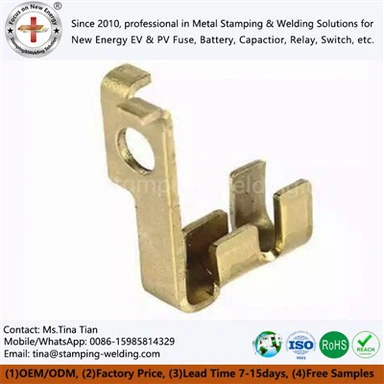
In the context of continuous upgrading and iteration of electrical protection systems, the overall operational reliability is directly related to equipment operation safety, and the quality of fuse assemblies is increasingly valued by the industry. End cap and contact points are the core supporting components for achieving safe circuit connections and overcurrent protection, and are the fundamental components for ensuring the long-term stable operation of electrical equipment. From a practical application perspective, its functional positioning, material performance, industry adaptation scenarios, structural design points, and later operation and maintenance standards are all core considerations for ensuring the long-term service capability of Fuse contact knife cap.

Core functions and factors affecting lifespan
End cap and contact play three core roles in the entire fuse system. Firstly, they serve as conductive connections, relying on high-quality copper materials to construct low resistance conduction paths, ensuring efficient power transmission under normal operating conditions;
Secondly, the structure is stable. Through the welding combination structure of the end cap and terminal, the fuse element is firmly confined inside the housing to resist the displacement risk caused by equipment vibration and temperature thermal cycling;
The third is fault protection, which assists in the precise action of fuses when overcurrent abnormalities occur in the circuit, quickly cutting off the circuit and avoiding the risk of damage to backend electrical equipment.
The key performance factors affecting the service life of Welding joints for fuse mainly include four aspects: material purity determines conductivity stability and oxidation resistance, and high-purity copper materials can maintain excellent conductivity performance for a long time; The welding process accuracy directly avoids the hidden danger of microcracks and prevents performance degradation after long-term use; Professional surface treatment processes can resist external erosion such as moisture and dust, and stabilize conductivity; The structural mechanical durability can withstand repeated thermal expansion and contraction changes, and maintain complete and reliable connections throughout multiple operating cycles.

Key points of industry application and structural design
Copper cap contact for semiconductor fuses are suitable for electrical protection scenarios in multiple fields, with a wide range of applications. Provide long-term circuit protection for high-voltage distribution networks of heavy machinery equipment in industrial electrical systems; In the field of automotive electronics, it can withstand complex vibrations and significant temperature fluctuations in the cabin, and is suitable for the use of on-board fuses; In the field of renewable energy, it is widely used in photovoltaic and wind power equipment, relying on excellent environmental adaptability to meet long-term outdoor service requirements.
To further extend the performance of Copper cap contact for EV battery fuse, structural design needs to grasp multiple core points: strict control of dimensional tolerance accuracy, ensuring assembly fit, and eliminating heat hazards caused by loose connections; Optimize welding process parameters, accurately control heat input, preserve the original properties of the substrate while improving bonding strength; Reasonably control contact pressure, maintain constant contact force through precision machining or elastic structure design, and suppress the deterioration of contact resistance year by year; Strengthen environmental sealing design, combined with sealing cushion layer and protective coating, to block water vapor intrusion and adapt to various harsh working conditions.

Comprehensive consideration of reliability and installation and operation standards
The comprehensive service life of End cap and terminal is determined by multiple related factors. The selection of materials should take into account both high conductivity and mechanical structural strength. Manufacturing processes such as stamping and welding must undergo strict quality control to eliminate hidden process defects; The product needs to have good environmental adaptability, be able to withstand corrosive media, extreme high and low temperatures, and chemical erosion; At the same time, based on the established current and voltage rated parameters, special design optimization is carried out to avoid early aging failure caused by overload operation and comprehensively consolidate the reliability of the fuse system operation.
Standardized installation and maintenance methods are important guarantees for extending the service life of Outer cap and contact. Ensure precise alignment of components during assembly to avoid additional stress on welded joints; The fastening operation adopts standard calibration tools, strictly controls the torque force, and prevents over tightening deformation or loose contact; Establish a regular inspection mechanism to promptly identify aging issues such as contact corrosion and wear, and replace parts as needed; Before selecting and assembling, conduct compatibility verification of specifications to ensure that the Outer cap and terminal match the parameters of the fuse housing, maximizing the product design performance.

contact us
If you need to know the specifications, process customization, and bulk cooperation details of the End cap and contact, please feel free to consult and negotiate at any time. We can provide professional technical solutions and stable supply support to help you efficiently implement your electrical projects.