Fast-acting fuse core connection solutions: key applications and manufacturing advantages of copper contacts in new energy and high-voltage electrical systems
Aug 01, 2025
In modern electrical protection systems, Blade Contact, as compact and fast-acting overcurrent protection components, is widely used in high-security scenarios such as new energy vehicles, photovoltaic energy storage systems, industrial automation, and rail transit. The core component, the copper blade contact knife, is crucial to the conductivity, response speed, and safety factor of the entire fuse system. The contact knife not only bridges the gap between the fuse and the circuit but also fulfills the crucial mission of interrupting the circuit and isolating fault currents within milliseconds. With the continuous development of new energy technologies and the increasing complexity of electricity usage, the technological evolution and manufacturing capabilities of copper blades are becoming crucial criteria for measuring electrical connection quality and system safety.

Copper contact blades are typically made from highly conductive metal materials. Currently, two types of high-quality metal substrates are primarily used:
1. 99.99% high-purity T2Y2 copper (SECu/C1100), with an international conductivity index (%IACS) exceeding 97 and a Vickers hardness (HV) between 80 and 110. This material offers excellent conductivity and bending resistance, making it widely used in DC fusing systems requiring extremely high contact performance.
2. 65% brass H65 (CuZn36/C2700), with a tensile strength of ≥440 MPa, ensures excellent conductivity while providing enhanced structural strength, making it particularly suitable for the vibration-tolerant environments found in electric vehicles and heavy-duty equipment.
These materials undergo high-precision stamping to create blade-style contacts with standardized structure and precise shape, ensuring high reliability during subsequent installation and system integration.

To further enhance the Blade-type Fuse Contact's conductivity, corrosion resistance, and mechanical stability in diverse environments, its surface treatment processes are becoming increasingly sophisticated and diverse. Current mainstream treatment methods include silver electroplating, bright tin electroplating, lead-free matte tin electroplating, nickel electroplating, and ultrasonic cleaning. Silver plating significantly improves contact conductivity and high-temperature resistance. Bright tin and matte tin electroplating offer excellent environmental and corrosion resistance, making them suitable for markets sensitive to directives such as RoHS and REACH. Ultrasonic cleaning effectively removes solder residue and surface oxide films, further optimizing the electrical contact interface. Multiple surface treatment options enable Blade Fuse Terminals to maintain stable performance in complex environments such as high humidity, acid, alkali, and salt spray.
The contact blade production process incorporates a variety of high-precision metalworking technologies, from stamping, drawing, riveting, to soldering, silver brazing, laser welding, and resistance welding. Each step ensures a solid foundation for the stability and reliability of the final product. In particular, the use of silver brazing and laser welding ensures electrical continuity and thermal expansion coordination in the weld zone, reducing the risk of increased contact resistance or joint cracking during long-term operation. Furthermore, cold forming and hot stamping processes play a key role when high-strength structural parts are required, while CNC metal precision machining technology provides high adaptability for special-shaped parts and customized projects, enhancing product diversity and engineering compatibility.

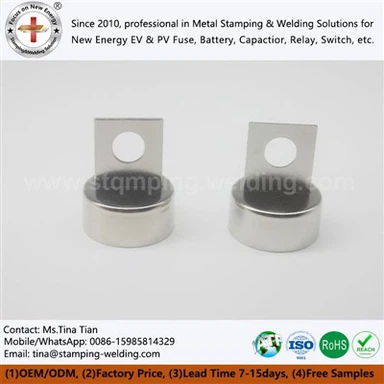
In practical applications, Cylindrical Body Contact Knifes are widely used in various types of fast-acting fuse systems, such as photovoltaic DC fuses (PV fuses), electric vehicle fuses (EV fuses), energy storage system fuses, UPS DC-link fuses (DC-link fuses), industrial PDU modules, and NH and BS standard fuses. The blade-type design enables quick plug-in connections, greatly improving assembly efficiency and facilitating subsequent maintenance. Furthermore, the precise slot positioning and retention mechanism effectively prevent the risk of contact loosening due to mechanical vibration or thermal expansion and contraction. As new energy vehicle voltage platforms advance toward 800V and even 1000V, energy storage system capacity continues to expand, placing higher standards on the reliability, stability, and temperature rise control capabilities of fuse contacts. The superior performance of NH Fuse Links Knifes in these core indicators makes them the preferred choice for overcurrent protection in emerging high-voltage and high-frequency scenarios.
The advantages of Cylindrical Body Contact Knifes lie not only in their structural design and material properties, but more importantly, in the batch consistency and long-term reliability achieved through their manufacturing process. Through mold standardization, process automation, and full-process quality control, high-quality Forged Copper Components can achieve a monthly production capacity of over 50 million units, while maintaining minimal dimensional tolerances and resistance fluctuations within each batch. These products are certified to ISO9001 quality management systems and IATF16949 automotive industry systems, and comply with environmental regulations such as RoHS and REACH, meeting the compliance needs of projects in various regions around the world. For projects with special performance requirements or complex assembly structures, the manufacturer also offers custom design, rapid prototyping, mold development, and other supporting services based on customer drawings, meeting the requirements of B2B projects with short engineering development cycles and high technical barriers.
Market trends suggest that future Copper Blade for Fast Fuse technology will continue to evolve towards higher power density, a more compact size, and lower contact resistance. For example, in applications such as new energy vehicle charging modules, high-speed rail traction systems, and data center UPS power protection, contacts must interrupt high currents in milliseconds while ensuring a lifespan of thousands of plug-in/plug cycles and long-term electrical stability. In photovoltaic energy storage and microgrid applications, contacts must not only handle continuous high current loads but also withstand frequent surges and complex installation environments. To meet these demands, contact blade design is increasingly adopting advanced technologies such as multi-layer composite structures, high-strength surface treatments, and bimetallic transition welding to meet the stringent requirements of high-performance fuse components in emerging markets.

Overall, Fuse Knife Contacts, as essential high-performance conductive components in fast-acting fuse systems, are becoming a key cornerstone for ensuring circuit safety and stable operation in various high-voltage, high-power density applications, thanks to their superior material properties, diverse surface treatment options, mature manufacturing processes, and broad industry adaptability.
contact us