Grounding method for cable shielding layer and laying specification for Grounding copper busbar
Mar 04, 2026
Main sources of interference and preventive measures in power plants and substations
During the operation of power plants and substations, secondary cables are susceptible to various interferences and require targeted preventive measures. Among them, cable shielding layer grounding is one of the core protective measures, and the Grounding copper busbar, as the core carrier of the grounding system, can provide reliable support for shielding layer grounding. In terms of magnetic field interference, the alternating magnetic field generated by the alternating current of a primary device will induce voltage on the secondary cable, and the cable shielding layer, as a conductor, will generate induced current when both ends are grounded, which will then generate reverse induced voltage on the cable core to offset the interference caused by the primary device. Without grounding or single point grounding, it cannot play this role.
Electric field coupling (capacitance coupling interference) originates from the mutual capacitance between primary high-voltage equipment and secondary cables. After the shielding layer is grounded, the capacitance of the cable core to ground will be converted into capacitance to the shielding layer, greatly reducing the coupling interference voltage on the core. Electromagnetic radiation interference can be reflected and absorbed by the shielding layer of woven materials, and its protective effect is independent of whether the shielding layer is grounded, without the need for Grounding bar holes for auxiliary protection.
Summary of Grounding Methods for Cable Shielding Layer
Taking into account the prevention requirements of various interference sources, grounding both ends of the cable shielding layer is the optimal way to prevent electromagnetic field coupling interference. This method is equivalent to parallel connecting the shielding layer to the ground grid, and the Grounding copper busbar can effectively optimize the potential distribution of the ground grid and reduce interference hazards. But the current of the ground grid will partially flow through the shielding layer, generating noise current, which will then generate interference voltage in the cable core.
For cables that transmit high voltage and high current, this type of interference accounts for a very small proportion and can be eliminated at the receiving end of secondary equipment; For communication cables and other cables that transmit weak electrical signals, interference has a greater impact, making single point grounding more suitable. Paired with Copper bus bars for earthing systems, grounding stability can be further improved. For the transmission of important signals, double shielded cables can be used, with single point grounding for the inner layer and two end grounding for the outer layer, further enhancing the protective effect. In addition, when a single-phase short circuit is grounded in the station, the potential difference of the ground grid may cause a large current to flow through the shielding layer. In addition to reducing the resistance of the ground grid, laying grounding busbars along the cable trench can effectively balance the ground potential, divert the shielding layer current, and avoid cable or terminal box burnout.
Requirements for laying dedicated grounding busbars for secondary equipment
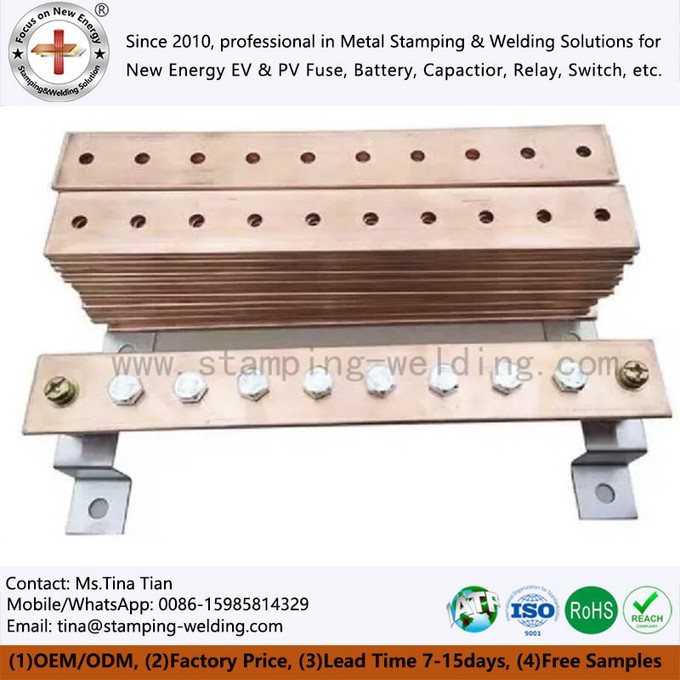
The core purpose of laying Copper ground bus bars is to balance the ground grid potential, ensure the number of grounding points, and reduce the resistance of the ground grid circuit, not just to meet the requirements of high-frequency protection countermeasures. Its laying must strictly follow relevant specifications according to the scene. A 100mm ² grounding busbar needs to be erected on the cable trench support with small insulators in a switch yard, connected end-to-end to form a ring network covering all secondary terminal boxes. The small grounding busbar in the terminal box is connected to the busbar with an insulated wire of not less than 30mm ², and is also connected to the main grounding grid; The grounding busbar should be connected to the main grounding grid with an insulated wire of not less than 150mm ² at a prominent location far from the single-phase grounding short-circuit current entry point. The grounding resistance should be regularly checked, and each connection point should be crimped and tinned to reduce contact resistance.
Inside the protection room, a 100mm ² Copper busbar for uninterruptible power stock needs to be erected on the cable layer support with small insulators, connected end-to-end to form a ring network covering all relevant control and protection cabinets. The small grounding busbar inside the screen is connected to the busbar and the main grid with insulated wires of not less than 30mm ², and the busbar is connected to the main grid with insulated wires of not less than 150mm ² at the obvious grounding point of the cable shaft. The resistance is checked regularly, and the connection points are also treated with crimping and tin plating to ensure the reliable operation of the grounding busbar.

Copper bus bar tapped ring network connection and supplementary requirements
The Power distribution bus bars ring network between the switch field and the protection room needs to be connected with copper cables of not less than 100mm ² to form a unified grounding network with only two grounding points (located below the switch field and the protection room respectively), ensuring balanced ground potential and overall stability of the grounding system, fully exerting the voltage equalization effect of the grounding busbar. In addition, for lines using high-frequency protection, relevant countermeasures must be strictly implemented, combined with Backplane bus bar laying specifications, to further optimize the grounding protection effect, avoid high-frequency interference affecting the normal operation of equipment, ensure the safety and stability of the power system, and make the grounding busbar the core support of power grounding protection.
Contact us
We focus on the research and production of high-quality Grounding copper busbars, which can meet the professional needs of various scenarios such as power plants and substations. If you have any procurement, technical consultation or customized solution needs, please feel free to contact us at any time. We will provide you with professional and reliable products and services.