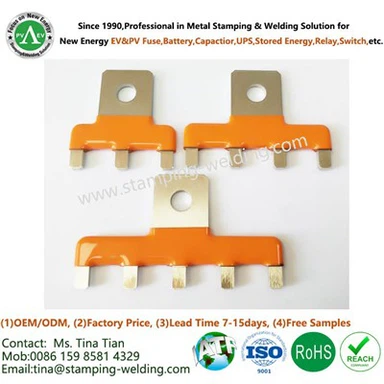
High conductivity and high reliability: Aluminum busbars are an ideal choice for new energy and power systems
Jul 24, 2025
Aluminum Flat Busbar, as one of the core components in modern power transmission and distribution systems, is being widely used in more and more engineering projects and high-tech fields. With its excellent conductivity, light weight, high cost performance, and excellent machining performance, Aluminum Busbars play an important role in many key industries such as new energy, industrial automation, electrical cabinet systems, rail transit, battery modules, photovoltaic energy storage, and electric vehicle charging stations. Especially in the context of the rapid development of green energy, energy storage systems, and electric transportation, aluminum flat busbar has become an important solution to promote cost reduction and efficiency improvement in the industry and electrical connection safety.

Material advantages: light weight and high conductivity, the preferred solution to replace copper
Aluminum Busbar Electrical Power Connectors usually use high-purity aluminum (such as 1060, 1350, 6061, 6063, etc.), among which 1350 aluminum has a conductivity of more than 61% IACS, which is one of the aluminum materials with the closest conductivity to copper. Compared with copper, the density of aluminum is only about 30% of that of copper. While maintaining good electrical conductivity, it greatly reduces the weight of the overall system, which has significant lightweight value for large electrical systems and new energy vehicle power platforms. In addition, aluminum materials have better antioxidant capacity, and the naturally formed oxide film has good insulation and corrosion resistance, and can still work stably for a long time in harsh environments such as outdoor or humid environments.

Mature and stable process, supports high-precision customization
Customized Aluminium Busbars have excellent plasticity and ductility, which is convenient for various secondary processing processes such as stamping, drilling, bending, welding, and crimping. We have an advanced automated busbar processing center, which supports customized proofing according to customer drawings, can achieve dimensional tolerance control of ±0.1mm, and the bending angle error is less than ±1°. It can customize the structure of any plane and three-dimensional layout according to customer design, and flexibly adapt to different product integration solutions.
In terms of surface treatment, we can provide a variety of optional solutions, including anodizing (to improve corrosion resistance and insulation), tinning (to enhance weldability and connection reliability), epoxy powder spraying/polyester insulation coating (to improve insulation level and meet UL94-V0 flame retardant standards), and even support laser marking and exclusive logo customization, which is convenient for customer project full-process traceability management and brand presentation.
Obvious cost advantage, helping to reduce costs and increase efficiency of the whole machine
Under the same electrical performance requirements, Flexible Aluminium Connections can replace traditional copper busbars, and the material cost is significantly reduced, especially for high current and long span wiring scenarios. For example, in photovoltaic inverters, energy storage battery modules, or electric heavy truck fast charging systems, the busbar system usually accounts for an important proportion of the weight and cost of the whole machine. The use of Aluminum Flexible Connections can effectively reduce the manufacturing cost of the whole machine while meeting the dual requirements of thermal stability and mechanical strength.
Excellent thermal management performance, suitable for high current and high density systems
Aluminum materials have good thermal conductivity (thermal conductivity is about 237 W/m·K), which can quickly release heat during high current density transmission to prevent the 6101 aluminum bus bar from heating out of control. At the same time, we can cooperate with additional structures such as heat sinks, thermal insulation sheets, or liquid cooling systems to optimize thermal management in high-density circuit boards and ensure the stability of system operation. It is particularly suitable for application environments that are sensitive to temperature rise, such as energy storage cabinets, battery PACK systems, high-speed charging stations, and IGBT modules.
Strong production capacity and delivery response capabilities
We have multiple automated tin-plated aluminum bus bar punching, bending, coating, and testing production lines, with the ability to produce tens of millions of aluminum busbar components annually. Conventional sizes such as 10×3mm, 20×5mm, 30×10mm, 50×5mm, etc. are all available in stock raw materials to support rapid batch shipments; customized specifications can be completed within 7-10 working days. Sample proofing, batch production cycle can be controlled within 15-20 days. All products pass 100% appearance and size inspection before leaving the factory to ensure stable and reliable quality.
Wide range of industry application scenarios
Bus bar aluminium has excellent performance in multiple electrical and new energy application scenarios due to its high cost-effectiveness and flexible design capabilities.
1. Photovoltaic power generation system: Aluminium flat busbar for switchgears is widely used in inverter busbar connections and DC combiner box wiring to achieve high-power and low-loss transmission.
2. Energy storage system: Applied to energy transmission between battery modules and BMS management systems, supporting modular PACK design.
3. New energy vehicles: Used for 6101 Aluminium Flat Busbar connections in power battery PACK, electronic control system, and charging system to improve the lightweight and cost control capabilities of the whole vehicle.
4. Industrial automation and power distribution system: Used for high-current 6101 t61 aluminum bus bar bridging and distribution connection in electrical control cabinets, frequency conversion cabinets, PDU units, and other equipment.
5. Electric piles and fast charging stations: Suitable for high-current, long-distance wiring environments to ensure transmission efficiency and safety.

contact us