How to Further Optimize the Nickel Plating Process to Improve the Durability of the Copper Cap?
Aug 08, 2024
The nickel plating process plays a vital role in the production of copper caps for electric vehicle fuses. Nickel plating not only improves the corrosion resistance and conductivity of the copper cap but also enhances its stability in complex environments. However, to further improve the durability of the copper cap, we need to optimize the nickel plating process. This article will introduce in detail how to further improve the quality and performance of nickel plating by improving the process flow and adopting advanced technologies.
1. Material selection and preparation
The first step in optimizing the nickel plating process is to select the appropriate plating solution and substrate.
1.1 Selection of high-purity nickel salts
High-purity nickel salts are the key to ensuring the quality of the plating. Low-purity nickel salts may contain impurities that will form defects in the plating and reduce its corrosion resistance and mechanical strength. Therefore, choosing high-purity nickel salts, such as nickel sulfate or nickel chloride, can effectively improve the quality of the plating.
1.2 Surface treatment of the substrate
Before nickel plating, the surface of the copper cap must be strictly cleaned and treated. Any residual grease, oxides or other contaminants will affect the adhesion and uniformity of the coating. Ultrasonic cleaning, pickling and electrolytic degreasing can effectively remove surface contaminants and lay a good foundation for the nickel plating process.
2. Optimization of plating solution
The formulation and maintenance of the plating solution have a direct impact on the quality of the coating.
2.1 Improvement of plating solution formulation
The traditional plating solution formulation usually includes nickel salts, buffers, and additives. By adjusting the proportion of each component in the plating solution, the structure and performance of the coating can be improved. For example, adding an appropriate amount of boric acid as a buffer can stabilize the pH value of the plating solution and improve the brightness and flatness of the coating.
2.2 Selection of additives
Additives play a key role in the nickel plating process. They can improve the grain structure and surface quality of the coating. Selecting appropriate additives, such as brighteners, wetting agents, and antioxidants, can further improve the performance of the coating. For example, using an appropriate amount of saccharin or diacetyl oxime as a brightener can make the coating smoother and flatter.
3. Optimization of nickel plating process parameters
In the nickel plating process, controlling various process parameters is the key to ensuring the quality of the coating.
3.1 Control of Current Density
The current density directly affects the thickness and uniformity of the coating. Too high current density may cause the coating to "burn", while too low current density may cause insufficient coating thickness. By determining the optimal current density through experiments, production efficiency can be improved while ensuring the quality of the coating.
3.2 Control of temperature
The temperature of the plating solution has a significant effect on the formation speed and quality of the coating. Generally speaking, higher temperatures can speed up the deposition of the coating, but may also cause the decomposition of the plating solution and the deterioration of the coating quality. By accurately controlling the plating solution temperature within an appropriate range, such as 50°C to 60°C, a uniform and dense coating can be obtained.
3.3 Optimization of stirring
The uniformity and stability of the plating solution are crucial to the quality of the coating. Mechanical stirring or gas stirring can prevent the sediment and bubbles in the plating solution from affecting the quality of the coating. Moderate stirring can improve the uniformity and brightness of the coating.
4. Post-treatment of coating
The post-treatment process of coating is equally important, which can further improve the performance and durability of the coating.
4.1 Heat treatment of coating
Through proper heat treatment, the grain structure and internal stress of the coating can be improved, and its mechanical properties and corrosion resistance can be improved. For example, heat treatment of coating at 200℃ to 300℃ for 1 to 2 hours can significantly improve the hardness and wear resistance of the coating.
4.2 Passivation treatment of coating
Passivation treatment is to further improve the corrosion resistance by forming a protective film on the surface of the coating. Common passivation methods include chemical passivation and electrochemical passivation. For example, by passivation treatment in dilute nitric acid solution, a dense oxide film can be formed on the surface of nickel coating to enhance its antioxidant properties.
5. Quality control and testing
Strict quality control and testing are the last line of defense to ensure the performance and durability of coating.
5.1 Detection of coating thickness
Non-destructive detection methods such as X-ray fluorescence (XRF) or coulometric methods can accurately measure the thickness of the coating to ensure that it meets the design requirements.
5.2 Testing of coating adhesion
Adhesion test can be carried out by methods such as cross-cutting methods and pull-out tests. Ensure that there is sufficient bonding strength between the coating and the substrate to prevent shedding during use.
5.3 Testing of corrosion resistance
The corrosion resistance of the coating can be evaluated by salt spray tests and cyclic corrosion tests. Ensure that the coating can maintain stable protection performance in various complex environments.
Through the optimization of the above methods and technologies, the quality and performance of nickel plating can be significantly improved, thereby further improving the durability of electric vehicle fuse copper caps. This not only helps to extend the service life of the product, and reduce maintenance and replacement costs but also improves the overall safety and reliability of electric vehicles.
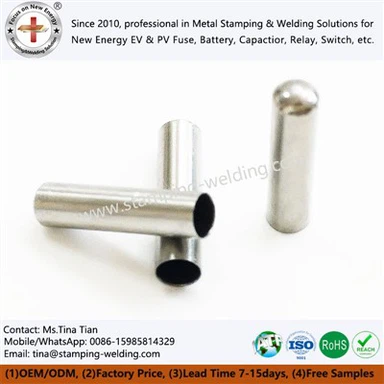
We are committed to producing high-quality nickel-plated fuse electric vehicle copper caps to provide safety for your project. The following is a detailed introduction to the product. If you are interested, you can click to learn more:

Of course, we will continue to devote ourselves to the research and improvement of nickel plating technology to provide customers with better quality and more durable products. If you have any questions or needs about our nickel-plated copper caps, please feel free to contact us.