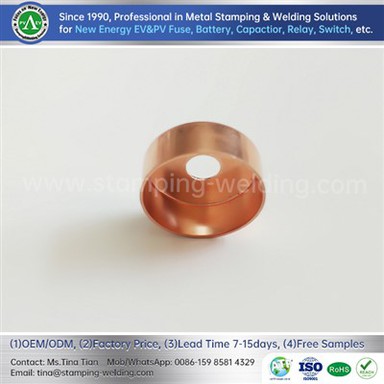
Innovation in Copper-Aluminum Adaptation of Custom Copper Caps: Core Solution to Abnormal Fuse Blowing
Jan 01, 2026
In the cost optimization process of new energy power systems such as photovoltaic, aluminum wires have gradually replaced copper wires as connecting wires for fuses due to their cost-performance advantage. However, the adaptation problem of direct connection between traditional Custom Copper Caps of fuses and aluminum wires has become prominent. Issues such as electrochemical corrosion and mismatched thermal expansion coefficients caused by differences in copper and aluminum materials are likely to lead to a sharp rise in contact resistance at the connection point, abnormal heating, and ultimately premature failure of the fuse. Based on this, the industry has formed an efficient copper-aluminum adaptation solution through structural innovation and process upgrading. Combining relevant patent technologies, this article systematically analyzes the application pain points, innovative designs and core advantages of Copper Cap in copper-aluminum connection scenarios, and sorts out relevant industry knowledge.

Core Pain Points of Direct Connection
Electrochemical Corrosion Problem
As a core conductive terminal component of fuses, Copper End Caps directly determine the operational stability of fuses through the reliability of their connection with wires. When Caps are directly connected to aluminum wires using traditional crimping methods, they first face the problem of electrochemical corrosion. In a humid air environment, copper and aluminum form a primary battery, and the active aluminum is rapidly corroded as the anode, generating a high-resistance aluminum oxide film, which leads to a sharp increase in the contact resistance at the connection point between Cap Copper and aluminum wires. This corrosion will continuously exacerbate the connection gap, further deteriorate the conductive performance, and ultimately cause abnormal heating at the connection point. In severe cases, it will ablate the insulation layer and lead to abnormal fuse blowing.
Hidden Dangers Caused by Thermal Expansion Coefficient Difference
The difference in thermal expansion coefficients further amplifies the connection hidden dangers between Copper End Cap and aluminum wires. The thermal expansion and contraction of aluminum is much greater than that of copper. During the temperature cycle caused by current fluctuations in the power system, the connection point between End Cap Copper and aluminum wires will repeatedly loosen, aggravating the poor contact problem. This dynamic loosening will not only further increase the contact resistance, but also may cause arc generation, ablate the surface of Copper Metal End Cap, damage their structural integrity, greatly shorten the service life of the fuse, and lay hidden dangers for the safe operation of the power system.

Innovative Copper-Aluminum Adaptation Design
Composite Structure Design
Aiming at the traditional connection pain points, the industry has innovatively launched a composite structure design of "Copper End Cap Fitting + aluminum terminals" to fundamentally block the direct contact between copper and aluminum. In this design, retain the core conductive function, and at the same time integrate aluminum terminals on their bodies. The aluminum terminals extend outward from the middle, and the outer ends are provided with concave connection holes specifically for precise butting of aluminum wires. This structure allows aluminum wires to connect with aluminum terminals of the same material without directly contacting Copper Pipe Cap, completely avoiding the electrochemical corrosion risk of copper-aluminum heterogeneous contact.
Oxygen-Free Brazing Connection Process
The connection process between Copper Pipe End Cap and aluminum terminals is the key to ensuring the reliability of the composite structure. The patent technology adopts oxygen-free brazing process to achieve a firm combination of the two. A dense metallurgical bonding layer is formed through high-temperature welding in an oxygen-free environment, ensuring low and stable contact resistance at the connection point. Compared with the traditional crimping process, oxygen-free brazing can effectively eliminate connection gaps, avoid the intrusion of air and moisture, and at the same time improve the connection strength between Copper Cap and aluminum terminals, resist structural stress caused by temperature cycles, and ensure long-term operational stability.

Assembly Optimization and Application
Assembly Process Optimization
The optimization of the assembly process further improves the application reliability. In the connection link between Copper End Caps and fuse tube bodies, through setting through holes at intervals on the circumferential side walls, corresponding riveting holes at both ends of the tube body, and using rivets to pass through the through holes for riveting and fixing, Cap Copper and the tube body form a firm mechanical connection. This assembly method can effectively disperse the stress during current transmission, avoid loosening of the connection point, and at the same time ensure the precise butting in the tube body, ensuring smooth conductive paths.
Core Application Advantages
Innovative Copper End Cap show significant application value relying on their structural and process advantages. On the one hand, they completely solve the corrosion and loosening problems of copper-aluminum heterogeneous connections, extending the service life of fuses in aluminum wire connection scenarios by more than 30% and greatly reducing operation and maintenance costs. On the other hand, the composite structure is compatible with various outer contour designs such as circular and rectangular, and can adapt to fuse products of different specifications, with a wide range of applications. In new energy power systems such as photovoltaic, the application of this type of End Cap Copper effectively improves the reliability of fuses and provides core guarantee for the safe and stable operation of the system.

summary
In summary, the innovation in copper-aluminum adaptation is a key breakthrough in responding to the cost optimization and safe operation needs of new energy power systems. From pain point analysis to structural design upgrading and process optimization, every innovation revolves around the core function. In the future, with the continuous improvement of power systems' requirements for fuses, Custom Copper Caps will continue to iterate in material selection, structural design and other aspects, further strengthening their adaptability in heterogeneous connection scenarios and providing support for the performance upgrading of electrical protection components.
contact us