Popularization of grounding copper bar industry knowledge
May 27, 2026
Grounding copper bars, often called grounding buses or grounding busbars in the electrical industry, are vital conductive components in the connection of electrical equipment and play an irreplaceable key role in grounding protection and electrical connectivity. As a low-impedance ground path conductor, the main function of the ground copper bar is to provide a safe and reliable current discharge channel for the electrical system. When electrical equipment suffers from insulation damage resulting in leakage, lightning strikes, or operating failures, abnormal current or fault current will be generated in the system. Grounding copper bars can efficiently introduce these dangerous currents into the earth, thereby protecting personnel from electric shock and preventing equipment from being damaged by overcurrent. In addition, the grounding copper bar is also responsible for voltage equalization and reducing potential differences.
By connecting multiple ground points in the system to the same potential reference point, the risk of circulation or electric shock caused by potential differences between different devices can be effectively avoided, helping to maintain the stable operation of the entire electrical system. When lightning or electrical faults occur, grounded copper bars can quickly conduct lightning current or short-circuit current underground, reducing damage caused by potential differences to sensitive electronic equipment. Copper Bus Bars for Earthing System is a special product designed based on this core function. Its material selection, size and processing technology must meet the strict requirements of low resistance and high reliability of the earthing system. At the same time, as the main conductor in the grounding system, the Copper Grounding Busbar is usually installed on the grounding busbar of the power distribution cabinet, control cabinet or substation. It is used to collect the down conductors from the grounding terminals of each piece of equipment and connect them to the earth uniformly.

Material advantages
The country has clear and strict standard requirements for the specifications of grounding copper bars, which ensure the quality and safety of the grounding system from the source. First of all, from the material point of view, the grounding copper bar is mainly made of high-purity copper or silver-containing copper materials, of which the pure copper content must reach more than 99.9% to ensure its excellent conductive properties. High-purity copper has extremely low resistivity. Under the same cross-sectional area and length, it can provide lower grounding resistance than aluminum or steel, thereby conducting fault current or lightning current into the earth more efficiently, improving leakage capacity and reducing the steady-state and transient impedance of the grounding system. Red copper can naturally form a dense oxide film in the air. This oxide film can effectively prevent the internal metal from further corrosion, allowing it to have a long service life in a variety of soil and atmospheric environments. This is crucial for grounding bodies that are buried underground or exposed outdoors for a long time.
In addition to purity requirements, the material of the grounding copper bar is also required to have good ductility and processing properties to facilitate subsequent processing operations such as cutting, punching, bending, and welding. Copper ground Bus Bar also needs to consider the corrosive factors in the use environment when selecting materials. For ordinary indoor environments, bare copper can meet long-term use requirements; for chemical plants, coastal areas or high-humidity environments, it is recommended to use copper bars with surface protection treatment.

Detailed display
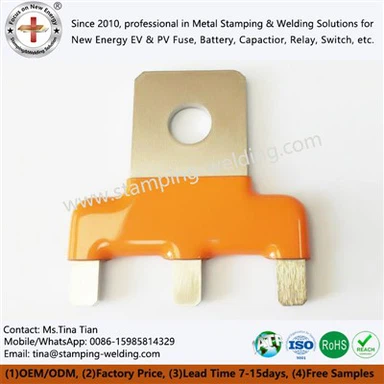
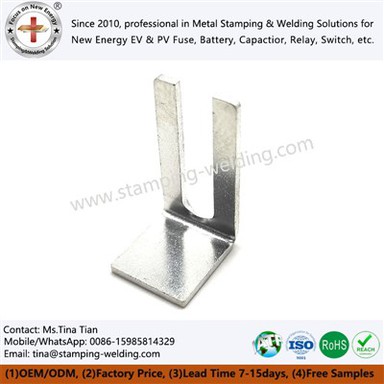
Grounding copper bars usually requires secondary processing in engineering applications to meet the specific needs of on-site installation and wiring. The most common processing feature is to process multiple wiring holes on the copper bus, that is, Copper Bus Bar Tapped, that is, to tap threaded holes or process smooth holes on the copper bus to use with nuts. The processing of threaded holes requires precise hole position, complete threads and no burrs to ensure that the connecting bolts can be screwed in smoothly and provide sufficient tightening force. For plain hole designs, copper or galvanized bolts, flat washers and spring washers are usually used to ensure contact pressure and shock resistance at the connection point. The number and arrangement density of holes depend on the number of devices that need to be connected to the grounding copper bar. They are generally arranged equidistantly according to standardized spacing (such as 20 mm or 25 mm), and mounting holes are reserved at both ends for fixing the copper bar itself. For scenarios where wires of different diameters need to be connected to copper bars, sometimes it is necessary to process mixed holes of different sizes or use oblong holes to adapt to terminal blocks with different hole spacings. All drilling and tapping operations should be completed before tin or nickel plating so that the exposed edges after processing are also covered by a surface protective layer.

Application areas
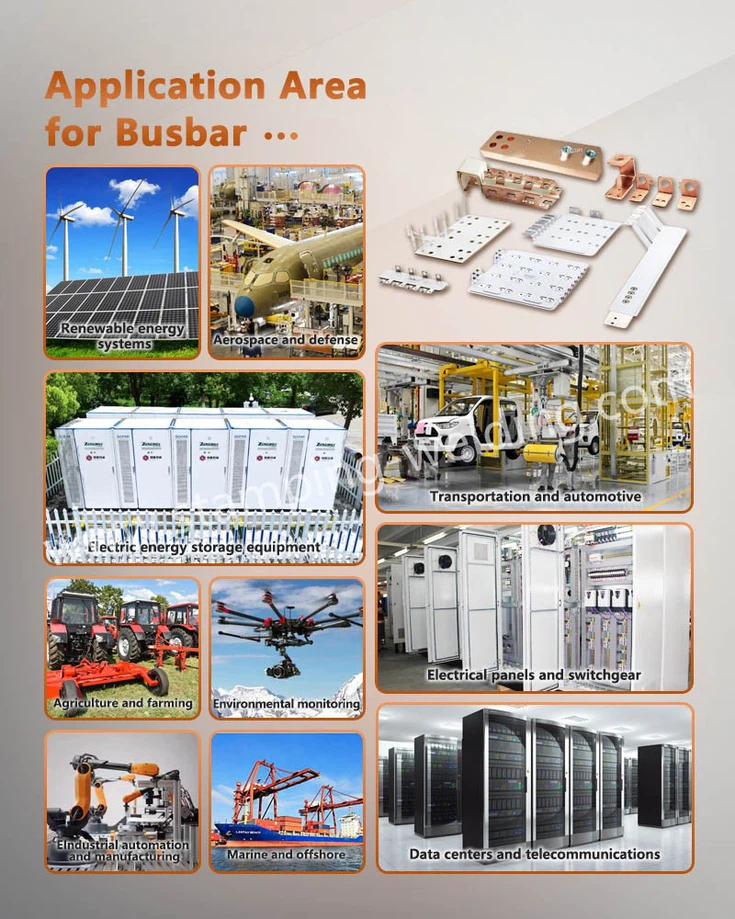
With its excellent electrical conductivity, good corrosion resistance and reliable mechanical strength, grounding copper bars are widely used in many industries such as electric power, communications, transportation, construction, and industrial manufacturing to provide grounding protection, electrical connection, and shielding functions for various types of equipment. In the power system, the grounding copper bar is the core component of the neutral point grounding of substations, distribution rooms, switch cabinets and transformers. It is used to collect grounding down conductors at various intervals and uniformly connect them to the main ground network. In the communications industry, equipment in communications base stations, data centers and switch rooms have extremely high grounding requirements. Grounding copper bars are used to connect cabinet shells, lightning arresters, power modules and the shielding layers of signal lines to form a complete equipotential bonding system. In the field of transportation, in the electromechanical systems of rail transit stations, tunnels, depots and highways, grounding copper bars are widely used for grounding protection of power supply equipment, signaling equipment and lighting systems.
In the fields of construction and home furnishing, grounding copper bars have gradually become an important choice for achieving grounding protection and electrical safety. Especially in the general equipotential terminal box and local equipotential terminal box of high-rise buildings, the grounding copper bar serves as the central node that collects the grounding conductors of all incoming and outgoing lines and plays an overall role. Power Distribution Bus Bar is used in conjunction with grounded copper bars in power distribution systems. The former is responsible for the distribution and transmission of current, and the latter is responsible for the safe discharge and potential equalization of fault currents. The two together form a complete and safe electrical circuit.
contact us
We support customized processing according to customer drawings, including Backplane Bus Bar of different widths, thicknesses, lengths, hole arrangements, and tin plating. You are welcome to send project technical parameters or drawings to our engineering team, and we will provide you with professional selection suggestions, reliable delivery cycles, and complete material certification and testing reports.