Square case battery copper bar product industry knowledge details
Jun 04, 2026
product definition
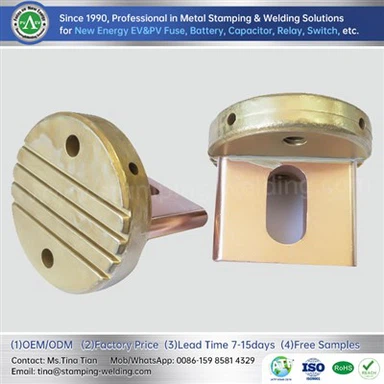
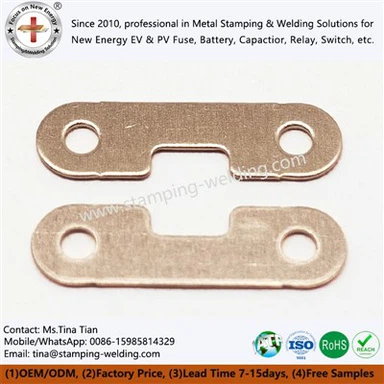
Square case cell connection copper bars are conductive connectors used in square aluminum case or steel case lithium battery modules to connect the positive and negative poles of multiple cells in series or in parallel. This product is usually in the shape of a flat or bent strip, with mounting holes or welding surfaces matching the battery poles at both ends. It forms a reliable electrical connection with the battery poles through bolt tightening, ultrasonic welding or laser welding. In power battery packs and energy storage battery clusters, copper bars not only undertake the core function of current-carrying transmission, but also play a certain role in structural support and heat balancing. From a morphological point of view, Copper Power Bar generally refers to various types of large-section current-carrying copper bars. For scenarios that need to bypass the internal structural parts of the module or adapt to special-shaped spaces, non-linear copper bars manufactured by the bending copper busbar process are required. In the ground protection system, copper ground busbar is used to collect equipment grounding wires, electrical ground bus bar is common in equipotential connections of distribution cabinets and computer rooms, isolated ground bus bar is specially used for ground loops of sensitive electronic equipment insulated from the ground, and telecom ground bus bar meets the special requirements of communication cabinets for high-frequency interference discharge. Bend Copper Busbar, as a process capability description, emphasizes the precise bending and molding of copper busbars to meet three-dimensional space layout requirements.

Material advantages
The mainstream choice of base material for connecting copper bars to square case batteries is high-conductivity copper. Commonly used brands include C1100 electrolytic tough copper and T2 copper, with copper content ≥99.90% and conductivity ≥56MS/m (corresponding to 97% IACS). For maintenance channel copper bars that require frequent disassembly and assembly, C1100-H04 hard material can be used to obtain higher mechanical strength; for dynamic connection scenarios that require flexibility and bending to adapt to cell expansion, C12000 deoxidized copper or C12200 phosphorus deoxidized copper is used. Such materials are less likely to crack after bending. Due to the electrolytic refining process, electrolytic copper busbar has extremely low impurity content and is especially suitable for high current applications where resistance temperature rise is strictly limited. In terms of grounding applications, copper ground busbars usually use C1100 or C12200 materials, and the surface can be bare copper or tin-plated to enhance corrosion resistance; electrical ground busbars can be made of all copper or copper-aluminum composite materials according to different installation environments to reduce costs.
For the isolated ground bus bar, since it needs to be insulated from the ground, insulating pads must be embedded between the copper bar body and the mounting bracket. The material itself is still mainly copper. Telecom ground bus bars often require copper bars with good welding performance to facilitate ground terminal connection, so C1100 materials with tinned surfaces are often used. In terms of surface treatment, the contact surface between the square case battery core and the copper bar usually requires nickel plating (thickness 3~8 μm) or silver plating (thickness 2~5 μm). The nickel plating layer has high hardness and corrosion resistance, and is suitable for bolt-tightening connections; the silver plating layer has the best conductivity and is suitable for welding connections under high current. For the bending part of Bend Copper Busbar, the material should be selected in semi-hard state (1/2H) or annealed state (O state) to avoid cracking of hard materials during bending.

Manufacturing process
The production of square case battery core connecting copper bars starts from the cutting of the base material. A precision slitting machine is used to cut the copper roll with a width of 100~600mm into the required width, and the edge burrs are controlled within 0.05mm. For the linear Copper Power Bar, the next process is CNC stamping or laser cutting. The pole connection holes, sampling wire harness fixing holes and module binding grooves are punched out on the copper bar. The position tolerance of the holes is ±0.1mm, and the diameter tolerance is H11. For scenes that require three-dimensional wiring, the bending copper busbar process is completed by a CNC bending machine or CNC bending machine. The bending procedure adopts the process sequence of punching first and then bending to avoid positioning difficulties after molding. When bending, the bending angle needs to be compensated and pre-adjusted according to the springback characteristics of the Bend Copper Busbar. Usually the springback angle of copper is between 1° and 3°, and the annealed material has smaller springback.
For occasions where multiple layers of copper bars are stacked (for example, two or three copper bars are connected in parallel when the current-carrying capacity needs to be increased), diffusion welding or brazing can be used to weld the overlapping surfaces into one body, and the tensile strength of the weld shall not be less than 80% of the copper base material. The manufacturing of grounding products such as copper ground busbar and electrical ground bus bar is relatively standardized, usually using automatic stamping lines for mass production and then surface treatment. In the production of telecom ground bus bars, in order to facilitate quick identification of circuits on site, we have added a laser marking process to engrave the circuit number and grounding symbol on the surface of the copper bar. The isolated ground bus bar requires an insulating component to be installed between the copper bar and the metal bracket. The insulating pad is injection molded with PA66 or POM, and is assembled with the copper bar through insert bolts. After assembly, 100% insulation resistance testing is performed (500V DC, insulation resistance ≥100MΩ). The contact surfaces of all copper bars will be deburred and passivated before packaging, and a protective isolation film will be used to cover the contact area to prevent oxidation and scratches.

Application industry
In the field of new energy vehicle power batteries, square case battery modules usually consist of dozens or even hundreds of cells connected in series through copper bars to form a high-voltage circuit. A single electrolytic copper busbar needs to carry a continuous current of 200~500A and a short-term peak current of 800~1200A. This places strict requirements on the cross-sectional area design of the copper bar (usually selected according to the current density of 2.5~3A/mm²) and the stress distribution at the bends. The copper busbar manufactured using the bending copper busbar process can effectively avoid the cooling pipeline and voltage sampling wire harness inside the module, and at the same time absorb the thickness expansion of the battery core during the charge and discharge cycle through reasonable deformation design. In the field of energy storage power stations, there are a huge number of square-shell cells in container-type battery systems. Series and parallel connections between modules require the use of large-section Copper Power Bars, which can reach a length of more than 1.5 meters. The straightness and flatness tolerances of the copper bars are extremely high to prevent additional stress from damaging the cell poles after installation.
At the same time, the grounding protection of the energy storage system relies on a reliable copper ground busbar network. Each battery cluster is connected to the busbar through an electrical ground bus bar to ensure that fault current can be safely discharged in the event of insulation failure. In the field of communication base stations and data centers, the DC power supply system (usually -48V) in the cabinet uses a telecom ground bus bar to separate the working ground and protective ground. Precision equipment isolated from the ground requires an isolated ground bus bar to block ground loop interference. In the fields of industrial power distribution and rail transportation, electrolytic copper busbar has become an indispensable current-carrying component in switch cabinets, rectifier cabinets and traction converters due to its high purity (copper content ≥99.95%) and excellent conductivity. The name chatsworth ground bus bar comes from the typical product form of cabinet grounding in North American data centers, and is widely used for equipotential bonding strips inside cabinets.

contact us
Whether it is a Copper Busbar for Prismatic Cell that requires high purity or high-precision repeatable positioning, our engineering team will provide feasibility assessment and cost optimization suggestions. Welcome to provide drawings or samples, we will match you with the most economical processing solution