Standard Electronic cabinet design specification and process points
Mar 12, 2026
core design requirements for Electronic cabinet installation environment
The design of standard Grp electrical enclosures is primarily based on adapting to a standardized installation environment, strictly following the basic principles of system hardware design, and ensuring the stable operation of equipment inside the cabinet in all aspects.
The core requirements include nine key points: the Outdoor weatherproof enclosure cabinet box should adopt a fully sealed structure to isolate external impurities from interference; Strictly control the temperature inside the cabinet to ensure that it does not exceed the allowable working temperature of various system units; Sealed cabinets require the installation of circulating fans, and equipment units with built-in cooling fans can be omitted at discretion;
To ensure smooth air circulation, a gap of at least 100mm should be reserved between the system unit and the cabinet wall; The display unit is strictly prohibited from being installed in areas where the coolant can come into contact, and the front end of the control unit needs to be protected against dust; Avoiding electromagnetic interference throughout the process and reducing the risk of signal fluctuations; Taking into account the convenience of later maintenance and optimizing the operating space during the design phase; Precision components such as hard drives and floppy drives should be kept away from areas with strong magnetic fields to avoid data damage; I/O units and I/O modules must match the corresponding installation conditions perfectly to prevent unauthorized installation.
In addition, the design of Outdoor electrical cabinet must be accompanied by professional thermal design, which controls internal heat loss through precise calculation. The core calculation formula is: internal heat loss P (W) ≤ 6 (W/㎡·℃) × surface area S (㎡) × temperature rise 13 ℃. If the surface area of the cabinet is sufficient, the heat dissipation of the equipment inside the cabinet can meet the standard through natural heat dissipation on the surface of the cabinet, without the need for additional heat dissipation devices; If the surface area cannot meet the heat dissipation requirements, a heat exchanger should be used to assist in heat dissipation. The heat generation parameters of each core component can refer to the standard hardware connection manual for values.

Main material and basic structure design
The main structure of a standard Electronic cabinet must be made of metal material and maintained in a sealed state throughout the entire process. The sealed design can effectively isolate electromagnetic radiation while also preventing dust and oil pollution. For complex working conditions, air conditioning cooling systems are preferred. The cabinet seams need to be welded to ensure no obvious gaps and prevent external impurities from infiltrating; The cuts and openings on the cabinet body should be minimized as much as possible, and the cabinet door and cover plate should be tightly fitted to the cabinet body, with conductive gaskets to enhance the sealing and conductive effect;
When connecting the Contactor cabinet to external components, it is necessary to scrape off the surface paint of the connection position to ensure that the conductivity and grounding performance meet the standards. At the level of sheet metal fabrication, electrical cabinets need to provide reliable protection for internal electrical equipment and have good grounding performance. Traditional galvanized grounding screws are prone to corrosion and affect the grounding effect. In standard design, copper screws are uniformly used, and all cabinet doors are welded with grounding piles to completely solve the problem of insulation grounding and ensure grounding reliability.
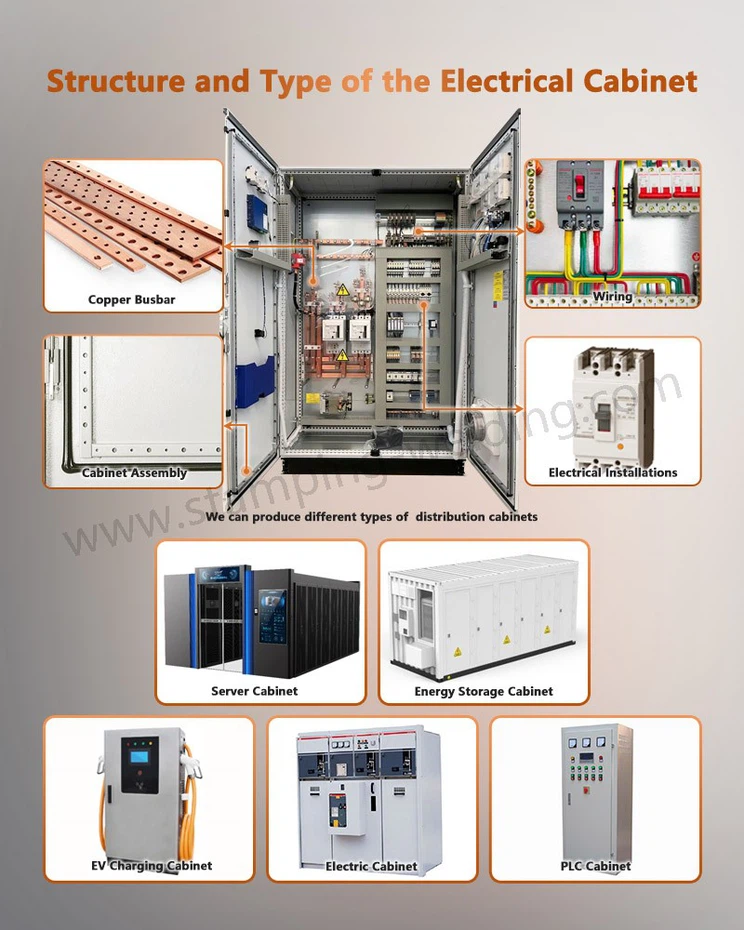
Sheet metal fabrication and process detail specifications
The sheet metal fabrication of External electrical cabinet must follow standardized processes to ensure the quality and ease of operation and maintenance of Metal electrical cabinet in all aspects. The surface of the cabinet should be flat and smooth, with edges and openings polished smooth, without burrs or cracks; The exterior surface, handle, and paint surface of the cabinet are free of damage or deformation, and various components are matched accurately. The cabinet doors, drawers, and other moving parts can be opened and closed flexibly, and the fasteners and connectors are firm and not loose; The activity cabinet door needs to be equipped with a stopper to prevent excessive opening and closing and damage to components; If components are installed on the cabinet door or panel, sufficient wire slot installation bars should be reserved to ensure that the wire slot is firmly fixed and the wiring is standardized;
The back of each base plate of the Electrical enclosure cabinet should be clearly labeled for easy and quick installation and alignment; The components installed in the cabinet must ensure that they meet the quality requirements, the model specifications meet the design requirements, the appearance is intact, the accessories are complete, the arrangement is neat, the fixation is firm, and the sealing is good.
At the same time, the door hinges of the Stainless steel electrical cabinet should be designed to be detachable, taking into account both wiring efficiency and ease of later disassembly, operation, and maintenance; The spare key of the cabinet needs to be fixed in a secure position inside the cabinet with zip ties for unified storage and management; The bottom of the base plate needs to be equipped with footrests and reserved installation gaps to facilitate the assembly of the base plate after wiring; The threaded diameter of the connecting post for protective grounding and working grounding shall not be less than 6mm. The dedicated grounding bolt shall be equipped with clear grounding identification. If steel grounding bolts are used, they shall be properly wrapped before painting the cabinet to avoid paint coverage affecting the grounding conductivity.
Sealing grade and protection design standards
Sealing protection is the core design element of standard Switching cabinet, which needs to meet the dual requirements of transportation and actual use environment, effectively blocking the intrusion of external substances such as dust, coolant, organic solutions, etc., and avoiding damage to internal components. Under normal working conditions, the sealing protection level should reach IP54 standard.
The IP protection level consists of two digits, with the first digit representing the dustproof level and the second digit representing the waterproof level. IP54 can meet the protection needs of most industrial scenarios. In addition to basic sealing, the sealing design of Electrical control cabinets should take into account both structural sealing and long-term stability, to prevent protection failure caused by improper gaps and openings, and to ensure that the electrical cabinet can maintain a stable internal working environment under complex working conditions, thereby extending the service life of components inside the cabinet.
contact us
If you need customized Electronic cabinets that comply with standards and adapt to working conditions, or have technical consultations related to design and process optimization, please feel free to contact us at any time. We can provide professional Electronic control cabinet design solutions and customized services based on your actual usage scenario, to assist in the long-term stable operation of the equipment.