The core ideas and practical principles of Electrical Control Cabinet design
Jan 21, 2026
The core positioning and basic premise of Electrical Control Cabinet design
A qualified PLC Control Cabinet relies not only on the skills of construction personnel but also on the design personnel's adherence to scientific and practical concepts to complete the overall planning. The design of a control cabinet is not simply a stacking of components, but a systematic, logical construction process that needs to take into account multiple requirements, such as safety compliance, process adaptation, and convenient operation and maintenance. The basic premise of PLC Panel Cabinet design is to complete the material statistics and technical data sorting of the entire process. It is necessary to comprehensively summarize the various parts and materials required for the design, sort out the list of purchased finished products, standard parts, main material consumption quotas, and auxiliary material quotas by category, and provide a clear basis for procurement preparation, production organization, and cost accounting.
From the perspective of design logic, as long as it complies with control laws, ensures electrical safety, and meets production process requirements, it can be considered a qualified design solution. However, in order to achieve standardized manufacturing and stable operation of equipment, a refined electrical control process design must be carried out. This process covers the structural design of the Control System Cabinet with PLC, the drawing of overall configuration diagrams and wiring diagrams, the preparation of electrical assembly diagrams and wiring diagrams for each component, and the completion of core technical data such as component catalogs, incoming and outgoing line numbers, and main material lists.

Overall configuration design and component division specification
Electrical Control Cabinet design is a key step in building the overall framework. Its core task is to break down the control system into several functional components based on the working principle and control requirements of the electrical schematic. Then, according to the complexity of the cabinet, each component is further divided into multiple components. Finally, the incoming and outgoing line numbers of each part are sorted out, and the connection methods between them are optimized and adjusted. This design process is ultimately presented in the form of a general assembly diagram and a general wiring diagram, which should indicate the installation positions, wiring relationships, routing methods, and key information, such as cable trays and pipelines used for each core component. These drawings are the core basis for carrying out subdivision design and coordinating the integration of various parts into a complete system. When designing, it is necessary to consider the concentration and compactness of the Application Cabinet layout. Under the premise of space allowance, heating elements, electrical components with high noise and vibration should be kept at a reasonable distance or isolated from other components; For multi station large equipment, it is necessary to fully consider the convenience of operating in two locations, and install the main power switch and emergency stop control switch in prominent and easy-to-operate positions. The rationality of the overall configuration design directly affects the manufacturing and assembly quality of the electrical control system of the PLC Panel Control Logic Program Stainless Steel Automatic Cabinet, and is more related to the stable implementation of system performance, operational reliability, and the convenience of subsequent operation, debugging, and maintenance.
In the component partitioning process, due to the differences in installation positions of various electrical components, in order to ensure the system integrity and maintainability of G8 Switchgear PLC Automatic Control Cabinet Panels, it is necessary to follow scientific partitioning principles: integrate functionally similar components into one group; Minimize the number of connections between components as much as possible, while grouping control appliances with close wiring relationships into the same component; Implement separate arrangement of strong and weak current controllers to reduce mutual interference; To ensure a neat and aesthetically pleasing internal layout of the PLC System Cabinet for Sewage, electrical appliances with similar external dimensions and weights can be centrally arranged; Combine components that require frequent adjustment, maintenance, and wear and tear to facilitate subsequent maintenance operations. At the same time as determining the component division scheme, it is also necessary to clarify the wiring methods between components, electrical boxes, and between electrical boxes and controlled devices: the incoming and outgoing lines of switchgear and control boards are usually connected using terminal heads or wiring noses, and suitable connectors can be selected according to the current size and number of incoming and outgoing lines; Electrical cabinets, control cabinets, and cabinets are connected to the controlled equipment through terminal blocks or industrial connectors; Various standard connectors are used to connect weak current control components and printed circuit board components; The connection between components in the Electric Cabinets PLC Panel Cabinet can be directly connected through the component's own wiring terminals, and the transition connection wires are connected through terminal blocks. The terminals need to be treated with the corresponding specifications of wiring terminals.

Principles and Key Points for Electrical Component Layout Design
The design of electrical component layout diagrams in PLC Programming Electrical Control Panel Power Distribution Cabinet is based on component schematics and component partitioning schemes, while also following a series of key principles to ensure the rationality and safety of the layout. Within the same component, electrical components with large volume and heavy weight should be installed under the electrical board, while heating elements should be installed on the upper or rear of the cabinet. However, thermal relays need to be arranged in the lower position. This is because the outgoing end of the thermal relay can be directly connected to the motor for easy wiring, and its incoming end can be connected to the contactor to shorten the wiring distance and facilitate the heat dissipation of the Control Cabinet Industrial PC; Strong and weak electrical components need to be arranged separately and shielded to prevent external interference from affecting system operation; Electrical components that require frequent maintenance, inspection, and adjustment should not be installed too high or too low. For manually operated switches and instruments that require real-time monitoring, the installation position should comply with ergonomic principles to ensure convenient operation for operators. Reasonable safety gaps should be reserved for component layout, and the overall layout should be neat, beautiful, and symmetrical. Electrical appliances with similar external dimensions and structures can be centrally arranged for easy processing, installation, and wiring. If the wiring method of trunking is used, the spacing between each row of electrical appliances should be appropriately increased to reserve sufficient space for wiring and maintenance.
After the positions of the internal electrical components in each Industrial PLC Cabinet are determined, the drawing of the electrical layout diagram can be carried out. The layout diagram is drawn based on the outline of the electrical components, with the component axis as the reference, indicating the spacing dimensions of each component. The installation dimensions and tolerance range of each electrical component must be strictly marked according to the product manual standards to ensure the quality of the installation plate processing and smooth assembly of the components. Electrical components in large electrical cabinets should be installed between two mounting beams, which can reduce the weight and save materials of the Programmable Logic Controller Cabinet, and improve installation convenience. Accurate calculation of longitudinal installation dimensions is required during design. In addition, according to the number of incoming and outgoing wires, wire specifications, and outgoing positions of this component, the incoming and outgoing wire methods, wiring terminal blocks, connectors, or plugs should be selected, and the incoming and outgoing wire connection numbers should be marked in the specified order. In the design of specialized cabinets for various special scenarios, such as the PLC System Enclosure, the component layout also needs to be combined with the working conditions of the sewage treatment site to strengthen protection and anti-interference design.
Drawing standards for wiring diagrams and key points for cabinet structure design
As the core basis for electrical installation, maintenance, and wiring inspection of PLC Based Control Cabinet, the electrical component wiring diagram needs to be drawn based on the component electrical schematic diagram and electrical component layout diagram, clearly presenting the connection relationship of the complete set of equipment. The drawing process must strictly follow relevant specifications and standards. The drawing of wiring diagrams and wiring tables shall comply with the provisions of GB6988.6-1993 "Drawing of Control System Function Diagrams"; All electrical components and wire markings of Standard PLC Cabinet must be consistent with the electrical schematic diagram, and the project codes, terminal numbers, and wire numbers in the schematic diagram must comply with the requirements of GB5094-1985 "Project Codes in Electrical Technology", GB4026-1992 "General Principles for Identification and Application of Alphanumeric Systems for Electrical Equipment Wiring Terminals and Specific Wire Ends", and GB4884-1985 "Insulation Wire Marking"; Unlike electrical schematics, the various parts of the same electrical component (such as contacts, coils, etc.) in the wiring diagram must be drawn together; The wiring diagram is uniformly drawn with thin lines, and the wiring methods are divided into pre board wiring and post board wiring. Pre board wiring is usually preferred. For simple electrical control components with few components and simple wiring relationships, the wiring between components can be directly drawn. For components with a large number of components and complex wiring, wiring slots are generally used for wiring. Only the wiring numbers need to be marked on the electrical components of each Modular PLC Cabinet, and there is no need to draw specific wiring between components; The wiring diagram should clearly indicate the model, specifications, cross-sectional area, and color requirements of the wires used for wiring; When connecting components to external circuits, large cross-sectional wires should be connected using connectors for incoming and outgoing lines, while others should be connected through terminal blocks.
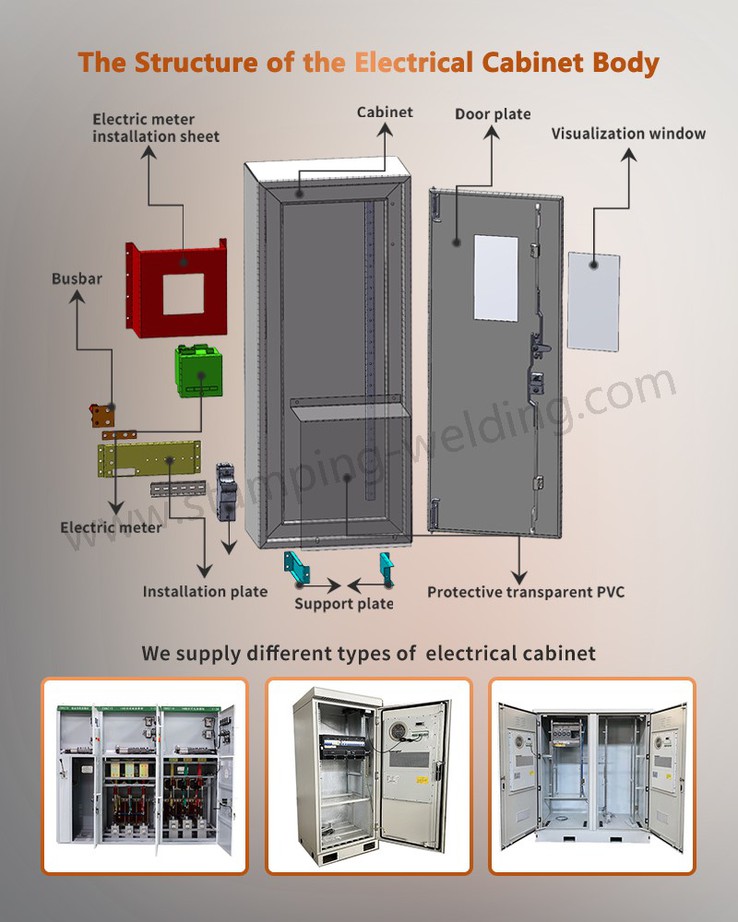
The device usually requires a dedicated cabinet or box, and its structural design needs to consider practicality, safety, and convenience. The core considerations include: determining the overall size and structural type of the cabinet based on operational requirements and the size of various electrical components, such as the control panel and Compact PLC Cabinet. Unless otherwise specified, it must comply with the basic structural dimensions and series standards; Based on the overall size, structural type, and installation dimensions, design the installation bracket inside the box, mark the installation holes, installation bolts, and grounding bolt dimensions, clarify the matching method, and prioritize the use of specialized profiles for cabinet materials; Design the opening method and type of Automation Panel Cabinet based on the installation location, operation, and maintenance convenience on site; To ensure ventilation and heat dissipation of Electrical Control Cabinet appliances, ventilation holes or slots should be designed at appropriate positions in the box, and forced ventilation devices should be installed if necessary; For ease of transportation, it is necessary to design suitable lifting hooks or bottom movable wheels. When designing, it is necessary to first outline the sketch, estimate the dimensions of each part, and draw the outline drawing in proportion. Then, optimize the size ratio from the perspectives of symmetry, aesthetics, and practicality. Afterwards, complete the structural design of each component, draw the assembly drawing and part drawing, mark the processing requirements, and select the appropriate door lock. For non-standard electrical installation parts, it is necessary to draw part drawings according to the design requirements of mechanical parts, clarify the fitting dimensional tolerances, and processing standards.
contact us