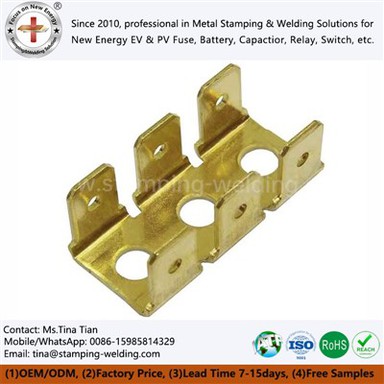
Development Trends For Copper Stamping Parts Industry
May 06, 2025
Industry background and market demand
As key components with high electrical and thermal conductivity, copper stamping parts continue to expand their applications in new energy vehicles, 5G communications, power equipment, and other fields. According to industry reports, the global copper stamp parts market size will reach 180 billion yuan in 2023, and it is expected to grow at a compound annual growth rate of 8.5% in the next five years. Among them, the demand growth in the new energy vehicle field is the most significant. Each pure electric vehicle uses an average of about 83-100 kilograms of Copper Strip Stamping, which is 4 times that of traditional fuel vehicles. The acceleration of 5G base station construction has also promoted the application of copper stamping parts in communication equipment. For example, the demand for signal shielding covers, high-frequency connectors, and other components has increased by 25% year-on-year.

Technological innovation and process upgrade
1. Mold technology breakthrough
The "thick Copper Stamped Components seamless bending mold" developed by a domestic technology company has effectively avoided product appearance defects and side wall deformation problems in traditional processes by optimizing the structural design, improving production efficiency by 30%, and increasing material utilization rate by 15%. The mold adopts a nitrogen pressure support unit to achieve lightweight and high-precision processing, which is suitable for the production of complex structural parts such as new energy vehicle battery connectors.
2. Automation and intelligent production
The popularization of high-precision punching equipment has promoted the improvement of the automation level of the Copper Stamping Processing Connecting process. For example, the 1,000-ton double-point closed crankshaft punch is equipped with an AI visual inspection system, which can monitor the dimensional accuracy and surface quality of the stamping process in real time, and the defective rate is reduced to 1% below. In addition, the combination of digital mold design (CAD/CAM) and virtual simulation technology has shortened the mold development cycle by 20% and reduced production costs by 18%.
3. Material performance optimization
The application ratio of high-purity copper (such as T2, C1100) is increasing, and its conductivity can reach 334.66 MS/m (57.7%IACS), which meets the needs of high-frequency signal transmission. Through alloying modification (such as adding trace phosphorus and tin), the strength of Cross Copper Metal Stampings is increased by 15%, while maintaining good ductility, which is suitable for heavy-duty machinery and aerospace fields.

Policy and environmental protection requirements
1. Industrial policy support
The "Implementation Plan for High-quality Development of the Copper Industry" issued in 2025 proposed that by 2027, the resilience of the copper industry chain supply chain will be significantly improved, and the target rate of recycled copper recycling will be 35%. The policy encourages enterprises to adopt green processes such as short-process casting and intelligent stamping to promote the industry's transformation to high-end and low-carbon.
2. Environmental regulations are becoming stricter
The production of Metal Stamping Parts Electric Copper must comply with the "Comprehensive Emission Standards for Air Pollutants" (GB 16297-1996) and the "Comprehensive Emission Standards for Sewage" (GB 8978-1996), and enterprises in key areas must achieve Class A environmental performance. For example, a recycled copper processing project uses activated carbon + bag dust removal technology to control the particle emission concentration below 30 mg/m³, and the wastewater reuse rate is increased to 85%.
Market competition and regional pattern
1. Regional distribution characteristics
East China accounts for 45% of the Cross Copper Metal Stamping market, mainly relying on perfect electronic information and automobile industry clusters. South China ranks second with 28%, benefiting from the rapid development of new energy vehicles and consumer electronics industries.
2. Competitive strategies of enterprises
Head enterprises integrate resources of the industrial chain to build an integrated capability of "raw material supply-mold development-stamping production-surface treatment" to improve cost control and delivery efficiency. Small and medium-sized enterprises focus on niche areas, such as precision stamping parts for medical equipment, 5G base station heat sinks, etc., and seize the market through customized services.
Challenges and future trends
1. Raw material price fluctuations
The price of copper is greatly affected by the international market. In 2024, the price of overseas Red Copper Stamping Parts will fluctuate between 8,000-10,000 US dollars/ton. Enterprises need to hedge price risks through long-term procurement agreements and futures tools.
2. Growing demand in emerging fields
New energy vehicles: The demand for battery connectors, motor windings, and other components is expected to grow by 18% per year, driving copper stamping parts to develop in the direction of ultra-thin (0.03mm) and high conductivity.
Renewable energy: The market size of copper foil and copper strip for photovoltaic transformers is expected to reach 8 billion yuan in 2025, which puts higher requirements on the weather resistance and welding performance of stamping parts.
3. Technology upgrade direction
Intelligent production: AI algorithm optimizes stamping parameters to achieve "process-equipment-quality" closed-loop control, improving production efficiency by 20%.
Green manufacturing: Promote lead-free surface treatment (such as nickel plating, and gold plating) and waste recycling technology, recycled copper utilization rate target is 40%.
arch.
contact us