Focusing On Fuse Link Contact Copper Blades To Solidify The Safety Line Of Electrical Transmission
Feb 18, 2026
In electrical switch and fuse assemblies, Fuse Link Contact Copper, as core conductive components, are receiving widespread attention in the industry due to the increasing safety standards of power distribution systems. Copper contacts are movable contact elements made of industrial pure copper, commonly found in knife switches, disconnect switches, and various connection structures, playing a crucial role in connecting and disconnecting circuits. In structures, their function is highly consistent with that of conductive components such as fuse contacts and terminal contacts, directly affecting the stability and safety of current transmission.

Material advantages
- Excellent electrical and thermal conductivity with controllable losses: Copper contains 99.5%-99.99% copper, second only to silver in conductivity. Its resistivity at 20℃ is as low as 0.01851 Ω·mm²/m, minimizing energy loss during current transmission and making it suitable for components requiring high conductivity, such as Copper Electrical Fuse Contacts. Simultaneously, leveraging copper's high thermal conductivity of 413 W/(m·K), the product quickly dissipates the high temperatures generated by switching operations, preventing metal softening or contact melting and ensuring operational stability.
- Excellent plasticity and easy processing: Copper possesses excellent plasticity, facilitating processing into various shapes and sizes through cold heading, extrusion, and other processes. This meets the assembly requirements of different electrical equipment and supports the integrated processing of Copper Sheet Fuse Parts, allowing the product to flexibly adapt to the matching needs of various switches and fuses, reducing the difficulty of customized production.

Manufacturing process
- Substrate Molding: Using high-quality industrial pure copper such as T2 as raw material, the copper is processed into shapes and sizes that meet the needs of various electrical equipment through plastic forming processes such as cold heading and extrusion. Strict control over processing precision is maintained throughout the process to avoid problems such as cracking and deformation, laying a solid foundation for the product's subsequent conductivity and wear resistance. It also adapts to the integrated molding requirements of Copper Sheet Fuse Parts.
- Precision Machining: The molded blank undergoes precision machining such as turning and milling to refine the smoothness and dimensional tolerances of the product's contact surfaces. This ensures precise fit between the product and components such as Fuse Terminal Contacts, improving the stability of circuit connection and disconnection. Simultaneously, it optimizes product structural details to meet the assembly and usage requirements under harsh conditions such as high voltage and high current.
- Finished Product Inspection: After molding, the product undergoes multiple rounds of rigorous testing, covering core indicators such as conductivity, dimensional accuracy, and surface plating adhesion. Defective products are eliminated, and potential structural defects are investigated to ensure that the finished product meets electrical equipment safety standards, balancing durability and compatibility to contribute to the stable operation of electrical systems.

Application scenarios
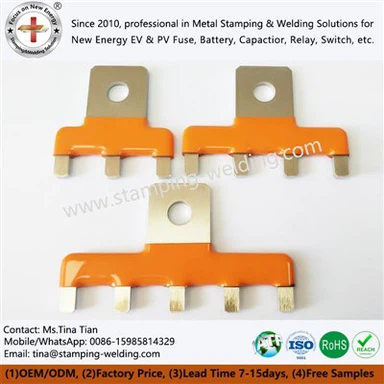
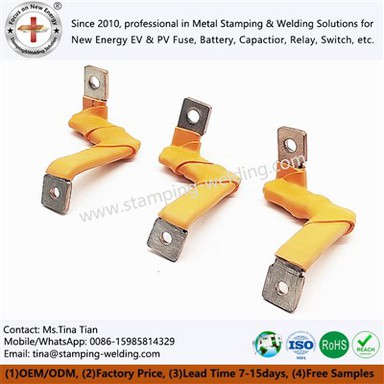
In typical applications, copper contacts are widely used not only in high-voltage disconnect switches and industrial knife switches, but also serve a crucial connection function within fuses. Chip-type structures such as copper sheet parts are often used in high-current fuses, increasing contact area to reduce current density per unit area and thus extending service life. This type of design has become an important direction for optimizing modern terminal contact structures.

in conclusion
With its superior materials and refined manufacturing process, the Fuse Link Contact Copper is suitable for the needs of electrical equipment in multiple fields, combining safety and adaptability. In the future, it will continue to iterate with industry upgrades, empowering electrical systems to operate at a high quality.
contact us
In practical engineering applications, the technical principles of the Fuse Link Contact Copper described above ultimately need to be implemented through specific product design. Different combinations of structures and materials will directly affect the long-term stability of the system.