Riveting
Aug 14, 2023
Introduce
——
Riveting stands as a fundamental joining technique that plays a crucial role in diverse industries, ranging from manufacturing and construction to aerospace and automotive sectors. Employing the principle of mechanical fastening, riveting involves driving a specialized fastener—called a rivet—through aligned holes in two or more materials. This process creates a permanent, robust connection by deforming the rivet's tail, which securely clamps the materials together. Riveting offers exceptional structural integrity, resistance to shear forces, and the ability to withstand heavy loads and vibrations. Its versatility spans from simple applications in sheet metal fabrication to complex assemblies in aircraft construction, where precision and reliability are paramount. As a proven method for joining materials, riveting continues to demonstrate its importance in achieving durable, load-bearing connections across a spectrum of industrial contexts.

Classification
——
Riveting, a pivotal method of mechanical fastening, encompasses various classifications that categorize its applications based on the specific techniques and characteristics involved. The classification of riveting can be broadly understood through the following categories:
- Solid Rivets: Solid rivets are traditional fasteners that consist of a solid, cylindrical shaft with a formed head on one end. They are commonly used in structural applications where strength and reliability are paramount. Solid rivets are installed by deforming the tail end through heat or mechanical force to create a secure joint.
- Blind Rivets: Blind rivets, also known as pop rivets, are versatile fasteners used when access is limited to one side of the materials being joined. These rivets have a mandrel that breaks off during installation, leaving a neat, finished appearance on the accessible side. Blind rivets find wide application in industries like aerospace, automotive, and construction.
- Tubular Rivets: Tubular rivets consist of a hollow, cylindrical body with a head on one end and a tail on the other. They are often used in applications where materials need to be secured without causing damage, making them suitable for leather goods, textiles, and soft materials.
- Semi-Tubular Rivets: Semi-tubular rivets have a partially hollow body with a shallow hole at the tail end. These rivets combine the benefits of solid and tubular rivets, offering structural strength while allowing for easier installation with less force required.
- Drive Rivets: Drive rivets, also known as split rivets, feature two separate legs that are driven apart during installation. These rivets are often used in applications where a permanent yet detachable connection is required, such as fastening nameplates or signs.
- Compression Rivets: Compression rivets consist of two parts, a hollow body, and a solid mandrel. During installation, the mandrel is compressed, expanding the rivet's body and creating a secure joint. These rivets are commonly used in applications that involve soft or delicate materials.
- Friction Stir Riveting: Friction stir riveting is an innovative method that involves rotating a specially designed rivet while it is inserted between two materials. The friction generated by the rivet's rotation heats and softens the materials, creating a solid-state joint as the rivet is driven in.
- Self-Piercing Rivets: Self-piercing rivets are designed to join materials without the need for pre-drilled holes. They penetrate through both materials, creating a strong joint without damaging the surfaces. This type of rivet is often used in joining lightweight metals like aluminum and steel.
- Rivet Nuts: Rivet nuts, also known as threaded inserts, are used to create a threaded connection in materials that are too thin to be tapped. They are inserted into pre-drilled holes and provide a threaded surface for bolts or screws.
- Multi-Grip Rivets: Multi-grip rivets have a unique design that allows them to accommodate a range of material thicknesses. This flexibility makes them suitable for applications where the materials being joined vary in thickness.
Process
——
The riveting process is a fundamental mechanical joining technique used to create strong and durable connections between materials. It involves the installation of a specialized fastener, called a rivet, which secures two or more materials together through deformation and mechanical interlocking. The riveting process typically follows these steps:
- Material Preparation: The materials to be joined are prepared by aligning them and creating holes where the rivet will pass through. The hole size and placement are crucial for achieving a secure and properly aligned connection.
- Rivet Insertion: The rivet is inserted into the aligned holes, with its head positioned on one side of the materials and the tail on the other. For certain types of rivets, the tail end might be pre-installed or partially formed.
- Rivet Deformation: The rivet is deformed to secure the joint. This deformation is achieved by applying force to the exposed tail end. The deformation process varies depending on the type of rivet being used.
Solid Rivets: A solid rivet is often heated to a specific temperature to make it malleable. A bucking bar or anvil is placed against the head of the rivet, while a pneumatic hammer or rivet gun applies pressure to the tail end. The hammer or gun compresses the rivet, causing it to expand and fill the hole tightly, creating a strong joint.
Blind Rivets: Blind rivets are installed using a rivet gun or tool that pulls the mandrel (the stem extending from the tail of the rivet) while the head of the rivet remains stationary. As the mandrel is pulled, the rivet body expands, creating a clamping force and securing the materials.
Compression Rivets: Compression rivets are often installed using a press or a specialized tool. Pressure is applied to the mandrel, causing the rivet body to expand and create a secure joint.
- Mandrel Removal (for Some Types): In the case of blind rivets, the excess mandrel is typically removed after installation. This process ensures a clean and finished appearance on the visible side of the joint.
- Quality Inspection: After riveting, the joint is inspected to ensure that the rivet is properly deformed and that the materials are securely fastened. This step is essential to guarantee the strength and integrity of the connection.
Application
——
- Aerospace: In the aerospace industry, where safety and structural integrity are paramount, riveting is used extensively to assemble aircraft components. It ensures secure connections in fuselages, wings, control surfaces, and other critical structures.
- Automotive: Riveting is a key technique in automotive manufacturing, utilized to assemble vehicle frames, chassis components, body panels, and structural elements. It offers a combination of strength and cost-effectiveness for high-volume production.
- Construction: Riveting is employed in building structures, bridges, and other architectural applications where durability and load-bearing capacity are vital. It joins steel beams, girders, and support elements, contributing to the stability of large-scale constructions.
- Shipbuilding: In maritime industries, riveting has historical significance in shipbuilding. While welding is more common today, riveting is still used for specific applications, ensuring watertight seals and robust connections in critical areas.
- Railway and Transportation: Riveting plays a role in railway and transportation applications, securing components in trains, trams, buses, and other vehicles. It ensures structural integrity and safety in various parts of transportation systems.
- Sheet Metal Fabrication: Riveting is widely used in sheet metal fabrication, forming joints in HVAC systems, appliances, enclosures, and various metal products. It offers an efficient way to join thin materials without compromising their integrity.
- Furniture and Woodworking: In furniture manufacturing and woodworking, riveting joins components like metal handles, hinges, and brackets to wooden or composite materials. It provides a secure connection without the need for visible screws or fasteners.
- Electronics and Appliances: Riveting is employed in assembling electronics, and securing components in appliances like washing machines, refrigerators, and ovens. It ensures a strong bond while maintaining a neat appearance.
- Agricultural Equipment: Riveting contributes to the assembly of agricultural machinery, such as tractors and harvesters. It creates robust connections in structural components that withstand the rigors of farm operations.
- Energy Infrastructure: Riveting is utilized in the construction of energy infrastructure, including power plants, wind turbines, and solar panels. It ensures reliable connections in various components critical to energy generation and distribution.
- Sporting Goods and Recreation: Riveting is used in the production of sporting goods such as bicycles, motorcycles, and even musical instruments. It provides a secure and durable connection in components subject to dynamic stresses.
- Art and Design: Riveting also finds application in artistic and design projects, creating unique connections in sculptures, installations, and architectural features that require a blend of aesthetics and functionality.
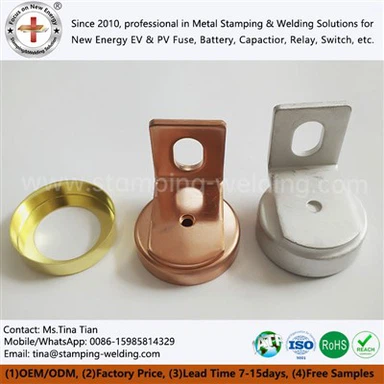
Our company is focused on top quality Copper End Cap, Fuse Terminal Contacts, (ELECTRICAL VEHICLE) EV Film Capacitor BusBar, (SOLAR POWER) PV Inverter BusBar, Laminated BusBar, Aluminum Cases for new energy batteries, Copper/Brass/Aluminum/Stainless Steel Stamping Parts, and other electrical products Metal Stamping and Welding Assembly for over 18 years in China. We started as a small operation, but now have become one of the leading suppliers in the EV and PV industry in China.
If you have any needs, please feel free to contact us and we will reply as soon as possible!