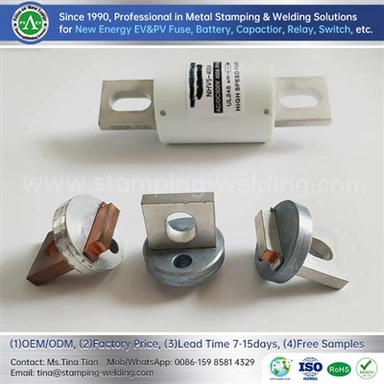


Blade Fuse Terminal
In modern electrical protection systems, the Blade Fuse Terminal bears the dual responsibility of carrying current and cutting off the circuit in critical moments. As the final link in power transmission, the purity of the terminal's material and its structural strength directly affect the safety factor of the entire circuit system. Our hot-pressing/hot-forging blades are specifically designed for high-voltage, high-current industrial environments and are indispensable high-reliability fasteners in photovoltaic inverters, electric drive systems for new energy vehicles (EVs), and power distribution networks.
- Fast Delievery
- Quality Assurance
- 24/7 Customer Service
Product Introduction

Unlike traditional sheet metal stamping and shearing parts, Blade Fuse Terminals are formed through high-temperature metal die forging, resulting in a denser internal structure.
Metal Flow Line Integrity: The hot-forging process allows metal grains to flow along the part's shape, preserving the complete fibrous structure. This means the contact blade has stronger resistance to thermal fatigue when subjected to high current surges.
High Dimensional Consistency: Formed using precision molds under hot conditions, the contact blade's thickness distribution is extremely uniform, effectively avoiding edge micro-cracks and stress concentration points common in traditional stamped parts.
Heavy-Duty Structural Design: Specifically optimized for high-amplitude applications, its thickened cross-section effectively reduces contact resistance and suppresses temperature rise.
Material Advantages: A Perfect Balance Between Conductivity and Mechanical Strength
Extremely High Conductivity (IACS ≥ 99.5%)
Using high-grade electrolytic copper ensures minimal resistance loss, minimizing heat loss during energy conversion and extending the lifespan of the Fuse Knife Contact.
Creep Resistance
Under long-term high-temperature operation, our materials maintain excellent elasticity and hardness, ensuring that the clamping force between the contact blade and the fuse base does not diminish, preventing arcing.
Environmental Compliance
All materials comply with RoHS 2.0 and REACH directives, meeting the compliance requirements of global green energy projects.

Manufacturing Advantages: Engineering Depth of Hot Forging Process
Our manufacturing center combines traditional forging techniques with modern automated control:
1. Constant Temperature Hot Forging Technology
Through an induction heating system, the blank is precisely temperature-controlled, ensuring the metal is formed within its optimal plasticity window, eliminating the risk of deformation caused by uneven thermal stress.
2. Precision Mold Development
Our independently developed tungsten carbide alloy molds enable the integrated forming of complex radius corners and reinforcing ribs. This allows the die to maintain extremely high mechanical strength while possessing excellent surface smoothness.
3. Fully Automated Deburring and Polishing
Utilizing a fully automated drum polishing process, minute burrs invisible to the naked eye are removed. Smooth edges not only improve assembly efficiency but, more importantly, eliminate potential tip discharge phenomena that may occur under high-pressure environments for the Fuse Terminal.

Application Advantages: Adaptable to Harsh Industrial Scenarios
Energy Storage Systems (ESS): During high-current charge-discharge cycles, the low resistivity of the EV Fuse Copper Contacts effectively reduces system self-heating.
Rail Transportation: Facing continuous vibration and impact, the high fatigue resistance of the hot-formed components ensures 24/7 online operation of the signal protection system.
Semiconductor Protection: Extremely fast heat dissipation and precise dimensional matching provide timely physical support for the melting of expensive IGBT modules.

contact us

Hot Tags: blade fuse terminal, China, manufacturers, suppliers, factory
No Information