

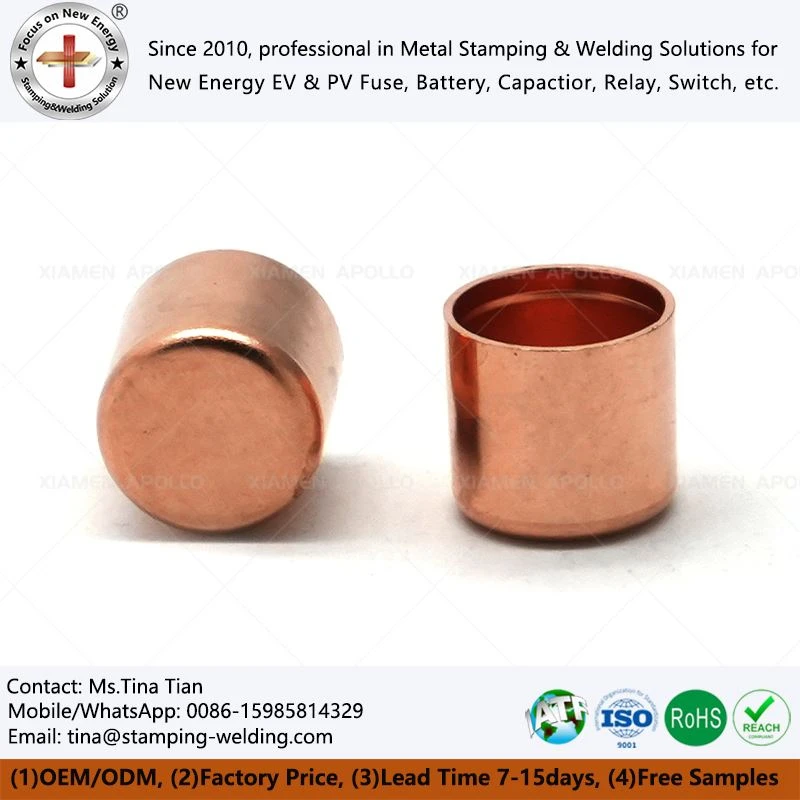


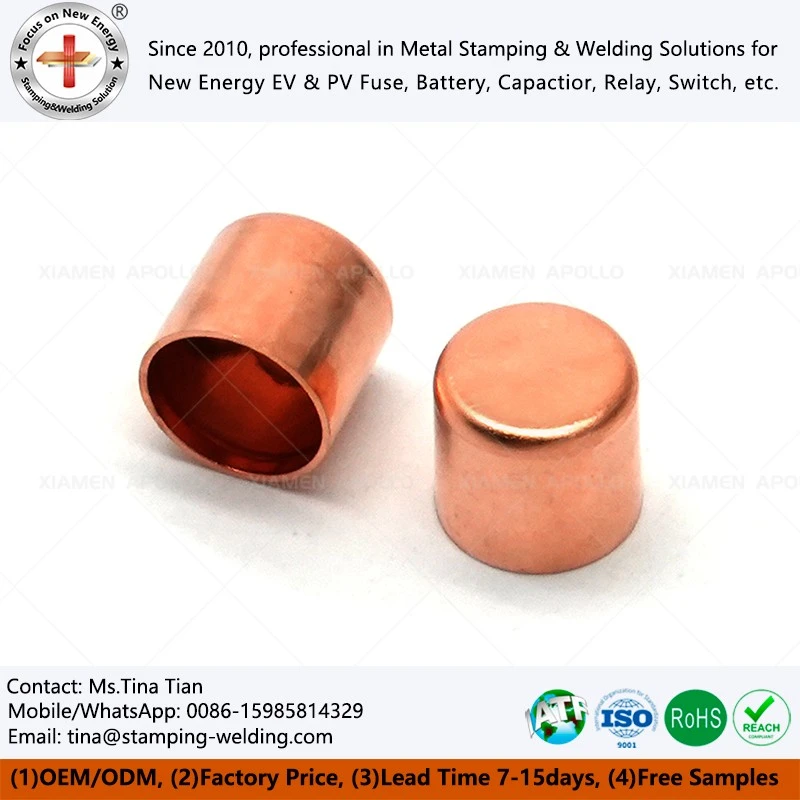


Round Shape Copper End Cap
A Round Shape Copper End Cap is a circular metal component fabricated from copper, primarily used in electrical connection assemblies, fuse structures, and other applications requiring end-sealing, conductive connections, or structural integration. These components typically feature a round, cup-like, cap-like, or sleeve-like geometry, with the specific shape determined by the intended mounting position and functional requirements. In the manufacturing of electrical components, an end cap is more than just a simple metal cover; its outer diameter, inner diameter, wall thickness, depth, end-face flatness, and fit dimensions all critically influence subsequent assembly, contact stability, and the overall structural integrity of the product. For applications involving current conduction, the electrical conductivity of the material, the nature of the end connection, and the quality of the contact interface are equally vital.
- Fast Delievery
- Quality Assurance
- 24/7 Customer Service
Product Introduction
T2 is a standard-grade pure copper (corresponding to the American C11000 classification) with a copper content of over 99.9%. The "Y2" designation denotes a half-hard (1/2 hard) temper-a deliberate compromise for stamped cap components, balancing formability with resistance to deformation.
Why avoid the soft (M) temper? While soft-temper copper offers excellent ductility, the resulting caps are prone to denting or deforming during assembly, transport, or thermal cycling, leading to poor dimensional stability.
Why avoid the hard (Y) temper? Although hard-temper copper provides high strength, it carries a significantly higher risk of cracking during deep drawing or flanging operations; furthermore, any subsequent annealing process would introduce additional, complex variables into the manufacturing flow.
The engineering value of the Y2 temper lies in its ability to provide an optimal window for stamping and forming, while ensuring long-term dimensional stability in the finished part. This is particularly advantageous for components like "outer caps," which must maintain a precise, nested fit with inner caps and tubular bodies.

Material Advantages: The Engineering Value of H65 and Related Brass Alloys
We primarily utilize H65 brass (CuZn35), while also offering similar grades-such as H62, H59, and H68-to meet specific customer requirements. H65 brass strikes an optimal balance between electrical conductivity, mechanical strength, cold-workability, and corrosion resistance. Copper Cap for Cylindrical Fuses is particularly well-suited for fuse end caps that require soldering and demand long-term stability.
Comprehensive Electrical and Thermal Performance
Brass possesses excellent electrical conductivity. Its thermal conductivity facilitates the rapid dissipation of heat during overload conditions, minimizing the impact of localized temperature spikes on solder joints.
Superior Solderability
Brass alloys like H65 exhibit excellent wettability with tin-based solders, enabling the creation of dense, high-strength solder joints while reducing the risk of cold joints or cracks.
Cold-Working and Formability
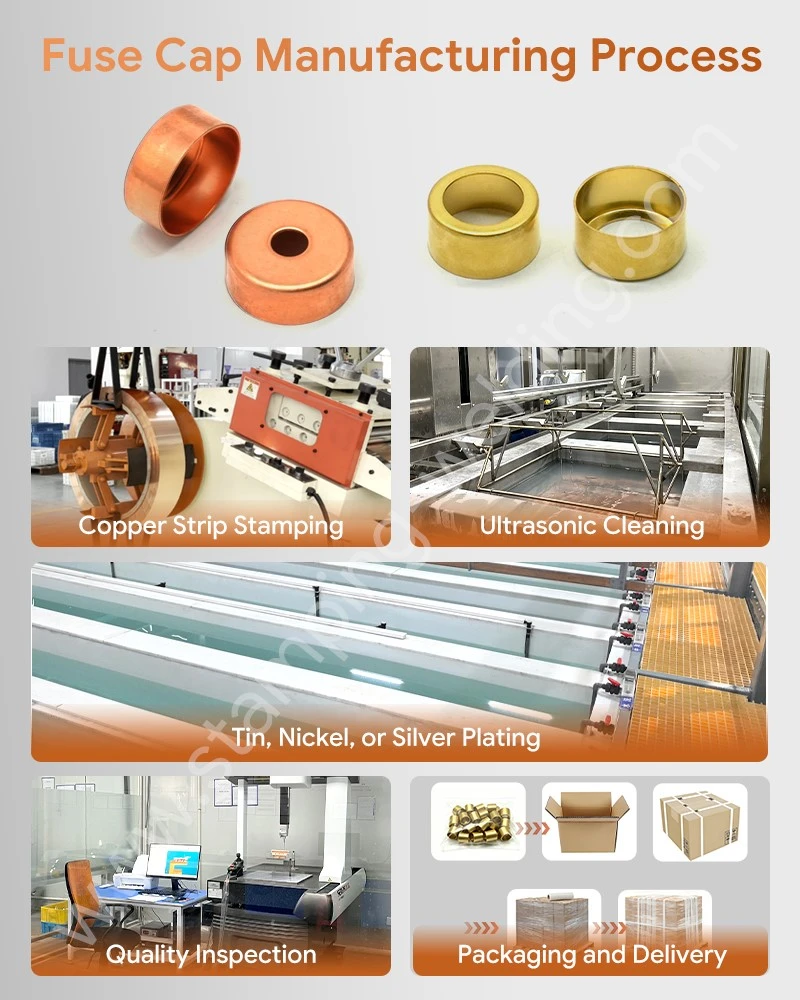
These alloys are ideal for precision stamping, deep drawing, and machining, allowing for thin-walled components and complex, multi-stepped geometries without compromising mechanical strength.
Environmental Resistance
When paired with appropriate surface treatments or platings, these materials offer robust resistance to heat, humidity, mild salt spray, and industrial atmospheric corrosion-meeting the long-term operational requirements for outdoor photovoltaic and energy storage applications.

Key Functions: Four Roles Served by a Single Copper Cap for BS(British Standard) Type Fuse
Conductive Path
Forms a continuous conductive interface with the fuse element, leads, or connectors. Through optimized wall thickness and contact design, it helps regulate contact resistance and long-term temperature rise.
01
Soldering Base
Serves as a foundation for soldering, requiring excellent wettability and surface cleanliness. We strictly control surface oxidation, oils, and residues to ensure robust solder joints and minimize the risk of "cold" or defective solder connections.
02
End-Sealing and Positioning
The outer cap seals the end, while the inner cap provides internal positioning. Together, they establish an assembly reference for the fuse element, filler material, and housing, preventing misalignment, looseness, or concentricity deviations.
03
Appearance and Protection
The circular, symmetrical geometry ensures a consistent visual appearance. Surface treatments-such as passivation, tin plating, or silver plating-enhance resistance to oxidation and discoloration, ensuring the component remains in good condition throughout storage and transport.
04

Frequently Asked Questions for Copper Cap High Pressure OEM
Q1: How does T2Y2 copper differ from other tempers or grades of copper? Why is the "soft" (annealed) temper often used for end caps?
-
The "T2" designation emphasizes high purity, while "Y2" generally denotes a soft (annealed) temper. This state offers excellent plasticity, making it ideal for deep drawing and complex forming, while also facilitating subsequent calibration (sizing) and assembly. If higher hardness is required, it can be achieved by controlling the degree of deformation or through post-processing; however, one must balance the complexity of the forming process against the final mechanical properties.
Q2: What are the primary differences in design and function between outer caps and inner caps?
-
Outer caps are primarily designed for external coverage, connection, and protection; they often feature flanges or larger outer diameters. Inner caps, by contrast, typically serve functions such as internal positioning, structural support, or acting as a conductive interface, with dimensions and fits that are generally more compact. During the design phase, it is essential to clearly define the specific load requirements and current paths for each component.
Q3: Do you support non-standard dimensions and small-batch trial production?
-
Yes, we support custom, non-standard production based on your drawings or samples. We can arrange rapid prototyping for samples and small-batch runs, allowing for the verification of dimensions and surface conditions before moving to full-scale production-thereby reducing the risks associated with potential engineering changes.
Q4: How can copper end caps be protected in humid or outdoor environments?
-
Oxidation can be mitigated through surface cleaning, passivation, or other appropriate protective treatments. The specific protective strategy should be determined based on the actual operating environment and subsequent joining processes, ensuring that treatments do not negatively impact electrical conductivity or weldability.
Q5: How do you ensure consistency in dimensions and electrical conductivity across different production batches?
-
We maintain comprehensive process management, ranging from controlling the state of raw materials and standardizing forming process parameters to monitoring critical dimensions throughout production. For long-term partners, we can implement batch traceability, which facilitates the identification of quality issues and supports continuous improvement.
Contact us
If you are selecting pure copper end caps for a new specification, please provide us with the housing drawings, the atmosphere used in the sealing process, and the press-fit method. We will first offer recommendations regarding material temper and fit tolerances before discussing the provision of samples.
Hot Tags: Round Shape Copper End Cap, Copper Outer Cap, T2Y2 Copper End Cap, Round Copper Cap, Copper End Cap Manufacturer, Brass Inner Cap For Electric Vehicle Fuse, Caps For Fuse Holders, Fuse Cap And Contact, Inner Cap With Hole For Fuse Base, Pipe End Cap Wind Power Converter, T2 Copper End Caps For EV Fuse


