



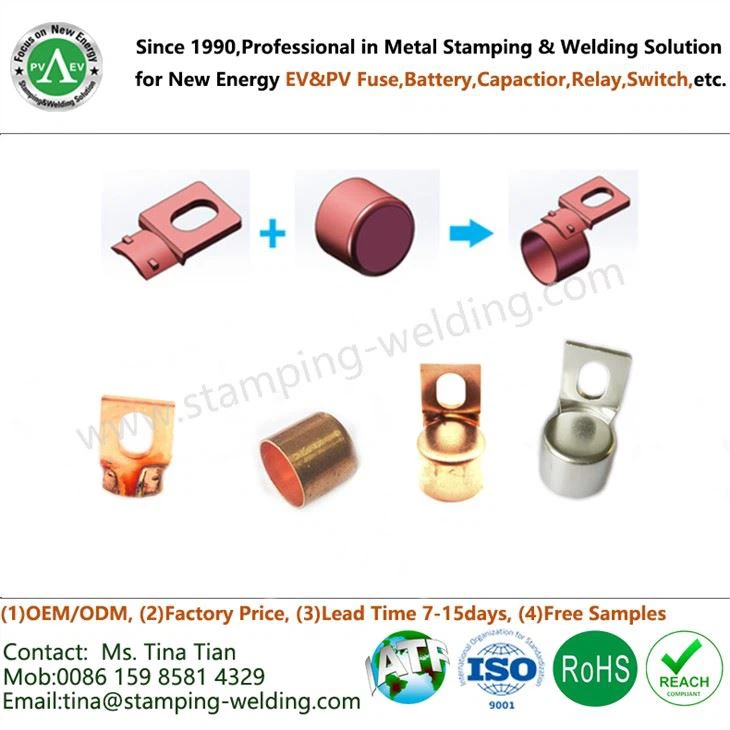
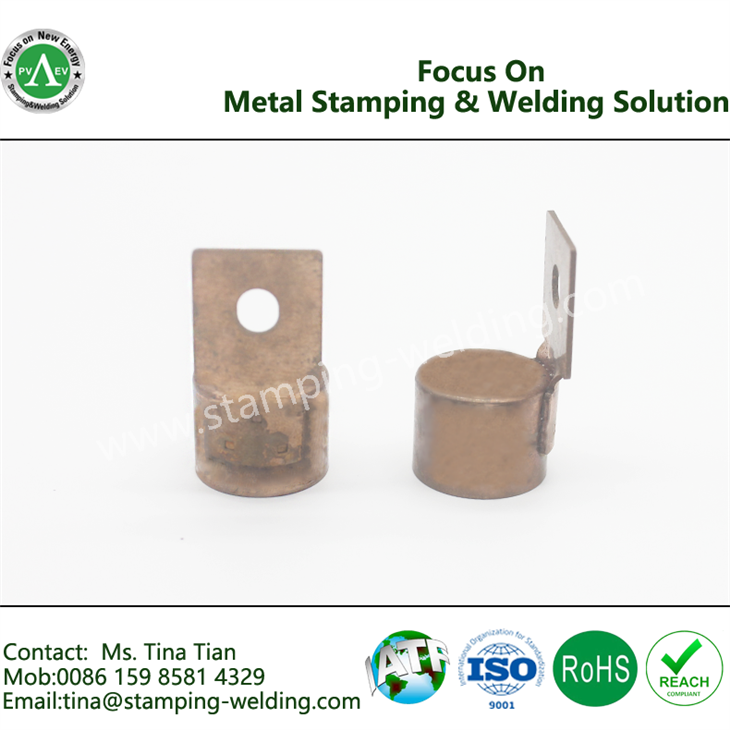

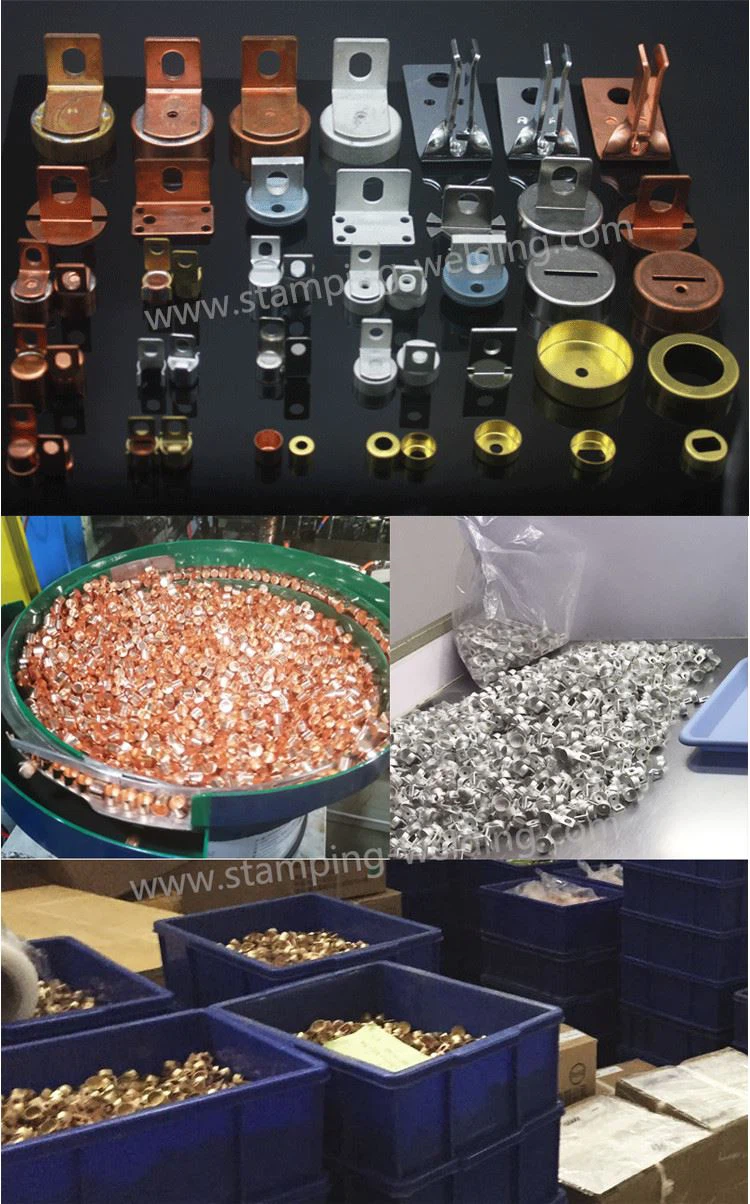
Copper Metal End Cap Resistance Brazing Components For Fuse
Model Number:ASWT-F501
Material:Copper
Application:EV/PV/NH Fuse link
MOQ:1000pcs
- Fast Delievery
- Quality Assurance
- 24/7 Customer Service
Product Introduction

What is the difference between resistance welding and resistance brazing for Fuse Contact Cap?
How to do post-weld cleaning for resistance brazing ?
Resistance welding of Fuse Contact Cap refers to a method of using electric current through the weldment and the resistance heat generated at the contact as a heat source to locally heat the weldment, and at the same time pressurize the welding method. When welding Fuse Contact Knife Cap, no filler metal is required, high productivity, small deformation of the weldment, and easy automation.
1. The difference between resistance welding and resistance brazing for Copper Cap and Fuse Knife
Resistance welding Copper Cap and Fuse End Tag is a method of applying pressure through electrodes after combining the workpieces Copper Cap and Fuse Link Contact, and using electric current through the contact surface of the joint and the resistance heat generated in the adjacent area to weld. Resistance welding Copper Cap and Fuse Terminal is a method of using electric current flowing through the contact surface and adjacent areas of the workpiece to heat it to a molten or plastic state to form a metal bond. There are four main methods of resistance welding Copper Cap and Fuse Contact, namely spot welding, seam welding, projection welding and butt welding.
Brazing Copper Cap and Fuse Terminal Contact is to use a metal material with a lower melting point than the base metal as the solder, heat the weldment and the solder to a temperature higher than the melting point of the solder and lower than the melting temperature of the base metal Copper End Caps Round and Fuse Link Contact, and use the liquid solder to wet the base metal to fill the joint gap and A method for connecting weldments by interdiffusion with the base metal. The brazing deformation is small, the joint is smooth and beautiful, and it is suitable for precision welding. Before brazing Outer Cap and Automotive Fuse Terminals, the workpiece must be carefully processed and strictly cleaned to remove oil stains and excessively thick oxide film to ensure the interface assembly gap. The gap is generally required to be between 0.01 and 0.1 mm.
2. How to do post-weld cleaning of resistance brazing Copper Cap and Fuse End Blade Femules?
Most of the flux residues have a corrosive effect on the brazed joints, and also hinder the inspection of the brazing joints Copper Metal End Cap and Fuse Link Contact, and often need to be cleaned. Residues of active flux containing rosin can be removed with organic solvents such as isopropanol, alcohol and trichloroethylene. Fluxes composed of organic acids and salts are generally soluble in water and can be washed with hot water. Soft fluxes composed of inorganic acids are soluble in water and can therefore be washed with hot water. Fluxes containing alkali metal and alkaline earth metal chlorides (such as zinc chloride) can be washed with 2% hydrochloric acid solution. The borax and boric acid flux residues used for brazing Copper End Cap and Fuse Terminal Contact are basically insoluble in water and difficult to remove. Generally, sandblasting is used to remove them. A better method is to put the brazed workpiece Copper End Caps and Fuse Contact in water in a hot state, so that the flux residue is cracked and easy to remove. Residues of brazing Copper Cap and L-Type Termial fluxes containing potassium fluoroborate or potassium fluoride (such as agent 102) can be removed by boiling or in 10% citric acid hot water.

Welding performance of copper stamping parts Fuse End Cap and Contact
1. Strong thermal conductivity, Fuse Copper Contact Knife Cap has high thermal conductivity, and requires a high-power heat source; preheating the weldment can be used for welding End Cap and Contact.
2. The fluidity is large, and the molten copper liquid has good fluidity, and can only be welded in the flat welding position. If one-side butt welding is to be performed in a spatial position, a backing plate must be added to ensure penetration and obtain good forming.
3. The thermal expansion and cold contraction are large, and the coefficient of linear expansion of Copper End Cap and Contact Welding Components is large, and the phenomenon of thermal expansion and cold contraction during the welding process is particularly obvious, so the deformation after welding is large.
4. Oxidation, copper of Design Welded Joints is easily oxidized in liquid state to form cuprous oxide, which is dissolved in copper liquid. During crystallization, a eutectic with a lower melting point is formed, which exists on the grain boundary of copper End Cap and Terminal, which reduces the plasticity and easily causes cracks.
5. Stomata, the solubility of hydrogen in liquid copper is very large; after solidification, the solubility decreases again. During welding Outer Cap and Contact, the welding seam cools very quickly, and the excess hydrogen does not have time to escape, so hydrogen holes are formed. In addition, the cuprous oxide at high temperature reacts with hydrogen and carbon monoxide to generate water vapor and carbon dioxide. If they cannot escape completely before solidification, pores will also be formed.


Hot Tags: copper metal end cap resistance brazing components for fuse, China, manufacturers, suppliers, factory, Electrical Fuse Components, Copper Outer Cap And Terminal For Fast Fuse, Copper Pipe Cap And Fuse Terminal For EV, Fusible End Cap And Contact For New Energy Car, End Cap And Contact Fuze Welding Components, Fuse Contact And End Caps Components
No Information


