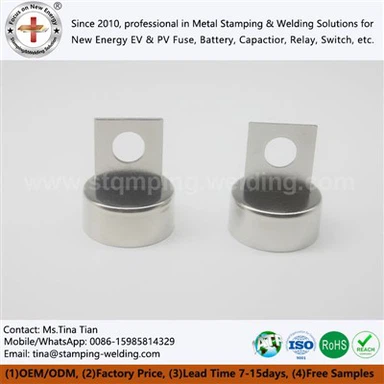


L-Type Terminal
In low-voltage power distribution systems, electrical control cabinets, and wall-mounted metal enclosures, terminal connectors play a vital role in current transmission, electrical interconnection, and structural mounting. As a key conductive component within distribution cabinets, the L-type terminal utilizes a well-engineered L-shaped design to facilitate changes in cable connection direction, optimize space utilization, and ensure stable electrical connections. These products are commonly used in distribution cabinets, fuse holders, power distribution modules, and industrial electrical equipment. Manufactured from highly conductive T2Y2 copper using precision metal stamping and tapping processes, they meet engineering requirements for high reliability, consistent performance, and long-term operational stability.
- Fast Delievery
- Quality Assurance
- 24/7 Customer Service
Product Introduction

What is an L-Type Terminal?
The L-type fuse base is essentially a "highly conductive connection point designed for repeated insertion and removal." It must withstand the rated current during normal fuse operation and reliably carry fault currents during short-circuit or overload events, all while maintaining contact surface integrity after repeated cycles of insertion and extraction. Its core characteristics include:
An L-shaped geometry that offers flexible wiring orientation, accommodating the top and bottom cable entry/exit requirements of power distribution cabinets;
A body made of pure copper, providing low electrical resistivity and excellent thermal conductivity;
Precision-tapped threads-formed after stamping-that ensure secure fastener connections and allow for repeated assembly and disassembly;
A clamping or insertion interface matched to the fuse, ensuring uniform contact pressure.
NH Series Fuse Base Knife Contact Key Functions and Comprehensive Application Scenarios
This product performs core functions such as power distribution, overload protection, signal aggregation, and rapid circuit disconnection. It is widely used in engineering projects with rigorous safety and stability requirements:
Data Centers and Communication Base Stations
Utilized in DC power distribution cabinets and UPS systems to ensure power safety in high-density computing environments.
New Energy Generation and Energy Storage Systems
Serves as a DC fuse holder and power distribution terminal in PV combiner boxes and battery energy storage system (BESS) cabinets, capable of withstanding high-voltage DC arc impacts.
Industrial Automation and Rail Transit
Deployed in industrial control cabinets, machine tool electrical enclosures, and trackside distribution boxes, designed to withstand complex outdoor environments characterized by high vibration and significant temperature fluctuations.
Commercial and High-End Residential Power Distribution
Functions as a secondary distribution unit and protection terminal within intelligent building power distribution systems.

Knife Contact Material Advantage: The Choice of T2Y2 Half-Hard Temper
Purchasing agents often ask, "Why not use softer pure copper? Wouldn't the conductivity be better?" This is precisely the point that requires clarification regarding this product.
| Temper | Conductivity & Ductility | Strength & Thread Retention | Suitability Assessment |
| M (Soft) | Excellent conductivity; resists cracking during bending | Threads prone to stripping; poor creep resistance; deforms easily when tightened | Unsuitable for load-bearing threaded components |
| Y2 (Half-Hard) | High conductivity; retains sufficient ductility | Good thread load-bearing and torque retention; resists cracking during bending. | Optimal balance of load-bearing, conductivity, and bendability |
| Y (Hard) | High hardness | Significant risk of cracking during bending; requires larger bend radii | Unsuitable for tight 90° bends |
For applications with tight temperature-rise margins or harsh temperature and humidity conditions, a low-temperature stress-relief annealing process can be applied. This relieves residual stresses from stamping and bending, stabilizes dimensions, and inhibits
subsequent warping or deformation, all while causing negligible loss of the Y2 temper's hardness. The decision to use this step is made on a case-by-case basis, depending on part geometry and operating conditions, rather than through a one-size-fits-all approach.

Frequently Asked Questions for Fuse Bases for Knife Type
Q: What certificates do you have now?
-
A: We currently have certifications such as RoHS, ISO9001, IATF16949, etc.
Q: What information do I need to send to obtain your company's quotation?
-
A: To provide a quotation as soon as possible, we need the following information:
1. Detailed drawing of required goods (format: CAD/PDF/DWWG/STEP/IGES)
2. Production materials
3. Required quantity
4. Process required for surface treatment
5. Other requirements or packaging methods required
Q: Can private customization be provided?
-
A: Of course, please provide your detailed requirements or samples.

contact us
If you are developing power distribution cabinets, fuse protection modules, or electrical connection systems, we can provide customized NH Fuse Base solutions tailored to your structural drawings, current requirements, and assembly environment. Leveraging our stable manufacturing capabilities and expertise in engineering optimization, we help you enhance product reliability and supply chain efficiency.

Hot Tags: L-Type Terminal, Distribution Cabinet Terminal, Copper Fuse Holder Base, Copper Terminal Block, T2Y2 Copper Terminal, Metal Stamping Parts