


Lightweight Advantage and Strength Balance of Aluminum Battery Case: Key Support for Range Improvement of New Energy Vehicles
Sep 27, 2025
Products Description
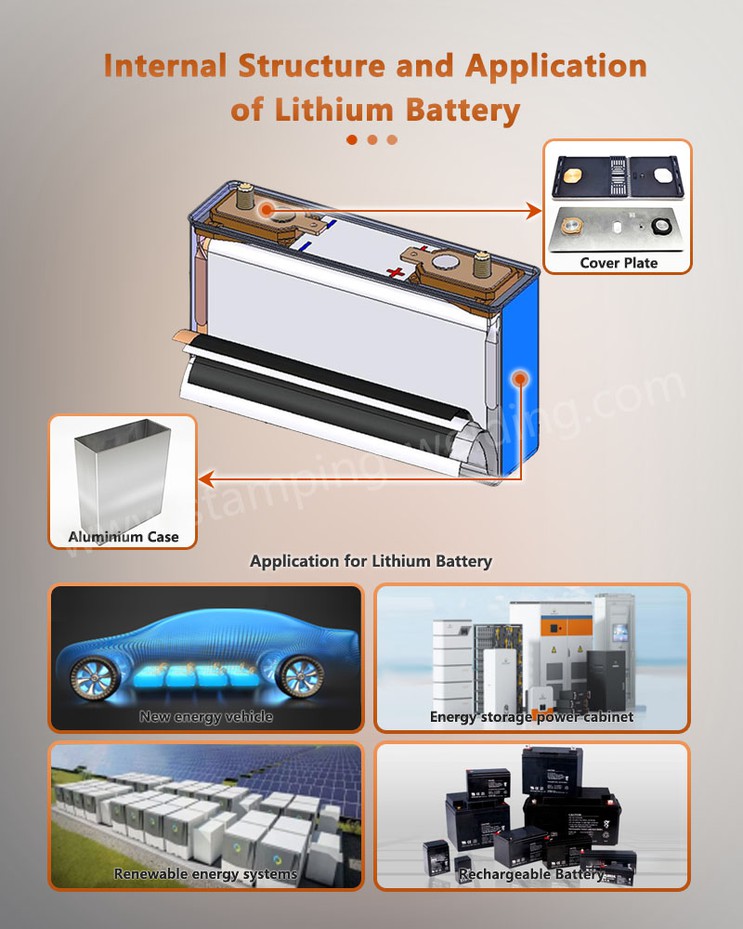
As global new energy vehicle (NEV) sales surge-surpassing 10 million units in 2024-consumers and manufacturers alike prioritize one critical metric: driving range. A NEV's battery pack, which accounts for 25–35% of the vehicle's total weight, is the single biggest factor influencing range. This is where the Aluminum Battery Case, including variants like the Lithium-ion Battery Aluminum Shell, has emerged as a game-changer: they reduce pack weight by 30–40% compared to traditional steel cases while maintaining the structural strength needed to protect fragile battery cells. For automakers aiming to hit 500+ km range targets without increasing battery size, balancing lightweight design and durability in cases, such as the Lithium Batteries Square Aluminum Casing, is no longer an option-it's a necessity.

Material Science: Why Aluminum Stands Out for Battery Cases
- High Strength-to-Weight Ratio: Aluminum alloy (typically 6000-series, e.g., 6061 or 6082) has a tensile strength of 270–310 MPa-comparable to mild steel-while weighing only 2.7 g/cm³ (vs. 7.8 g/cm³ for steel). This translates to a battery case, like a Deep Drawn Aluminum Battery Housing, that's 30–40% lighter than steel, directly cutting the vehicle's curb weight and reducing energy consumption.
- Corrosion Resistance: NEV battery packs are exposed to road salt, moisture, and temperature fluctuations. Aluminum forms a natural oxide layer (Al₂O₃) that prevents rust, a key advantage for the Pack Aluminum Housing, eliminating the need for heavy anti-corrosion coatings (common in steel cases) that add weight.
- Thermal Conductivity: Aluminum's thermal conductivity (205 W/m·K) is 5x higher than steel, helping dissipate heat from battery cells during charging and operation. This is particularly beneficial for the Lithium-ion Battery Aluminum Shell, reducing the load on the vehicle's thermal management system, further saving energy and extending range.
- Formability: Aluminum can be cast, extruded, or stamped into complex shapes-critical for fitting battery packs like those using Lithium Batteries Square Aluminum Casing into tight vehicle chassis spaces (e.g., under-seat or floor-mounted designs).

Production Process: Ensuring Strength While Maintaining Lightweight Design
The production of the battery cases, including the Deep Drawn Aluminum Battery Housing, requires precision to balance structural integrity and weight. Leading manufacturers follow a four-step process:
- Material Selection & Preparation: High-purity 6000-series aluminum ingots are melted and alloyed with magnesium and silicon (to enhance strength). The molten alloy is cast into billets, then heat-treated (T6 tempering) to increase hardness-this step ensures the final case, such as the Pack Aluminum Housing, can withstand 150+ kN of compressive force (per ISO 26262 safety standards).
- Forming: Extrusion vs. Die Casting:
Extrusion: Ideal for long, narrow cases (e.g., for sedan floor-mounted packs). The billet is pushed through a die to create hollow profiles, which are then cut and welded into a frame. Extruded cases offer uniform strength but are limited in complex shapes.
Die Casting: Used for complex, compact cases (e.g., for SUV or EV pickup packs). Molten aluminum is injected into a steel mold under high pressure (100–150 MPa), forming the entire case in one piece. This method is suitable for creating a robust Lithium-ion Battery Aluminum Shell, reducing welding (a potential weak point) and allowing for integrated features like cooling channels-critical for thermal management.
- Machining & Surface Treatment: After forming, the case is precision-machined to ensure tight tolerances (±0.1 mm) for fitting battery cells and lids. It then undergoes surface treatment: either anodizing (to thicken the oxide layer) or powder coating (for extra scratch resistance)-both processes add minimal weight (<5% of the case's total mass).
- Quality Testing: Each case, including the Aluminum Battery Case, undergoes rigorous testing, including:
Impact Test: Dropping a 50 kg weight from 1.5 m to simulate a collision (per UN R100 safety standards).
Waterproof Test: Submerging the case in 1 m of water for 30 minutes to ensure IP67/IP68 rating (no moisture ingress).
Weight Verification: Using precision scales to confirm the case meets target weight (typically 8–12 kg for a 70 kWh battery pack-vs. 12–18 kg for steel).

Application in NEVs: Direct Impact on Range and Safety
The Power Battery Shell, such as the Lithium Batteries Square Aluminum Casing, is now standard in mid-to-high-end NEVs, with automakers reporting measurable range improvements:
Range Boost: A 2024 study by the European Automobile Manufacturers Association (ACEA) found that switching from a steel to an Aluminum Battery Case reduced a NEV's curb weight by 80–120 kg. For a vehicle with a 70 kWh battery, this translated to a 15–20% range increase (e.g., from 450 km to 540 km) at highway speeds (120 km/h).
Safety Performance: During crash tests, aluminum cases like the Deep Drawn Aluminum Battery Housing absorb 2x more energy per kg than steel (per IIHS data). For example, Tesla's Model 3 uses an extruded Aluminum Battery Case that withstood a front crash at 64 km/h without damaging battery cells-meeting the strictest global safety standards.
Integration with Battery Technology: As NEVs adopt larger battery packs (100+ kWh for long-range models), the cases' lightweight design becomes even more critical. Chinese automaker BYD's Han EV uses a die-cast Pack Aluminum Housing for its 101 kWh blade battery, keeping the pack weight under 500 kg and enabling a 715 km range (CLTC standard).
Future Trends: Towards Even Lighter and Stronger Designs
As NEV range targets push to 800+ km, the Aluminum Battery Case for powerwall lithium battery pack technology is evolving:
Hybrid Alloys: Adding lithium or scandium to alloys increases strength by 20–30% without adding weight. Swedish company Gränges is developing a lithium-aluminum alloy case that weighs 5% less than current designs while withstanding higher impact forces, a potential advancement for the Lithium-ion Battery Aluminum Shell.
Integrated Design: Future cases will combine the battery enclosure with the vehicle's chassis (e.g., "skateboard" platforms), eliminating redundant components and further reducing weight. Volkswagen's Scalable Systems Platform (SSP) will use this approach, with the Pack Aluminum Housing integrating suspension mounting points-cutting overall vehicle weight by an additional 50 kg.
Sustainability: Recycled aluminum will become standard. By 2027, 70% of Lithium Batteries Square Aluminum Casing will use recycled material (up from 40% in 2024), aligning with automakers' carbon neutrality goals.
Contact us


