Analysis and market prospects of EV charging cabinet technology
Apr 01, 2026
Key nodes under industrial transformation
With the global energy structure shifting towards green and low-carbon, and the general increase in environmental awareness, electric vehicles have become the core direction of modern transportation development. As a key infrastructure supporting the large-scale application of electric vehicles, the construction and operational efficiency of EV charging cabinets directly determine the user experience and popularization process of electric vehicles. In this industry chain, battery cabinets, as the core technical unit of charging stations, have a profound impact on charging efficiency, battery life, and overall operational safety in terms of their performance.
Currently, driven by continuous breakthroughs in battery technology and a sharp increase in charging demand, Fireproof battery charging cabinet technology is facing unprecedented development opportunities. Governments around the world have successively introduced policies to support the new energy vehicle industry and accelerate the layout of charging infrastructure in order to promote energy transformation. The battery cabinet technology is also iterating towards intelligence, efficiency, and safety, becoming a key factor determining the charging service capability and market competitiveness.
Composition and operating principle of battery cabinet
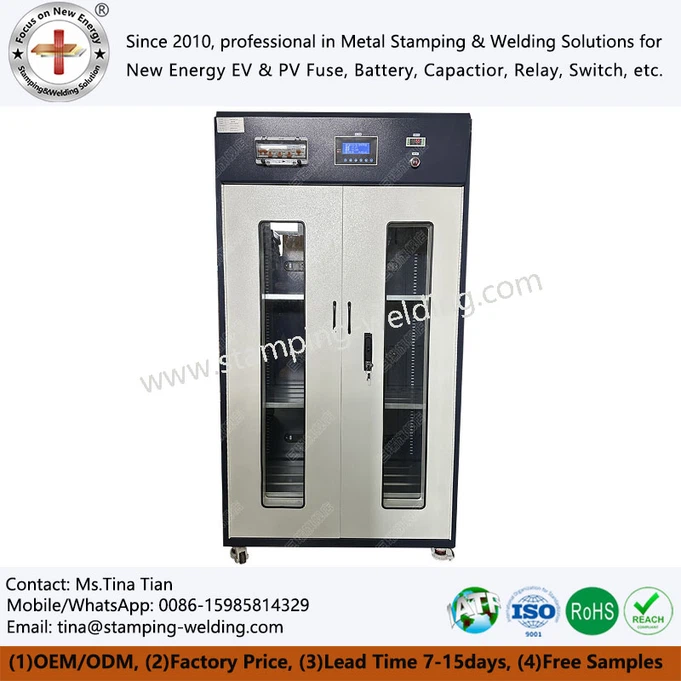
EV charging cabinet is the core equipment for energy storage and scheduling in charging stations, and its design and technical level directly determine the comprehensive efficiency of the system. From a structural perspective, the battery cabinet mainly consists of four parts: the box structure, battery modules, management system, and heat dissipation system.
Lithium battery charging cabinets typically use high-strength metal materials such as stainless steel or aluminum alloy to ensure structural stability and safety protection. The interior is equipped with battery slots with good insulation performance for fixing and protecting battery modules. The battery module, as the core energy storage unit, is composed of multiple individual batteries connected in series or parallel to form a module with specific voltage and capacity. Currently, lithium-ion batteries are the dominant type.
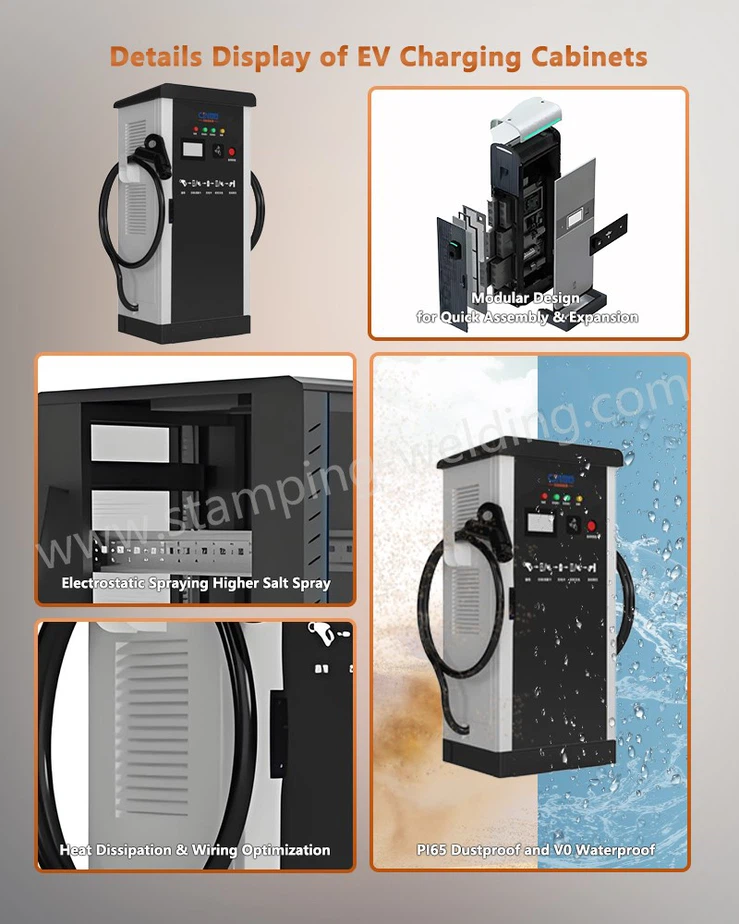
In terms of operation mechanism, the management system of the 12v battery charger cabinet plays the role of the "central nervous system", ensuring that the battery always operates in the optimal range by real-time monitoring of battery status, executing charging and discharging strategies, implementing safety protection and data communication. The cooling system adopts air cooling or liquid cooling methods to effectively control the working temperature and prevent the risk of thermal runaway, targeting the heat generated by the battery during charging and discharging. Overall, the DC rapid charging is based on the principle of electrochemical energy storage, which converts electrical energy into chemical energy during charging and releases it in reverse during discharge. The management system achieves precise control during this process, ensuring operational efficiency and safety. With the evolution of technology, modern battery cabinets increasingly emphasize electromagnetic compatibility, modular design, and convenient maintenance, gradually evolving towards integration and intelligence.
Development Trends: Intelligence, Efficiency, and Security
Currently, Electric vehicle charging cabinet technology is rapidly developing along three main lines: intelligence, efficiency, and safety. In terms of intelligence, advanced battery cabinets have functions such as self diagnosis, adaptive charging strategy optimization, remote monitoring and warning, which can dynamically adjust charging parameters based on battery status, significantly improve charging efficiency and delay battery degradation. Efficiency is reflected in the continuous breakthroughs of fast charging technology, which optimizes battery materials and charging protocols to significantly shorten single charging time and better meet users' needs for convenient energy replenishment. At the same time, the widespread application of high-power density battery cabinets also puts forward higher requirements for heat dissipation design and energy management.
Security is the bottom line of technological development and a top priority for the industry. Modern Charging docks generally integrate multiple safety protection mechanisms, including overvoltage protection, overcurrent protection, short circuit protection, and thermal management systems, which can effectively prevent safety accidents caused by overcharging, overheating, or internal short circuits. The improvement of battery status monitoring technology has made the evaluation of battery health more accurate, providing data support for preventive maintenance and hierarchical utilization. Overall, battery cabinet technology is transforming from a single functional device to an intelligent system with sensing, decision-making, and collaborative capabilities, becoming the technological cornerstone for charging stations to achieve efficient operation and safety assurance.
Demand driven and networked layout
From the perspective of market prospects, with the continuous increase in the number of electric vehicles, the demand for Power supply cabinets and their supporting battery cabinets is entering a period of rapid growth. On the policy side, many countries have included charging infrastructure in the key category of new urban infrastructure construction, promoting industry maturity through multiple means such as subsidies, planning, and standard guidance. On the application side, with the continuous expansion of scenarios such as public fast charging stations, dedicated charging stations, and integrated photovoltaic storage and charging projects, higher requirements have been put forward for the power response, energy scheduling, peak shaving and valley filling capabilities of battery cabinets.
In the future, the Battery management system will gradually move from a discrete point layout to a networked and systematic development, forming a three-dimensional charging network covering major urban transportation nodes, highway service areas, and community terminals. In this process, the Charging module not only undertakes energy storage and power supply functions, but also deeply integrates with smart grids and distributed energy systems, participates in demand side response and grid auxiliary services, and improves energy utilization efficiency. Battery cabinet products with high reliability, compatibility, and safety will gain a larger market share in competition. Overall, battery cabinet technology is at a critical stage of transitioning from supporting equipment to a core hub role. Its technological progress and market expansion will continue to drive the maturity of the electric vehicle industry chain and optimize the energy efficiency system.
Contact us
If you have further requirements for EV charging cabinet technology solutions or project applications, please feel free to contact us. We will provide you with professional technical consultation and customized solutions.