Analysis and solutions to difficulties in Aluminum stamping forming for new energy vehicles
Mar 11, 2026
Cause and control measures of Aluminum stamping rebound problem
Rebound is the most prominent forming problem for Aluminum mounting brackets, which directly leads to a low dimensional qualification rate and poor stability of the parts. The dimensional qualification rate of some automotive aluminum forming parts is only about 55%.
The reason for this is that the elastic modulus of aluminum alloy is only one-third of that of steel, and its mechanical properties are significantly anisotropic. After stamping, the elastic recovery force is strong, the stress distribution is uneven, and the rebound amount is much greater than that of steel.
Secondly, Aluminum photovoltaic bracket accessories are often complex and irregular structures, with multiple processes such as deep drawing, bending, and flanging resulting in deformation and superposition. Sudden changes in cross-section can easily cause stress concentration, further amplifying rebound.
The third issue is insufficient edge pressure, unreasonable mold clearance, and low mold manufacturing accuracy, which can also exacerbate springback deformation due to process and mold problems. To address this issue, high elastic modulus and low anisotropy aluminum materials can be selected, the part structure can be simplified, transition corners and reinforcement ribs can be added, the variable pressure edge force parameters in different zones can be optimized, and CAE simulation can be used to compensate for mold surface springback and improve mold processing accuracy, effectively reducing springback and ensuring the dimensional stability of aluminum forming parts.
Cracking and aluminum chip defects and solutions
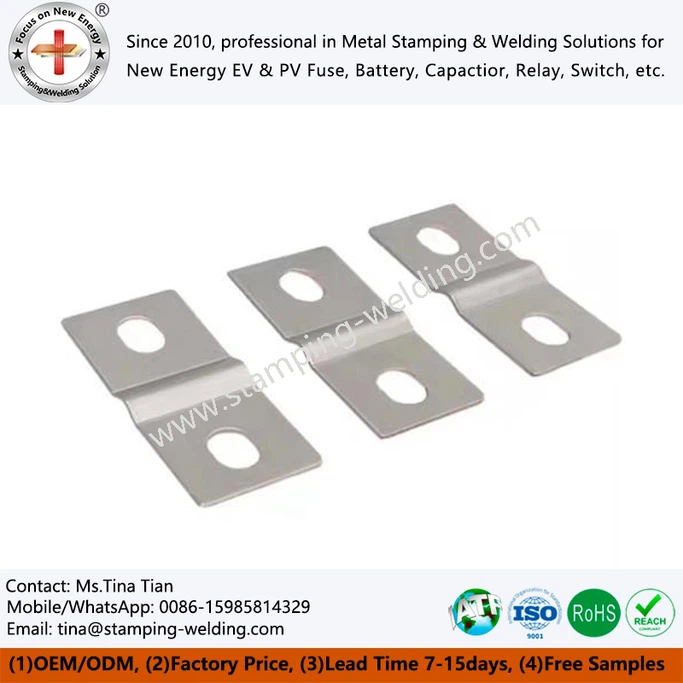
The frequent occurrence of cracking problems in Aluminum stamping is mainly due to the fact that the elongation rate of aluminum alloy is only 20% -23%, much lower than that of steel, which is 42% -47%. The thickness anisotropy index is low, and the anti thinning ability is poor. The deep drawing and flanging parts are prone to local excessive deformation and cracking. To solve this problem, we need to start from both the design and process ends, enlarge the rounded corners of the part shape, standardize the rounded corners and draft angles of the convex and concave molds, and strictly control the thinning rate through CAE simulation. The conventional area should not exceed 16%, and the flanging radius area should be controlled within 12%, with a maximum of 14%.
Aluminum chips are another major pain point in the formation of Aluminum accessories for solar mounting. Due to the low hardness of aluminum alloys, secondary cutting occurs when the shear section rubs against the mold edge, which can easily form chip lumps and aluminum chip accumulation, affecting production efficiency and product appearance. By optimizing the structure of the trimming edge, performing passivation and PVD/DLC coating treatment, setting the gap between punching and flanging reasonably, regularly polishing the mold, spraying special lubricating oil, adjusting the punching and return speed, and other measures, the production and adhesion of aluminum chips can be reduced.
Impact line and compression cracking problems and optimization methods
Aluminum alloy waterproof solar rail impact line defects are mainly caused by low yield strength of aluminum alloy, unreasonable mold clearance, high surface roughness, too fast stamping speed, and excessive edge pressure. The friction state changes abruptly during material flow, and obvious marks are formed at the rounded corners of the concave mold. Optimizing this problem requires increasing the draft angle of the parts, reducing the roughness of the mold surface, optimizing the design of the mold fillet, while slowing down the stamping speed and adjusting the edge pressure reasonably to ensure uniform material flow.
Compression cracking is a common defect in the Aluminum clamp hook for roof photovoltaic support edge wrapping process. Due to the poor toughness of aluminum alloys, they are prone to cracking under external pressure during the compression process. It is necessary to adjust the compression speed, pressure, and angle according to the characteristics of the aluminum material, and gradually press them step by step to avoid excessive stress in a single step. At the same time, edge treatment of the parts should be done in advance to eliminate local stress concentration and avoid defects from both process parameters and mold structure.
Summary of forming quality control
The quality control of Aluminum solar panel end clamps for PV mounting system forming in new energy vehicles requires close attention to the characteristics of aluminum alloy materials, and full process control from part structure design, mold optimization, process parameter debugging, and daily production maintenance.
Targeting the five core difficulties of rebound, cracking, aluminum shavings, impact lines, and compression cracking, specialized solutions are developed based on their respective causes. By combining CAE numerical simulation to predict risks in advance and synchronously standardizing mold processing, material selection, and on-site process operations, the dimensional accuracy and appearance quality of Aluminum solar middle clamp can be significantly improved, the mass production pass rate can be increased, and the stable production and application of lightweight components for new energy vehicles can be assisted.

Contact us
If you have any related needs in Aluminum stamping process optimization, customized production, or quality problem solving for new energy vehicles, please feel free to contact us for consultation at any time. We can rely on a professional technical team to assist in the efficient implementation and stable mass production of projects.