Analysis of common surface treatment processes for Stainless steel stamped parts
Mar 02, 2026
Overview of Surface Treatment for Stainless steel stamped parts
Stamping 304 stainless steel is prone to forming a hard gray black oxide layer on its surface after rolling, bending, welding, or high-temperature processing. The main component is nickel chromium oxide, which not only affects its appearance but also reduces its corrosion resistance. To improve the appearance, precision, and service life of products, the industry usually conducts professional surface treatment on Stainless steel sheet metal stamping. At present, the mainstream surface treatment methods can be divided into three categories: surface natural whitening treatment, surface mirror gloss treatment, and surface coloring treatment. Different processes are suitable for products with different structural, precision, and appearance requirements.

Surface natural whitening treatment
The purpose of the natural whitening treatment of Stainless steel stamped parts is to remove oxide scale, oil stains, and impurities, restore the original silver white matte texture of stainless steel, and improve the basic corrosion resistance. The traditional process uses strong acid corrosion method, which is costly, highly polluting, and poses significant harm to human health and the environment. It has gradually been phased out. There are currently two mainstream methods: one is shot blasting and sandblasting, which physically remove the oxide scale of Custom stainless steel stamping, suitable for large and structurally complex workpieces; The second is the chemical method, which uses environmentally friendly acid pickling and passivation paste or phosphorus free non-toxic cleaning solution for room temperature cleaning. It can efficiently restore the natural color of stainless steel and is friendly to complex parts. After treatment, the color is uniform and the applicability is strong. It is currently the mainstream method promoted and applied in the industry.
Surface mirror gloss treatment
Mirror polishing treatment is used to improve the surface smoothness and glossiness of stainless steel. According to the structural complexity and appearance requirements of Custom metal stamping parts, it can be divided into three types: mechanical polishing, chemical polishing, and electrochemical polishing. Mechanical polishing has good flatness and high brightness, but it requires high labor intensity and heavy pollution, making it suitable for simple small and medium-sized workpieces. Complex parts are difficult to process and have poor overall gloss consistency. Chemical polishing has low cost and high efficiency, and can process complex 304 stainless steel punching. However, the brightness is average and requires ventilation equipment, making it suitable for products with low brightness requirements and small batch production. Electrochemical polishing can maintain mirror gloss for a long time, with stable process, low pollution, and high cost-effectiveness. It is suitable for products that require high brightness and long-term use, and is currently a widely used precision polishing method in industry.
Surface coloring treatment
Stainless steel coloring treatment not only endows products with rich colors, enhances appearance grade and added value, but also enhances the surface wear resistance and corrosion resistance of OEM stainless steel stamping parts. It is widely used in decoration, high-end hardware, automotive parts and other fields. Common coloring methods include ion deposition oxide method, high-temperature oxidation method, chemical oxidation method, electrochemical oxidation method, gas-phase cracking method, etc. The ion deposition oxide method is suitable for large-scale production of Chinese factory price stainless steel stamping parts and can be used to deposit stable colors such as titanium gold, but it requires high equipment investment and cost; High temperature oxidation, chemical oxidation, and electrochemical oxidation are widely used in commercial production, and stable and uniform colors can be formed by controlling process parameters; The gas-phase cracking process is complex and has relatively few industrial applications.
contact us
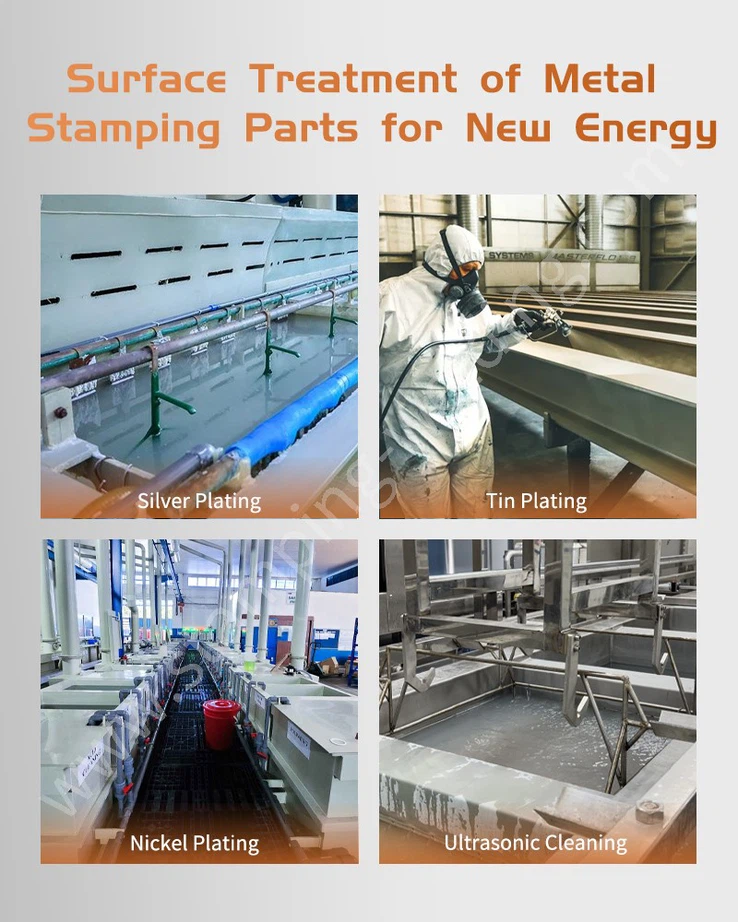
Surface treatment directly determines the appearance, precision, and service life of Stainless steel stamped parts, and selecting the appropriate process is the key to improving product quality. If you have any needs for surface treatment, customized processing, or material selection for OEM stainless steel stamped products, please feel free to contact us. We will provide you with professional process solutions and one-stop processing services.