Analysis of Fuse Blade Contact Materials: Technological Evolution and Diverse Applications
May 03, 2026
As a core component of circuit protection, the choice of materials for Fuse Blade Contact directly affects their fusing performance and electrical stability. With the rapid development of new energy vehicles, industrial automation, and other fields, the market is placing higher demands on the reliability and adaptability of fuse contacts. In different application scenarios, contact materials must balance melting point characteristics, conductivity efficiency, and physical stability, leading to diversified technological approaches.

Low melting point materials: Precise protection for low current scenarios
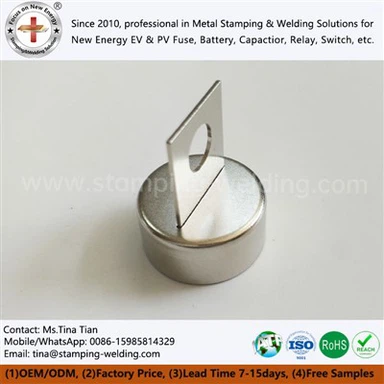
In low-current, fast-blowout scenarios, traditional materials still hold an important position due to their melting point advantage. Lead-antimony alloys, with their low melting point, were the mainstream choice for early fuse contacts, achieving fusing sensitivity through precise control of the alloy ratio. Furthermore, zinc materials, with their moderate melting point and cost advantage, are commonly found in chip fuse designs, especially in consumer electronics and other fields, meeting basic protection requirements. These materials, through the precise design of the Fuse Contact Blade, ensure timely response even under minor overloads.
High-power applications: Silver-copper alloys lead performance breakthroughs
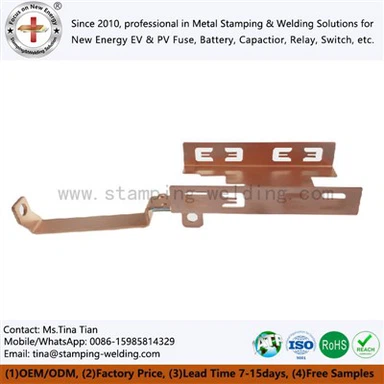
Facing the high-power environments of new energy vehicles and industrial equipment, contact materials are being upgraded towards higher conductivity and higher melting points. Silver (Ag) and silver-copper alloys, with their extremely low resistivity and stable electrical properties, have become the core materials for high-current fuses. For example, Copper Blade for Fast Fuse improves conductivity through a composite silver layer while maintaining the mechanical strength of the copper substrate. Furthermore, silver-palladium alloys, with their low electrical noise characteristics, are widely used in precision instruments, meeting the stringent requirements of high-performance equipment.
Technological Innovation: Composite Materials and Surface Engineering Optimization
To balance cost and performance, the industry is actively exploring composite materials and surface treatment technologies. For example, by coating an aluminum-magnesium alloy substrate with a highly conductive metal layer, a combination of lightweight and high conductivity is achieved. Surface mount fuses utilize silver or gold plating processes to optimize the surface contact resistance of the metal copper blade, adapting to the trend of miniaturization. In terms of structural innovation, the Cylindrical Body Contact Knife and Copper Knife designs improve heat dissipation efficiency through geometric optimization, ensuring long-term stable operation under high current.
New energy vehicle drive material upgrade
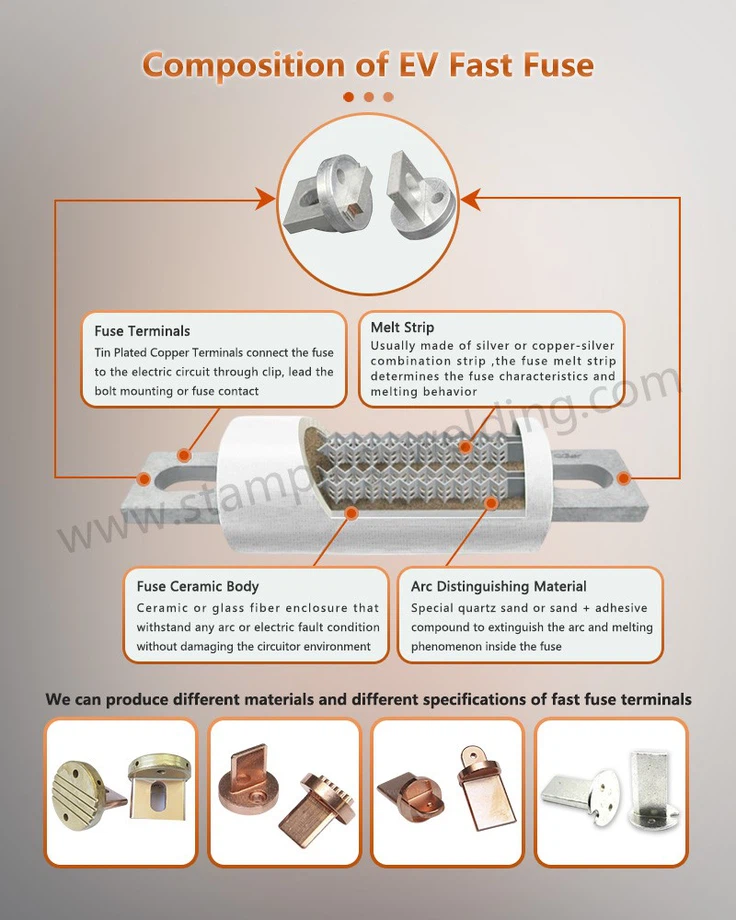
The high-voltage electrical systems of new energy vehicles pose entirely new challenges to fuses. EV fuse copper contacts need to achieve millisecond-level melting under high voltage and high current conditions, making copper-based materials the mainstream choice due to their excellent thermal conductivity and mechanical strength. For example, fuse copper parts and hot-forging parts strengthen the crystal structure through hot forging processes, improving impact resistance. Meanwhile, to meet the requirements of 800V high-voltage platforms, blade-type fuse contacts are gradually adopting silver-copper composite contacts, balancing rapid melting with low contact resistance.

Industry Outlook: The Balance Between Performance and Cost
In the future, Fuse Blade Contact materials will continue to evolve around the principles of "high efficiency, reliability, and lightweight." Low-melting-point alloys will move towards lead-free production to comply with environmental regulations; in the high-power field, the focus will be on optimizing the microstructure of silver-copper materials to reduce material costs. With the deepening application of new energy and smart grids, the collaborative design of Fuse Terminal and Blade Contact will become a technological focus, driving circuit protection systems towards higher integration and intelligence.
Contact Us
If you need customized high-performance Fuse Blade Contact solutions for new energy vehicles or high-power systems, please contact us immediately-our professional team provides precise selection and optimized design from silver-copper alloys to composite materials, helping to achieve millisecond-level safety protection.