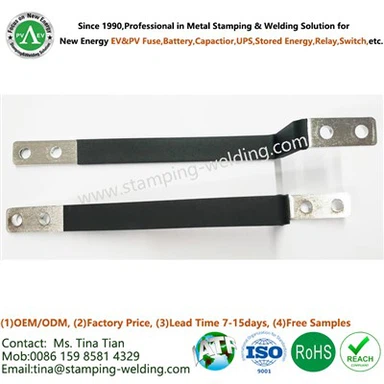
Braided Connectors:Deep analysis from manufacturing to application
Jul 10, 2025
Braided connectors are essential components in various electrical and electronic systems. They are designed to provide reliable electrical
connections while offering flexibility to accommodate movement and vibration. Made from materials like copper, these connectors play a crucial role in ensuring efficient power transmission in applications ranging from new energy vehicles to industrial machinery. They are widely used due to their unique structure.e The braided allows for better flexibility compared to solid conductors, making them suitable for applications where components may experience thermal expansion, mechanical stress, or continuous movement.

Types of Product
1. Braided Copper Wire Connectors
Composition and Structure:
Braided copper wire connectors are primarily made of Braided Copper Wire. The copper wires are intricately braided together to form a flexible yet durable conductor. The braiding process involves interweaving multiple copper strands, which can be customized based on the application requirements. For example, in high-current applications, the number of strands and the braiding density can be adjusted to ensure sufficient current-carrying capacity.
Advantages:
High Conductivity: Copper is an excellent conductor of electricity, and the braided structure further enhances the surface area, which helps in reducing electrical resistance. This ensures efficient power transmission with minimal energy loss.
Flexibility: The braided design allows the connector to bend and flex without damaging the conductor. This is particularly important in applications such as automotive wiring harnesses, where the connector may need to move with the vehicle's components.
Durability: The interwoven strands provide strength to the connector, making it resistant to mechanical stress and wear. This extends the service life of the connector in harsh operating environments.
2. Braided Flexible Busbar Connectors
What are Braided Flexible Busbars?:
Braided Flexible Busbar or Flexible Braided Copper Busbar is used for distributing electrical power in large-scale electrical systems. They are made by braiding copper strips or wires and are designed to carry high currents. These busbars offer installation flexibility, as they can be bent and shaped to fit into complex electrical enclosures.
Applications:
In new energy systems, such as electric vehicle (EV) battery packs and photovoltaic (PV) power stations, braided flexible busbars are used to connect different components. For instance, in an EV battery pack, they connect individual battery cells to the main power circuit, ensuring a stable and efficient power supply. They can also be found in industrial power distribution systems, where they help in distributing power to various machinery and equipment.
3. Custom-Designed Copper Braided Wire
Flexible Braided Custom Connectors:
These connectors are tailored to meet specific application requirements. Manufacturers can customize various aspects such as the braiding pattern, material thickness, length, and terminal configurations. For example, in some high-precision electronic devices, custom flexible Connectors may be required to fit into limited-space enclosures while providing the necessary electrical performance.
Design Considerations:
When designing custom Braided Connectors, factors such as the operating environment (temperature, humidity, vibration), electrical requirements (voltage, current), and mechanical constraints (space limitations, movement) need to be carefully considered. This ensures that the final product meets the performance and reliability expectations of the application.
Manufacturing Process
Raw Material Preparation
Copper Wire Selection:
The first step in manufacturing braided connectors is selecting high-quality copper wire. Usually, pure copper (with a high purity level, such as 99.99% pure copper) is used for Braided Copper Wire to ensure excellent electrical conductivity. The diameter and length of the copper wire are determined based on the design requirements of the connector.
Other Materials:
In some cases, additional materials may be used for insulation or protection. For example, a thin layer of insulation may be applied to the braided copper wire in certain low-to-medium voltage applications to prevent short-circuits.
Braiding Process
Braiding Machinery:
Specialized braiding machines are used to interweave the copper wires. These machines can be set to different braiding patterns and densities. The braiding process requires precise control to ensure uniform braiding and consistent quality. For complex braided structures, computer-controlled braiding machines are often employed.
Quality Control during Braiding:
During the braiding process, quality control measures are implemented to check for any defects such as broken strands, uneven braiding, or incorrect braiding patterns. This helps in ensuring that the final braided connector meets the required specifications.
Finishing Processes
Cutting and Shaping:
After braiding, the connectors are cut to the desired length. In some cases, they may also be shaped to fit specific applications. For example, Braided Flexible Busbar may need to be cut and shaped to match the layout of the electrical system they are intended.
Terminal Attachment:
Terminals are attached to the ends of the braided connectors to facilitate easy connection to other electrical components. The terminal attachment process involves techniques such as soldering, crimping, or welding, depending on the design and application requirements.
Surface Treatment:
Surface treatment processes such as electroplating may be applied to enhance the corrosion resistance of the connectors. Electroplating with materials like tin or nickel can protect the copper from oxidation and other environmental factors, extending the service life of the connectors.

Future Trends
1. Miniaturization anHigh-Densityty Integration
With the continuous development of electronic devices towards miniaturization and high-density integration, the demand for smaller and more compact Copper Braided Busbars For Electrical is increasing. Flexible Braided Custom Connectors will need to be designed with smaller form factors while maintaining high performance. This may involve developing new braiding techniques and materials to achieve higher density and smaller sizes.
2. Integration with Smart Technologies
In the future, flexible copper bar may be integrated with smart technologies such as sensors. These smart connectors could provide real-time monitoring of parameters such as temperature, current, and vibration. This would enable predictive maintenance and improve the reliability of electrical systems. For example, in an EV battery pack, smart Copper Braided Busbars For Electrical could monitor the temperature of the connections and alert the system in case of overheating.
3. Sustainable and Environmentally Friendly Materials
As the focus on sustainability increases, there will be a trend towards using more environmentally friendly materials in the manufacturing of Copper Braided Busbar for Power Distribution. This may include the use of recycled copper and eco-friendly insulation materials. Manufacturers will also need to consider the end - of - life disposal of flexible copper bar to minimize their environmental impact.
Contact Us