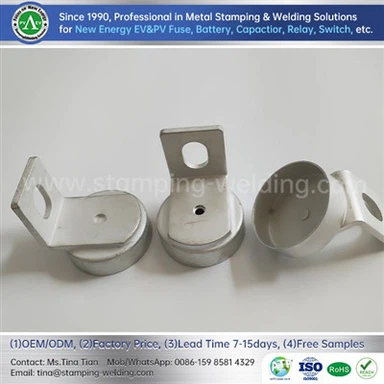
Copper stamping parts: comprehensive analysis of material properties, manufacturing processes and market trends
Aug 12, 2024
Copper, an alloy of copper and a small amount of impurities, is widely used in electronics, automobiles, aviation and other fields due to its excellent electrical conductivity, thermal conductivity and corrosion resistance. Copper stampings are parts made by stamping copper sheets, which have good mechanical properties and chemical stability. This article will discuss in detail the material properties, manufacturing processes, application fields and future development trends of copper stampings, providing comprehensive industry knowledge for industry practitioners.
Material properties of copper
Physical properties
Copper (usually refers to copper alloys with a copper content of more than 99%) has excellent electrical and thermal conductivity, with an electrical conductivity close to 100% IACS (International Conductivity Standard) and a thermal conductivity of about 380 W/m·K. This makes copper outstanding in applications that require efficient conduction of current or heat.
Chemical properties
Copper has good corrosion resistance, especially in dry environments, and can resist the erosion of most acids and alkalis. However, in wet and acidic environments, copper may corrode slightly, so surface treatment is required in some applications to enhance its corrosion resistance.
Mechanical properties
Copper has high ductility and toughness, can withstand large tensile and impact forces, and has good processability. It has moderate hardness and is suitable for manufacturing parts that require complex shapes and precise dimensions.

Manufacturing process of copper stamping parts
1. Overview of stamping process
Stamping is a metal processing process that uses dies and stamping machines to press metal sheets into parts of the desired shape at room temperature or under heating. The stamping process usually includes cutting, drawing, punching, bending, forming and other steps.
2. Production process of copper stamping parts
Raw material preparation: Select suitable copper sheets, usually thin sheets of copper alloy. According to the requirements of the parts, select the appropriate thickness and hardness.
Die design and manufacturing: Design the stamping die, which usually includes an upper die and a lower die. The design of the die should take into account the physical properties of copper and the complex shape of the stamping parts.
Stamping: Place the copper sheet in the stamping machine and perform pressure processing on it through the die. The stamping process may include multiple steps, such as initial blanking, finishing, bending, etc.
Post-processing: The copper parts after stamping may need to be deburred, surface treated, cleaned, etc. to ensure the quality and appearance of the parts.
Quality inspection: Perform dimensional inspection and performance testing on stamping parts to ensure that they meet design requirements and standards.

Application fields of copper stampings
Electronics industry
Due to its excellent electrical conductivity, copper is widely used in the electronics industry to manufacture electrical contacts, connectors, switch components, etc. Copper stampings play a key role in electrical conduction and connection in electronic products, ensuring the stability and reliability of the circuit.
Automobile industry
In automobile manufacturing, copper stampings are used to produce radiators, connecting pipes, contact points and other components. Due to the high thermal conductivity of copper, it can effectively improve the heat dissipation performance of automobile parts and enhance the overall performance and safety of the car.
Aerospace
In the aerospace field, copper stampings are used to manufacture various structural parts and connectors. These parts require high strength, light weight and excellent corrosion resistance, and the characteristics of copper make it perform well in these applications.
Power industry
Copper stampings are used in power equipment to manufacture switches, contactors, cable connectors and other components. Its good electrical conductivity and high temperature resistance make it an indispensable material in the power industry.
Market Trends and Challenges of Copper Stampings
Market Trends
With the development of science and technology and the progress of industry, the demand for copper stampings market continues to grow. Especially in the fields of electronics, automobiles and aerospace, the demand for high-performance and precision copper stampings is increasing. In addition, with the promotion of green environmental protection concepts, copper materials have also received more and more attention due to their good recyclability and environmental protection.
Technical Challenges
Although copper stampings have many advantages, they also face some technical challenges in practical applications. For example, copper materials are difficult to process, and deformation, cracks and other problems may occur during the stamping process. To solve these problems, R&D personnel need to continuously improve the stamping process and mold design to improve production efficiency and product quality.
Cost Issues
The price fluctuations of copper have a direct impact on the cost of stampings. Changes in raw material prices may lead to unstable production costs. Therefore, enterprises need to control costs and maintain market competitiveness by optimizing production processes and improving material utilization.
Future Outlook
The future development of the copper stamping industry will be mainly reflected in the following aspects:
Material innovation: With the advancement of materials science, new copper alloys and their modified materials will be developed to meet the needs of higher performance and special applications.
Process optimization: Advanced manufacturing technologies, such as computer numerical control stamping, high-precision mold manufacturing, etc., will further improve the production efficiency and quality of copper stamping parts.
Environmental protection requirements: Environmental protection regulations are becoming increasingly stringent. Enterprises need to focus on energy conservation and emission reduction in the production process, adopt environmentally friendly materials and processes, and improve the environmental performance of products.
Market expansion: With the development of the global economy, the application areas of copper stamping parts will continue to expand, especially in emerging fields such as new energy and intelligent manufacturing, which will bring new opportunities to the industry.

Conclusion
As an important industrial material, copper stampings play a key role in many fields due to their excellent performance. Understanding the material properties, manufacturing processes and application areas of copper will help industry practitioners better grasp market dynamics and technological trends. With the continuous advancement of technology and changes in market demand, the copper stamping industry will usher in more development opportunities and challenges. Enterprises need to continue to innovate and improve production processes and product quality to occupy a favorable position in the fiercely competitive market.
our products
Our Custom Metal Copper Stamped has excellent conductivity and corrosion resistance, suitable for demanding industrial applications. Through advanced stamping processes, each product is ensured to be precise and flawless, providing extremely high reliability and stability. Whether it is electronic equipment or mechanical parts, our copper stamping parts can meet your needs and help your project reach the ultimate performance standard.
https://www.stamping-welding.com/metal-stamping/copper-stamping-parts/

contact us
Welcome to consult us at any time! We are happy to answer any questions for you and help you find the most suitable Metal Stamping Parts Electric Copper solution. Whether it is technical details or customized requirements, our professional team will serve you wholeheartedly. Please contact us and let us explore how to meet your needs.