


Copper vs. Aluminum Busbars: How to Choose the best products?
Sep 17, 2025
what are Copper busbars and Aluminum busbars

Copper busbars are thick copper bars that move large electric current inside panels, transformers and battery racks. Copper has very low resistance, so the bars stay slim and run cool. They are strong, easy to bend and weld, and they fight corrosion. People use them when space is tight, heat must be low, or the system will run for many years.
Aluminum busbars are flat aluminum bars that do the same job. Aluminum weighs about one third of copper and costs much less, but it needs a bigger cross-area to carry the same amps. Its surface grows a hard oxide film, so joints must be plated and bolts must be checked often. Owners pick aluminum when weight and first price matter more than size and long-term losses, such as in roof boxes or car power units.

Core performance comparison
- Conductivity and Current-Carrying Capacity
Copper has about 98% IACS conductivity. Aluminum has about 61% IACS conductivity. This means a copper busbar can carry more current than an aluminum busbar with the same cross-sectional area. To carry the same current, an aluminum busbar needs about 50% more cross-sectional area. For example, a 1000A copper busbar may use 100mm², but an aluminum busbar needs about 150mm².
- Mechanical Strength and Installation Reliability
Copper busbars have higher tensile strength and hardness than aluminum. They handle short-circuit currents better and are less likely to deform. Aluminum is softer. During installation, you must control the tightening pressure. Too much pressure can cause creep (plastic deformation over time). This may lead to loose connections and higher contact resistance. Using high-performance aluminum alloy (like 6101-T6) can help reduce this problem.
- Weight and Cost
Aluminum has a density of 2.7 g/cm³, which is only 30% of copper's density (8.9 g/cm³). So aluminum busbars are lighter. They are good for weight-sensitive applications like electric vehicles and solar power stations. Aluminum material cost is lower. But because aluminum busbars need a larger size, they may require larger connectors and insulation. Copper busbars cost more initially, but they use less space.
- Corrosion Resistance and Surface Treatment
Aluminum forms a dense oxide layer (Al₂O₃) in air. This gives good corrosion resistance in atmosphere. But this oxide does not conduct electricity. So aluminum often needs tin or silver plating to ensure good electrical connection. Copper can form a non-conductive patina in wet environments. It often needs tin or nickel plating for protection. The performance of both in corrosive environments depends on the actual conditions.
- Thermal Expansion and Connection Technology
Aluminum has a higher thermal expansion coefficient than copper. Temperature changes can cause stress at connection points. So aluminum connections often need spring washers or anti-loosening bolts. Copper busbar connection methods are more mature and reliable.
How to choose the busbar
Situations where copper busbars are chosen:
- For areas requiring high reliability: such as data centers, financial infrastructure, and hospital power distribution systems, because these systems cannot tolerate failures.
- For space-constrained occasions: when space inside switchgear is limited and busbar size needs to be minimized.
- For high short-circuit current requirements: copper's mechanical strength can better withstand electromagnetic force impact.
- For frequent plugging, unplugging, and maintenance scenarios: copper's wear resistance and deformation resistance make it more suitable for equipment that requires repeated adjustments.
Situations where aluminum busbars are chosen:
- For cost-sensitive projects: such as commercial and industrial power distribution and large-scale photovoltaic power stations, because controlling initial investment is important.
- For weight-sensitive applications: such as new energy vehicle battery packs, rail transportation, aerospace, and other fields.
- For high-current, low-voltage scenarios: such as energy storage systems (ESS) and wind power combiner boxes, where increasing the cross-sectional area can balance conductivity requirements.
- For corrosive environments (with surface treatment required): in specific environments like chemical plants and ships, aluminum's corrosion resistance can be utilized when combined with coating technology.

why choose us
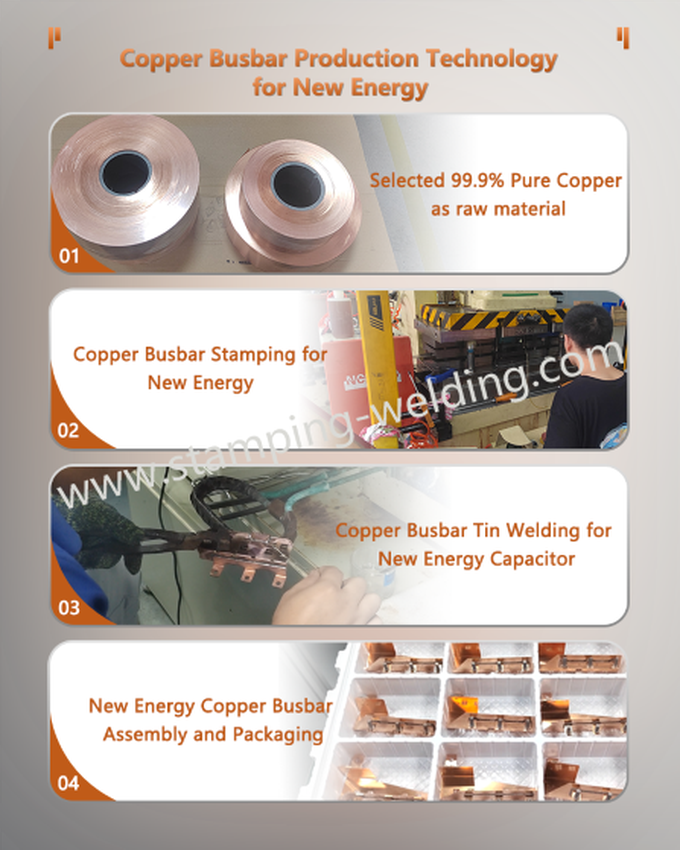
XIAMEN APOLLO boasts in-house stamping, welding, stamping and drawing die manufacturing, CNC and machining, cold heading, plating and cleaning, and automated equipment assembly workshops. With mastery over core technologies and key production processes, we are capable of providing customers not only with a wide range of metal stamping and welding products, but also with metal stamping dies, assembly production equipment for various electrical products, and electrical performance testing instruments for diverse electrical applications. So we can fabricate copper and aluminum busbars to tour specifications.
Contact Us


