


Flexible copper foil connectors industry trends: Upgrading to new energy and high-density electrical drive technologies
Apr 26, 2026
With the increasing demand for high-current-carrying, vibration-resistant, and compact connection solutions from electric vehicles, energy storage systems, and smart grids, Flexible copper foil connectors are rapidly expanding from traditional power soft connections into new energy battery systems, charging facilities, and industrial frequency converters. These products are made from multiple layers of high-purity copper foil using a molecular diffusion welding process, combining the excellent conductivity of copper with structural flexibility. They effectively absorb thermal expansion and mechanical vibration, making them an ideal alternative to rigid copper busbars in high-voltage, high-current scenarios.

New energy vehicle battery connection
Inside electric vehicle battery packs, the connections between cell modules need to withstand continuous currents of hundreds of amperes while enduring driving vibrations and temperature cycling. New Energy Battery Copper Foil Flexible Connectors utilize a laminated copper foil structure, allowing for flexible design of the equivalent cross-sectional area and a current-carrying capacity of up to several thousand amperes. Compared to soldered copper busbars or cables, Copper Foil Flexible Busbar Connectors offer lower contact resistance and higher fatigue life, making them particularly suitable for the long or winding wiring paths in CTP (cell-to-pack) battery packs. Furthermore, by using an external insulating tube or heat-shrink sleeve, the Copper Foil Flexible Busbar with Insulated Tube can provide flexibility while meeting high-voltage resistance and flame-retardant requirements, becoming an important option for standardized connection solutions in power battery systems.
Power transmission and distribution and industrial equipment
In high-voltage switchgear, transformers, and reactors, traditional rigid copper busbars cannot eliminate thermal stress caused by load changes or ambient temperature, easily leading to terminal loosening or busbar breakage. Laminated Flexible Copper Busbars, with their multi-layer welded structure, can absorb displacement and vibration without reducing conductivity, making them particularly suitable for high-current flexible connection scenarios. For example, the Copper Foil Flexible Connector for Busway Systems is used for transition connections in busbar trunking junction boxes, ensuring low-impedance transmission while simplifying on-site installation and adjustment. On the transformer outgoing side, Flexible Copper Foil Soft Connectors for Electrical Transformers replace multiple parallel cables, resulting in a more compact and organized cabinet layout.

Manufacturing process trends
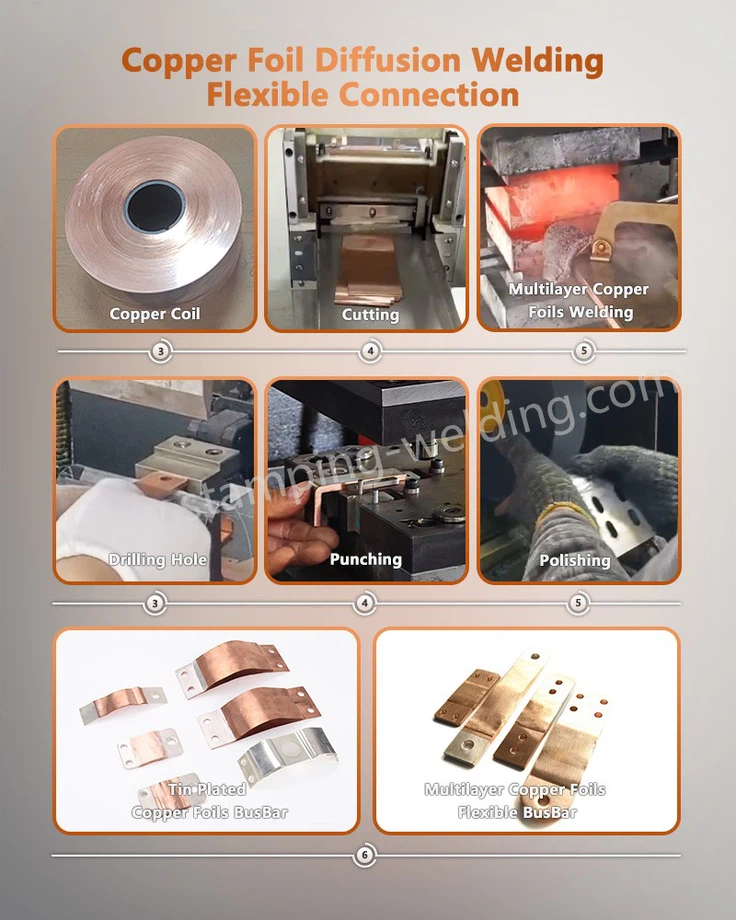
Traditional copper foil flexible connectors often require tin or silver plating at the ends to improve contact performance. Now, No-Plating Flexible Copper Foil Laminated Connectors, with their controlled copper foil surface oxidation and high-purity pressure welding process, can directly provide solid copper block ends with low contact resistance, avoiding the environmental pollution and hydrogen embrittlement risks of electroplating. Meanwhile, the Press Welding Foil Busbar is integrally formed using warm-press molding, eliminating the heat-affected zone between the ends and the foil body, ensuring consistent mechanical properties. Copper Foil Laminated Flexible Connectors for Transformers, through optimized layer count and welding parameters, achieve a bending life of tens of thousands of cycles, meeting the high fatigue requirements of applications such as wind power converters.
Materials and Surface Treatment Innovation
To withstand varying levels of corrosion in different environments, the Tinned Copper Foil Connector features a tin-plated layer on its copper foil surface, making it suitable for automotive chassis or outdoor charging facilities. Copper Foil for Laminated Copper Flexible Connectors is gradually expanding from pure copper to high-toughness copper alloys, balancing conductivity and elastic modulus.
Industry Outlook
With the expanding application of high-voltage platforms (800V and above) in electric commercial vehicles and energy storage systems, the requirements for the voltage resistance, temperature resistance, and electrochemical corrosion resistance of flexible copper connectors will further increase. It is expected that within the next three years, Copper Foil Flexible Laminated Copper Busbar will develop towards thinner single-layer foil (≤0.05mm) and online quality monitoring welding processes, while introducing high-temperature resistant aramid or silicone rubber materials into the insulation system. Furthermore, for the quick-connect requirements of battery swapping stations and heavy-duty truck battery swapping modules, integrated flexible copper foil connectors with guiding structures and error-proof designs will also become a new growth area.
Contact Us
For Flexible copper foil connectors solutions tailored to specific current carrying capacities and installation space requirements, please feel free to contact us.


