Fuse Cap and Contact Joined by Tin Brazing: a key process for improving electrical performance and mechanical strength
Apr 26, 2026
In the manufacturing process of fuses, the connection process between the fuse cap and the contacts is crucial. Fuse Cap and Contact Joined by Tin Brazing, a traditional and reliable connection method, uses a low-melting-point tin-based alloy solder to firmly connect the metal cap (contact) of the fuse to the molten metal, ensuring smooth current flow and guaranteeing the overall performance of the fuse.
Functions and uses of fuse caps and contacts
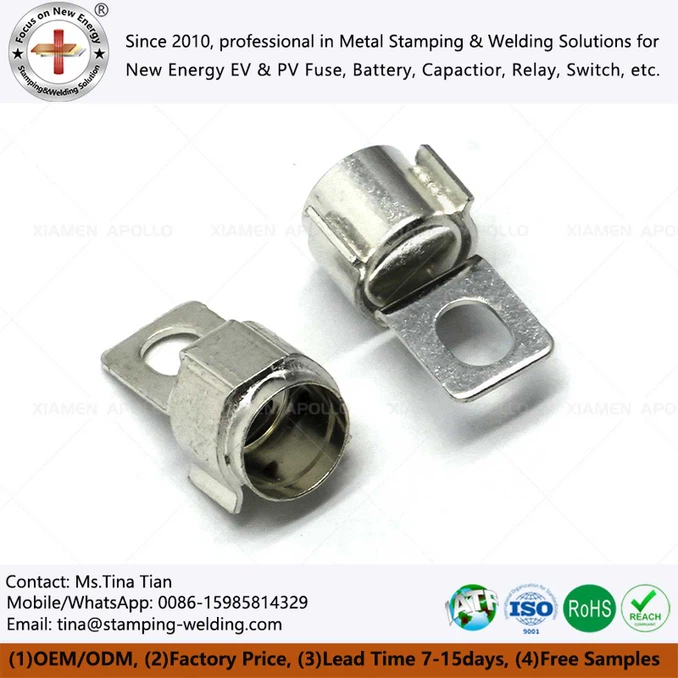
A fuse cap (or end cap) is typically made of a highly conductive metal such as brass or copper and serves to connect the power supply line to the fuse. It is not only a conductive contact but also effectively seals both ends of the fuse, preventing the internal fusible element from contacting the external environment, thus protecting the circuit from damage. The contact point is the part of the fuse cap that comes into contact with the external circuitry and is a crucial path for current flow.
The principle of soldering connection
Soldering uses low-melting-point (typically between 200-400℃) tin-based alloy solder (such as tin-lead alloy or lead-free solder paste). The solder is melted by heating and wets the connection surfaces of the fuse cap and fuse element. After cooling, a strong metallic bond layer forms, firmly fixing the fuse cap to the fuse body, ensuring good electrical conductivity and sufficient mechanical strength.
Compared to traditional soldering methods, soldering not only avoids damage caused by high temperatures but also provides a more reliable connection, making it particularly suitable for components such as fuses that require high mechanical strength and electrical performance.
Advantages and solutions for solder joints
The greatest advantage of this process lies in its excellent sealing performance and mechanical strength. Soldering not only effectively seals the fuse ends, preventing the casing from loosening due to high temperatures, but also provides a low-resistance path for current. This connection method is particularly suitable for electrical equipment requiring high reliability and long-term stable operation, such as electric vehicle (EV) fuses, fast-acting EV fuses, and battery pack fuses.
Furthermore, soldering can resolve solder overflow issues that may occur during the manufacturing process. To ensure connection quality, the amount of solder used needs to be precisely controlled during production to avoid poor soldering due to overflow. This technical detail is especially important in Fuse Cap and Contact High Temperature Soldering.

Comparison with similar products
Compared to traditional soldering methods, Fuse Cap and Contact Joined by Tin Brazing offers higher reliability and lower connection impedance, making it particularly suitable for applications requiring rapid response and high current transfer. For example, compared to Outer Cap and Terminal Welded Components, soldering achieves higher mechanical strength while improving current transfer efficiency and reducing contact resistance. Furthermore, soldering is widely used in the electric vehicle sector, especially in Cap and Contact for Hybrid Electric Vehicle Fuses and Cap and Contact for EV Fuses, ensuring the stable operation of the battery management system and auxiliary power supply.
summary
In summary, soldering not only provides high electrical performance and strong mechanical strength, but also overcomes the limitations of traditional soldering processes. Whether in electric vehicles, battery pack fuses, or various high-performance electrical devices, soldering the fuse cap and contacts is one of the key technologies for achieving reliable connections.
Contact Us
For more information about Fuse Cap and Contact Joined by Tin Brazing, or to obtain customized services, please feel free to contact us. We are dedicated to providing you with professional solutions.