From parasitic inductance to fully sealed structure: how Laminated copper busbars improve the reliability of distribution systems
Apr 02, 2026
Background of the emergence of Laminated copper busbar technology
In traditional power distribution systems, the parasitic inductance of discrete busbars is relatively large. When the power switch is turned off, the transient voltage generated by parasitic inductance overlaps with the DC circuit voltage, posing a serious threat to the insulation of power switch devices and motors. The larger the parasitic inductance, the greater the load current, and the shorter the current drop time of the power switch, the more significant this hazard becomes, and it will not be eliminated due to different selection of power switch devices. To fundamentally solve this problem, Laminated inverter busbar technology has emerged.

Structure and Working Principle
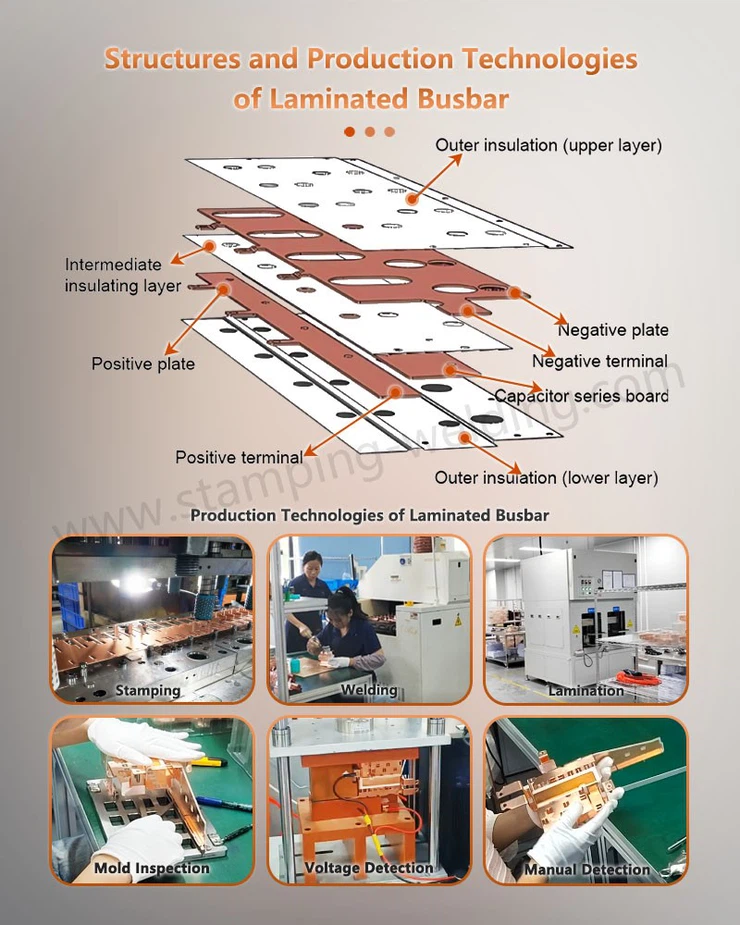
Laminated copper busbar, also known as laminated busbar, is composed of alternating layers of flat copper conductors and insulating films coated with thin adhesive layers. The exposed edges are sealed with insulating medium. This unique laminated structure endows it with inherent electrical characteristics such as capacitance, low inductance, and low impedance, which can effectively reduce transient voltage drop, suppress circuit oscillation, and minimize electromagnetic interference. With the above advantages, Laminated busbar connectors have been increasingly widely used in power electronic systems.
main types
According to different application scenarios and environmental conditions, Laminated copper bars are mainly divided into two structural types. The first type is a multi-layer copper plate and internal insulation compression structure, suitable for industrial frequency converters UPS, In scenarios such as photovoltaic converters and inland wind power converters, the long-term working temperature of insulation materials should not exceed 105 ℃. The second type is a multi-layer copper plate and fully enclosed compression structure with internal and external insulation, suitable for scenarios such as large railway traction converters, mining and marine drive converters, and offshore wind power converters with harsh environments. It also meets the requirement of long-term insulation working temperature not exceeding 105 ℃.
Core strengths
In terms of low distributed inductance, the Laminated bus bar for telecom compresses the positive and negative conductors of the same circuit together to cancel out the distributed inductance. At the same time, the sealed structure of the mounting holes effectively increases the creepage distance, further reducing the inductance value.
This feature can prevent the breakdown of power semiconductor components due to induced high voltage during the switching process, reduce or eliminate bypass capacitors, and maximize the efficiency of power components. Traditional discrete busbars generate induced voltage spikes at the moment of IGBT turn off, which usually require parallel absorption capacitors to suppress. However, this reduces IGBT output efficiency, increases high-frequency losses, increases component and assembly costs, and leads to equipment volume expansion.
In terms of partial discharge control, the insulation layer of the Laminated bus bar for high current inverter is completely bonded to the copper plate through adhesive hot pressing, without any air gap, thus fundamentally eliminating the hidden danger of partial discharge. Partial discharge usually occurs under high voltage conditions.
If there is an air gap between the insulation and the copper plate, it will accelerate insulation aging and cause equipment failure within about five years. The design lifespan of wind power converters and other equipment is usually 20 years, and using traditional separated Laminated bus bars for mounting structures of capacitor banks may require multiple replacements, significantly increasing component and after-sales costs. The laminated busbar undergoes 100% partial discharge testing before leaving the factory, with an insulation life of over 25 years, and can achieve maintenance free operation throughout the entire lifespan of the inverter.
In terms of adaptability to harsh environments, traditional separated busbars have obvious shortcomings in vibration, salt spray, and dust environments. Long term vibration may cause loosening or even disintegration of the connection, moisture infiltration into the insulation layer may cause interlayer breakdown, and dust accumulation may cause creeping electrical breakdown. The Laminated bus bar for high frequency welding power IGBT adopts a high-strength integral bonding structure to ensure long-term operation without looseness. Under the same current conditions, copper bar thickness optimization can be achieved, effectively improving the stability and durability of the system under complex working conditions.

Contact us
The structural design and insulation scheme of Laminated copper busbars for different application scenarios such as rail transit, new energy generation, and industrial transmission need to be optimized and matched according to specific working conditions. Welcome to contact us for professional selection advice and engineering support tailored to your project.