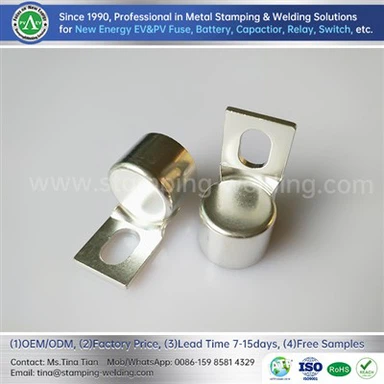
In-Depth Guide to Copper Bus Bar Tapped Technology: Manufacturing, Applications
Nov 19, 2025
A Copper Bus Bar Tapped (tapped copper bus bar) refers to a copper conductor (bus bar) that has been precisely machined or drilled to create tap-off points for branching circuits or connections. These tap-outs allow stable, low-impedance connections from the main power trunk to multiple sub–circuits. The use of high-purity copper ensures excellent electrical and thermal conductivity, while the tapped design maximizes flexibility in power distribution.

Manufacturing and Production Detail
Material Selection
- The base material for Grounding Copper Busbar is often high-purity electrolytic copper, such as C11000, which provides excellent conductivity and mechanical strength.
- Some designs even use oxygen-free copper (e.g., OFHC) for applications requiring ultra-high conductivity.
Layering and Bonding
- In some cases, laminated structures are used: copper sheets and insulating layers are stacked and diffusion-bonded under heat and pressure to form a solid, multi-layer bus bar.
- This process helps the Power Distribution Bus Bar maintain structural integrity even under high current loads.
Precision Machining
- CNC machines perform accurate cutting, drilling, and tapping for creating tap-off points on the Backplane Bus Bar.
- The hole tolerances, thread depths, and alignment must be tightly controlled to ensure reliable electrical contact.
Forming and Finishing
- After machining, the bus bars may be bent or shaped to match design requirements.
- Surface treatments - such as tin plating, silver plating, or bare copper - are applied to copper grounding bus bar to improve corrosion resistance, contact performance, and longevity.
- Insulation can be added through methods such as heat-shrink tubing, PVC sleeves, or epoxy coating.
Quality Control
- Each Grounding Bar Holes undergoes rigorous testing: conductivity (often via four-probe measurement), dimensional accuracy, mechanical strength, and finish integrity are all verified.
- All production steps conform to international or national standards, such as IEC, IEC/IEEE, or relevant copper handling norms.

Applications
Power Distribution Systems
- In switchgear, distribution boards, and control panels, a Copper ground Bus Bar is used as the main trunk to branch out multiple circuits. Its tapped points simplify wiring and improve modularity.
Renewable Energy & Energy Storage
- For solar inverters, battery energy storage systems, and electric vehicle (EV) battery packs, tin plated copper ground bar designs allow efficient connection from the main bus to individual modules.
- The tapped structure enables more compact layouts and lower impedance paths, boosting system efficiency.
Data Centers and Critical Power Infrastructure
- In PDUs (Power Distribution Units), UPS systems, and high-density server racks, ground bus bar electrical panel helps distribute power reliably with high redundancy and minimal voltage drop.
- The flexibility of tap-offs supports future scaling or reconfiguration.
Industrial Machinery & High-Power Equipment
- In motor control centers (MCC), large transformers, and heavy-duty switchgear, Grounding Copper Busbar is used to deliver current to sub-units or secondary circuits.
- In harsh environments like electrolytic or metallurgical plants, these tapped bus bars may also be integrated with cooling systems (e.g., water-cooled) for thermal stability.

Advantages & Challenges
Advantages
Excellent Electrical Conductivity: The high-purity copper used in Power Distribution Bus Bar delivers very low resistive losses and high ampacity.
Flexible Circuit Design: With precision-machined tap-offs, it's easier to branch circuits or modules without additional wiring complexity.
Superior Thermal Management: Copper's thermal conductivity helps dissipate heat effectively in high-current applications.
Robust Reliability: Surface plating and insulation enhance durability and protect Backplane Bus Bar from environmental degradation.
Challenges
Higher Material Cost: Pure copper is more expensive than alternatives such as aluminum, which can increase the cost of copper grounding bus bar.
Manufacturing Complexity: Drilling, threading, and precise machining of tap points on Grounding Bar Holes require advanced CNC equipment and skilled labor.
Weight: Copper is relatively heavy, which may present installation or mounting challenges in weight-sensitive designs.
Insulation and Safety: The addition of insulation and plating must be carefully engineered for safety, especially in tapped designs where exposed connection points may pose risks.

Conclusion
Copper Bus Bar Tapped is a highly specialized and technically advanced solution for modern power distribution systems. By combining copper's outstanding electrical and thermal performance with precision-machined tap-off points, this design offers both high efficiency and flexible connectivity. Despite higher material costs and manufacturing demands, its advantages in reliability, modularity, and performance make it a strategic choice in industries such as data centers, renewable energy, electric vehicles, and industrial power systems. As manufacturing technologies and material science continue to evolve, the role of Copper ground Bus Bar is poised to grow even more central in the future of high-current electrical infrastructure.
contact us